Bluerock TMS is taking direct aim at the most expensive and least visible part of the supply chain with their cloud-native Last Mile Distribution solution, which is being highlighted at Modex 2026 in Atlanta. It manages the full delivery lifecycle from order intake through proof of delivery in one system. For technology and logistics leaders, the platform promises to replace disconnected routing tools and manual checks with an AI assisted, execution centric control layer that plugs into existing ERP and warehouse systems.
Analysis
What This Means for ERP Insiders
Last mile performance will become a core ERP signal. As platforms like Bluerock’s capture detailed execution data and feed it into ERP and analytics systems, finance and supply chain teams will increasingly use first time delivery rates and re delivery costs as standard performance metrics alongside inventory and order cycle times.
From Route Planning tools to Execution-Centric Platform
Most last mile platforms stop at route generation, leaving dispatchers and drivers to manage real world complexity with limited feedback loops. Bluerock positions its new solution as an answer to that execution black box, combining an explainable AI planning agent, engine agnostic routing and full operational support across planning, depot and field execution.
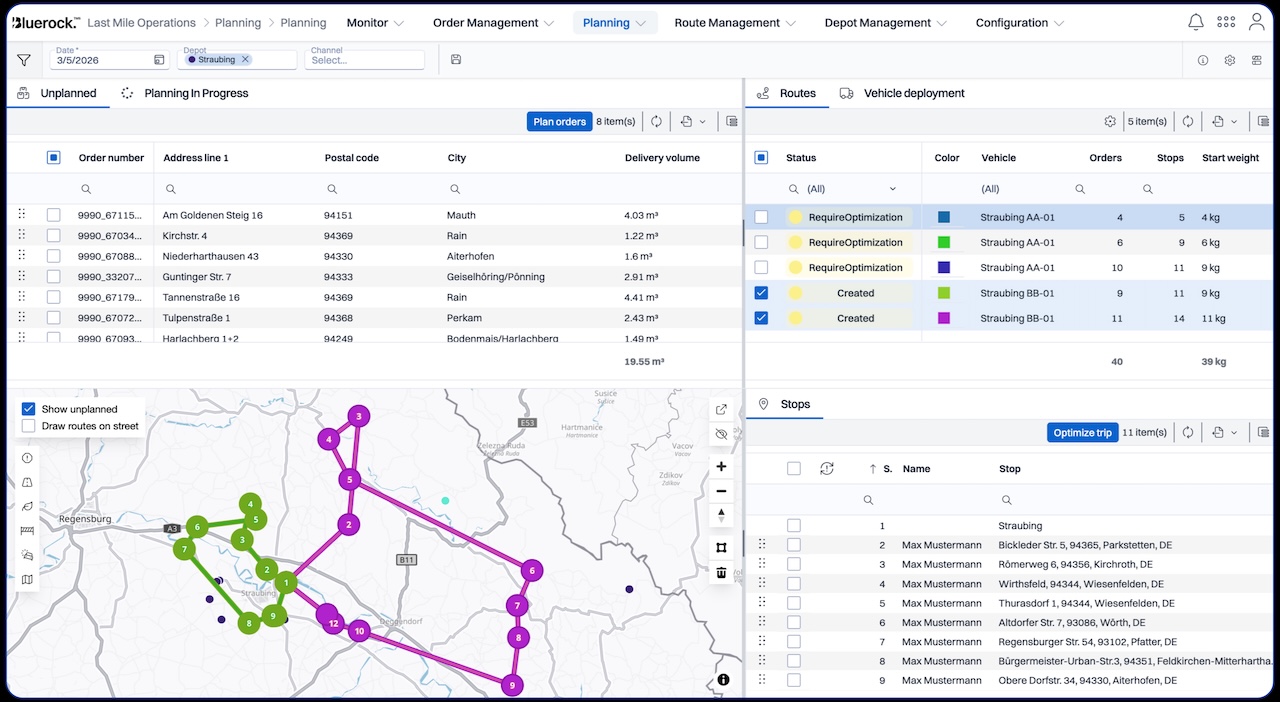
In practice that means planners work in a single environment where orders are captured, routes are generated, loading is validated and drivers are dispatched through an integrated mobile app. Pre dispatch loading checks help ensure vehicles leave the depot with correct items, while a configurable driver app walks crews through task sequences at each stop. A live trip monitor tracks progress and exceptions, giving control tower teams real time insight into delays, failed deliveries or capacity shortfalls.
Bluerock reports that early adopters using the platform have achieved first time delivery success rates between 96 and 98% along with an 18% reduction in total transport costs. For day to day operations, that translates into fewer costly re deliveries, better truck utilization and more predictable service performance that can be reflected in ERP KPIs and customer scorecards.
The solution supports high value retail, B2B warehouse distribution and healthcare and pharma segments, each with specific requirements for scheduling, installation tasks or Good Distribution Practice compliance and temperature control. IoT based temperature monitoring and automated deviation alerts help regulated shippers maintain chain of custody, while a white labeled customer portal provides accurate ETA updates and proof of delivery information to end customers.
Analysis
What This Means for ERP Insiders
Execution-centric TMS will pressure integration strategies. The need to connect planning, depot operations and driver workflows with ERP, WMS and OMS platforms raises the bar for API quality and event driven architectures, pushing vendors and GSIs to deliver cleaner integration patterns and shared data models across transport and enterprise systems.
Integration, Governance and Next Steps for AI-Driven Logistics
For CIOs and enterprise architects, the platform’s integration stance is as important as its routing algorithms. Bluerock’s Last Mile Distribution runs on Amazon Web Services and exposes standardized REST APIs so it can connect to existing ERP, order management and warehouse management systems without forcing a rip and replace of core platforms. That makes it a candidate for organizations running SAP or other ERPs that need to modernize last mile execution while preserving their transaction backbone.
The company’s broader TMS portfolio already consolidates data from carriers, telematics and IoT sensors into a single view for planning and performance management. Adding last mile execution creates a closed loop between strategic routing decisions and what actually happens at the curb, which gives analysts richer data for continuous improvement and network design.
Adoption will still require careful change management. Drivers and depot staff need training on new mobile and monitoring tools. Organizations must tune exception thresholds so control towers focus on meaningful deviations, not noise. However, the combination of measurable cost savings and improved delivery success rates gives transformation leaders concrete value to bring to finance and commercial stakeholders when building the business case.
Analysis
What This Means for ERP Insiders
AI-driven logistics will reshape partner and product roadmaps. Bluerock’s move toward explainable planning agents and self healing last mile operations signals that future TMS and ERP ecosystems will compete on how well AI can manage real world variability, influencing investment in sensor data, simulation twins and autonomous workflow capabilities.