Cloud Platform and Technology

Enterprise Resource Planning (ERP) integrates smoothly with cloud platforms, representing a pragmatic evolution in technology. The collaboration between ERP and cloud technology offers practical advantages, including scalability, accessibility, and agility for businesses. This combination enables real-time collaboration, data analytics, and improved security. Embracing the cloud allows ERP systems to adapt dynamically to changing business needs. Cloud-based ERP solutions offer efficient resource utilization, cost-effectiveness, and swift deployment, contributing to operational efficiency. In the current landscape of digital transformation, the integration of ERP with cloud technology serves as a practical strategy, ensuring businesses remain adaptable, competitive, and technologically proficient.

SAP Claude integration
SAP and Anthropic Integrate Claude with SAP Joule Using Model Context Protocol
SAP and Anthropic announced the integration of Claude into the SAP Business AI Platform and Joule, enabling AI agents to execute tasks across SAP S/4HANA, SuccessFactors, Ariba, and third-party systems using Model Context Protocol (MCP).
SAP Joule AI
SAP Pushes Joule Toward Enterprise Execution, but Readiness Remains the Constraint
SAP is turning Joule into an enterprise execution surface, not just an AI assistant, but the layer through which ERP users interact with SAP data, agents, generated workspaces, voice, desktop tools, and cross-system workflows.
Taming Landed Costs
‘Mid-market manufacturers should avoid treating automation and ERP as separate initiatives:’ Chris Brumett
Over the past decade, ERP systems have evolved from merely tracking transactions to becoming integral to the operational backbone of global supply chains, necessitating dynamic orchestration, real-time data integration and a focus on adaptability to support manufacturers.
The Impact of the Sovereignty Gap in Enterprise Architecture
Recent power outages and data center disruptions have challenged the assumption that cloud infrastructure is resilient, highlighting the necessity for enterprises to develop data sovereignty.
Epicor Insights 2026 Makes Cloud Migration a Trust Test, and It Is Not Alone
At Epicor Insights 2026, the company faces its most consequential conference yet: with on-premises Kinetic development ending at the 2028.1 release, the pressure is on to demonstrate that cloud ERP migration is not just necessary for manufacturers and distributors — but genuinely worth it. This analysis examines how Epicor is addressing the trust gap through security governance, data architecture strategy, and change management, and what still needs to be proven on the conference floor.
SAP Sapphire customer keynote
SAP Sapphire Customer Keynote Shows AI Value Depends on Readiness, Data, and Standardization
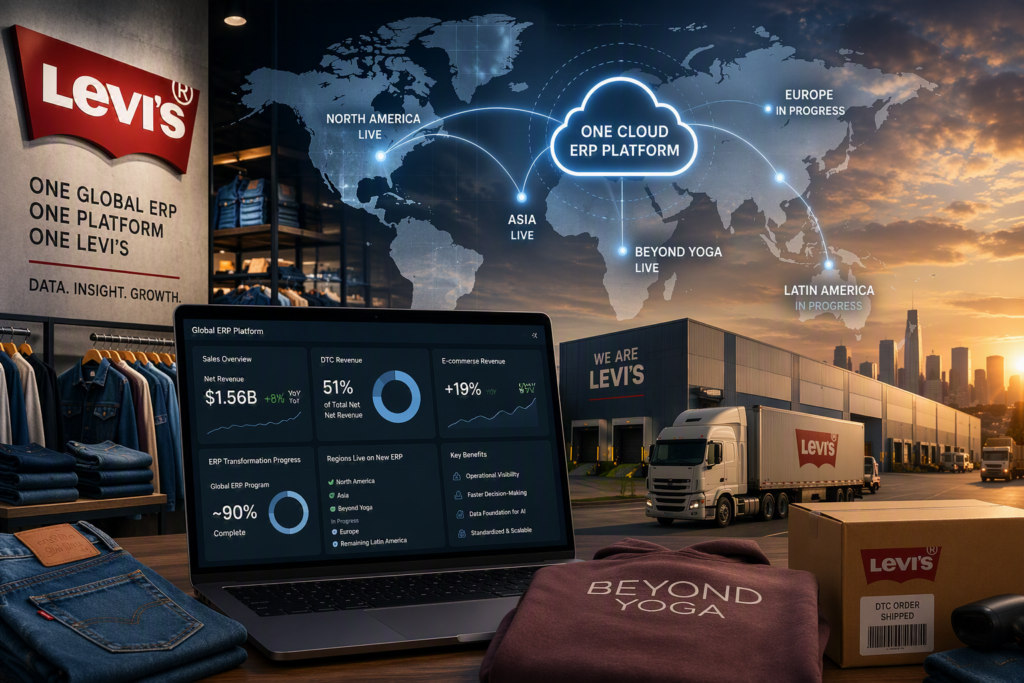
At SAP Sapphire 2026, the customer keynote made a definitive case: AI value in the enterprise depends on readiness, data standardization, and clean core ERP foundations—not experimentation. Through transformation stories from Lockheed Martin, ExxonMobil, Levi Strauss, and Aeropuertos Argentina, SAP reinforced that organizations succeeding with AI have built the operational and data infrastructure to support it on SAP S/4HANA and BTP.
EU flag displayed on the glass exterior of the European Parliament building, representing ERP governance questions around the EU AI Act delay.
What the EU AI Act Delay Means for ERP Governance
The EU AI Act delay eases some near-term compliance pressure, but ERP teams still need to build governance evidence around how AI is used across business processes.
SAP autonomous enterprise strategy
How SAP Is Using Anthropic, NVIDIA and Palantir to Shape Its Autonomous Enterprise Stack
At Sapphire 2026, SAP expanded its partner ecosystem by collaborating with Anthropic, NVIDIA, and Palantir to enhance its Autonomous Enterprise strategy, integrating AI capabilities for workflow optimization, secured agent execution, and streamlined data migration to SAP Cloud ERP.
Software developers working at laptops, representing SAP Security Patch Day May 2026 risks across developer tooling and software supply chains.
SAP Security Patch Day May 2026 Shows Risk Beyond Core Applications
SAP’s May 2026 Security Patch Day shows why SAP teams need to look beyond severity scores. Critical vulnerabilities affected S/4HANA and Commerce Cloud, while Mini Shai-Hulud brought developer tooling, credentials, and supply-chain exposure into the SAP security conversation.
SAP Autonomous Enterprise
Sapphire’s Post-Keynote Q&A Unpacks The Hard Part of the Autonomous Enterprise: Delivery, Governance, Trust
The post-keynote Q&A at SAP Sapphire 2026 put SAP's Autonomous Enterprise strategy under the closest scrutiny yet, with executives pressed on what's actually ready for production, how hybrid and on-premise customers participate, and why enterprises should trust AI agents inside live business processes. This ERP Today analysis unpacks SAP's answers on AI governance, the Knowledge Graph differentiator, cloud migration strategy, and API compliance controls.
SAP Business AI Platform governance
SAP Sapphire 2026: SAP Business AI Platform Consolidates SAP BTP Stack to Solve Enterprise AI Fragmentation
At SAP Sapphire 2026, SAP introduced the Business AI Platform, unifying its AI, data, and application ecosystems into a three-layer architecture focused on governance and business context, aiming to position itself as the control plane for enterprise AI amidst growing interest in compliance and auditability from enterprise buyers.
SAP Sapphire 2026 Keynote
‘Will SAP Be a Software Company in the Future?’ Sapphire 2026 Keynote Maps SAP’s New ERP Stack
At SAP Sapphire 2026, CEO Christian Klein declared that SAP is becoming a business AI company, introducing the Autonomous Suite, Joule Studio 2.0, a company memory layer, and centralized agent governance as the pillars of SAP's reimagined ERP stack.
Sage Future 2026 Recap: AI Transparency and Smarter ERP Decisions
At Sage Future 2026, the focus on AI in ERP shifted from capability to the necessity of trust and transparency, with a strong emphasis on glass box AI that is traceable and auditable, reflecting the need for accountability in financial workflows to enhance operational efficiency across various industries.
Orange County Convention Center in Orlando, where SAP Sapphire may clarify SAP AI access for ECC and cloud ERP customers.
Will SAP Open AI Access to Customers That Haven’t Moved to the Cloud?
SAP is reportedly preparing to open more AI access to some customers that have not moved fully to the cloud, including some SAP ECC users. The details could determine whether the move becomes a narrow transition offer or a broader shift in SAP’s cloud-first AI strategy.
Marine Construction IFS
Rauma Marine Constructions Selects IFS Cloud to Modernize Shipbuilding Operations, Reduce Build Times
Finnish naval shipbuilder Rauma Marine Constructions (RMC) has selected IFS Cloud to modernize its shipbuilding ERP infrastructure, replacing fragmented systems with a unified platform spanning project management, procurement, production, logistics, and financial control. The IFS Cloud implementation targets real-time operational visibility and reduced vessel build times across RMC's complex, multiyear shipbuilding programs.
Rootstock Ready Cuts ERP Implementation Time, Costs for Midmarket Manufacturers
Rootstock Software has introduced Rootstock Ready, a streamlined ERP solution for midmarket manufacturers and distributors that offers a fixed-fee implementation model, promising faster deployment, reduced costs and immediate access to AI readiness on the Salesforce platform.
Manufacturers face deployment hurdles for smart technologies: SYSPRO
Syspro Marketplace Expands ERP Reach for Manufacturers and Distributors
Syspro has launched a curated marketplace to help manufacturers and distributors enhance their ERP platforms by providing access to a growing ecosystem of integrated solutions, thereby reducing the need for costly custom integrations and accelerating operational performance.
SaaS ERP Market Accelerates as AI and Cloud Reshape Enterprise Operations
The global SaaS-based ERP market is set for rapid growth, projected to reach $281.58 billion by 2034, driven by cloud adoption and AI integration, reshaping procurement and competitive strategies in response to increasing expectations for real-time intelligence and industry-specific solutions.
ERP cost
ERP Overspending Is Being Driven by Governance Gaps, Not Just Software Pricing
ERP cost overruns stem more from post-purchase management and governance issues, like underutilized licenses and ongoing subscription growth, rather than the initial license pricing itself.
AETC Implements Rootstock Cloud ERP to Strengthen Planning, Growth
Applied Energy Technology Corp. has successfully implemented Rootstock Cloud ERP to modernize its manufacturing processes for small explosive devices, enhancing operational efficiency, compliance and scalability.
ERP Today 2025 Awards: Operational Innovation Expands Beyond Traditional Boundaries
Inetum won the Operational Innovation of the Year Award for its successful SAP S/4HANA Public Cloud implementation with Erri Berri, enhancing efficiency and agility, while Solvoz secured the runner-up position for its Mawared MENA platform, which digitizes procurement processes in humanitarian operations.
neocloud providers for ERP
Neoclouds: What They Are and How They Cut ERP Cloud Costs
Neoclouds lower ERP cloud costs by running AI workloads on specialized GPU infrastructure, improving efficiency and reducing the need for expensive general-purpose cloud resources.
Stanford University campus buildings under blue sky representing Stanford AI Index 2026 research on enterprise AI readiness.
AI Is Expanding, but ERP Systems May Not Be Ready — Stanford AI Index 2026
AI adoption is expanding across enterprises, but ERP systems may not be ready. The Stanford AI Index 2026 highlights gaps in governance, trust, infrastructure, and talent that affect how AI supports business decisions.
Infor Index Shows AI Ambition Outpacing ERP Readiness
Infor's Enterprise AI Adoption Impact Index reveals a significant gap between organizations' AI ambitions and their actual ability to scale AI beyond initial deployments, with over half of surveyed leaders acknowledging operational challenges despite confidence in their internal capabilities.
Thales site in Saint-Héand, France, 2022 Description Production of night vision goggles (NVGs) at the Thales Saint-Héand site, Group's centre of excellence for optics. A total of 350 employees work across the full spectrum of functions, from product design to final delivery and support. Credit-copyright Julien Lutt / CAPA Pictures_SAP France sovereign cloud S3NS Thales
Thales First to Deploy SAP Cloud ERP on S3NS Sovereign Cloud in France
SAP is enabling SAP Cloud ERP Private to run on S3NS’s trusted cloud platform in France, allowing regulated industries to adopt cloud ERP and AI while meeting strict sovereignty requirements.
Office environment representing France’s tech dependency plan and shift from Windows to Linux across public sector IT systems.
How France’s Tech Dependency Plan Could Influence ERP Decisions
France’s tech dependency plan requires ministries to map reliance across infrastructure, AI, and core systems, introducing new scrutiny that may influence ERP evaluation and system design.
A Smarter Way to Run a City: How San Luis Obispo gets time back with Opkey
The City of San Luis Obispo enhances ERP operations and saves IT time by leveraging Opkey for automated testing and lifecycle management, which stabilizes processes, minimizes manual work, and adapts to continuous changes.
How Ameren Supercharged their Oracle Cloud Migration with Opkey
Ameren successfully accelerated its Oracle Cloud migration by leveraging Opkey's agentic AI platform, which facilitated automated testing, change impact analysis, and end-to-end lifecycle management, ultimately reducing risk and effort for a quicker and more efficient go-live.
TekSpark Cuts Redwood Migration Effort by 50% with Opkey
TekSpark successfully utilized Opkey's agentic AI to halve Oracle Redwood migration efforts by implementing automated testing and intelligent change impact analysis, resulting in quicker delivery, reduced risks, and enabling consultants to focus on more valuable tasks.
The SaaS Mess: How Enterprises Lost Control Of Their Software
The Forbes article discusses how ERP Lifecycle Optimization, encompassing change detection, impact analysis, automated testing, and AI-driven training, is essential for enterprises to regain control and efficiency amid the chaos created by disconnected composable ERP applications.