Enterprise Architecture

Enterprise Architects shoulder the responsibility of maintaining an organization’s IT networks and services, overseeing the enhancement and upgrading of enterprise services, software, and hardware. A pivotal aspect of their role involves mapping the alignment of business processes with the infrastructure and software utilized, ensuring a cohesive IT landscape. In this context, Enterprise Architects leverage Enterprise Resource Planning (ERP) systems to streamline and optimize business processes. This includes understanding the challenges faced by the organization, collecting relevant data, and utilizing ERP knowledge to identify effective solutions. Communication skills are crucial, as they articulate these solutions clearly across the organization, contributing not only to technical upkeep but also to strategic alignment and efficiency through ERP integration.

Real-Time Requirements for Accurate Tax Calculations
E-invoicing is often misidentified as the sole challenge of indirect tax compliance, whereas it is merely a symptom of a broader need for enterprises to develop resilient tax architectures capable of adapting to emerging regulatory demands and continuous transaction controls.
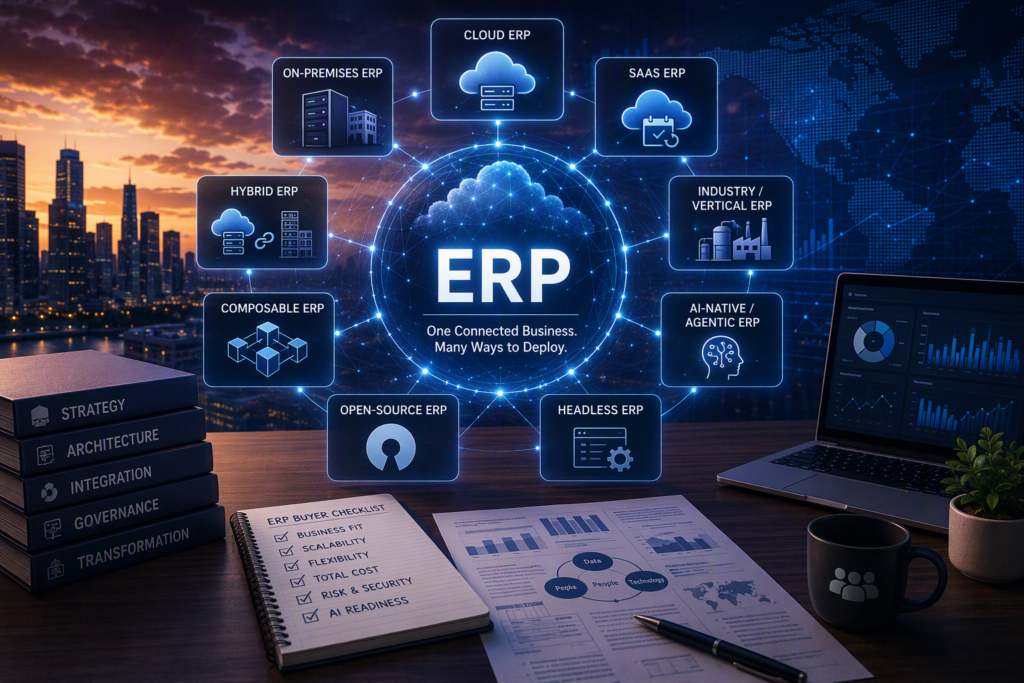
Diagram representing a structured ERP delivery framework with interconnected processes and system components.
Unit4 Makes Success4U Default Delivery Model for ERP Deployments
Unit4 is making its Success4U framework the default delivery model for ERPx and existing ERP deployments. The model packages implementation services, advisory guidance, and outcome-based service packages into a single subscription designed to simplify ERP adoption and optimization.
Abu Dhabi skyline representing the UAE as the country prepares to implement its national e-invoicing mandate for businesses by 2027.
UAE E-Invoicing Mandate: What ERP and Finance Teams Need to Know Before 2027
The UAE e-invoicing mandate will require businesses to generate structured invoice data and report transactions through accredited service providers by 2027. The shift moves invoice compliance into ERP systems, where billing data, validation workflows, and compliance architectures determine whether invoices pass regulatory checks.
European Economic and Social Committee building in Brussels representing EU cloud sovereignty and data governance policy.
‘Sovereignty Washing’: Why Cloud Sovereignty Claims Don’t Always Match Reality
As concerns about data sovereignty grow across Europe, many cloud providers now promote “sovereign cloud” solutions. But legal jurisdiction, technology dependencies, and supply-chain relationships can complicate these claims. This article explores the emerging phenomenon of sovereignty washing and explains how organizations can evaluate whether cloud services truly meet sovereignty requirements.
Johor Bahru skyline and transport infrastructure near Singapore, a fast-growing hub for hyperscale data center development in Southeast Asia.
AI Is Redrawing Southeast Asia’s Data Center Map
AI infrastructure investment is rapidly reshaping Southeast Asia’s data center geography. As hyperscale providers expand across Singapore, Malaysia, Indonesia, and emerging markets, the region is evolving into a distributed infrastructure network that will increasingly influence cloud availability, AI compute capacity, and enterprise ERP deployments.
CData logo representing MCP performance optimization and managed AI connectivity platform.
Optimizing MCP for Production: 10 Proven Performance Techniques
Model Context Protocol (MCP) is becoming production infrastructure for AI agents. This article outlines 10 proven performance optimization techniques to improve latency, throughput, and scalability while positioning managed MCP platforms as a foundation for reliable enterprise AI.
Pathlock logo representing SAP threat detection integration with Microsoft Sentinel SIEM architecture.
Pathlock Extends SAP Threat Detection into Microsoft Sentinel’s SIEM Architecture
Pathlock has extended its SAP Threat Detection capability into Microsoft Sentinel’s SIEM architecture, bringing enriched SAP security telemetry into centralized SOC workflows across hybrid SAP environments.
Nvidia logo displayed against stock market chart background symbolizing AI infrastructure growth and earnings performance.
Nvidia Earnings Signal Expanding AI Infrastructure—and New ERP Risk Dependencies
Nvidia’s FY26 earnings confirm accelerating AI infrastructure investment. For ERP leaders, the real story lies in emerging dependencies across hyperscaler leverage, security posture, and enterprise data governance.
NetSuite Pushes Persona-Driven AI Agents to Make ERP Intelligence Contextual, Actionable
At SuiteConnect New York, Oracle NetSuite emphasized that effective AI in business relies on operational context rather than just model sophistication, advocating for an autopilot approach that integrates intelligence into workflows, exemplified by their Ask Oracle conversational interface tailored for specific roles.
OpenAI Expands Enterprise AI Push with Consulting Alliances and $50B Amazon Deal
OpenAI is aggressively partnering with major consulting firms and Amazon to promote its Frontier AI platform, positioning it as a direct competitor to traditional enterprise software vendors by enabling organizations to efficiently deploy and manage AI agents across various business applications.
Bharat Mandapam New Delhi lit at night during India AI Impact Summit highlighting AI infrastructure and enterprise platform strategy discussions.
At the India AI Impact Summit, SAP Makes the Case for Platform-Centric AI
As infrastructure pledges dominated the India AI Impact Summit, SAP focused on platform-centric AI, positioning Business AI inside enterprise systems rather than competing in the compute investment cycle.
Security analyst monitoring code and identity access controls across multiple screens following accelerated AI-driven breach activity
AI Compressing Breach Timelines as Identity Weaknesses Drive 90% of Incidents
Unit 42’s 2026 Global Incident Response Report finds attackers reaching data exfiltration in as little as 72 minutes, with identity weaknesses involved in nearly 90% of incidents. The findings highlight AI-driven acceleration, over-permissioned identities and multi-surface exposure across modern enterprise environments.
Unit4 office corridor with employees who developed Financials by Coda walking signage.
Building a Financial Backbone for Mixed-Application Enterprises with Unit4
Unit4 Financials by Coda is positioned as a financial backbone for mixed-application enterprises. This analysis explores its multidimensional ledger model, cloud deployment options, and low-code integration layer — and what that structure means for finance teams operating across jurisdictions and systems.
Sumner Explains Benefits of Microsoft’s Pegasus Program for i-Genie.ai
i-Genie.ai's acceptance into Microsoft's selective Pegasus Program provides the startup with critical resources, advanced AI tools and a global enterprise network that accelerates its ability to deliver actionable consumer insights and improve operational efficiencies for multinational brands.
Munich Security Conference 2026 venue interior with MSC screens and white dove installation, photographed by Jens Hartmann for MSC.
Cybersecurity at the Munich Security Conference—What It Means for Businesses
Cybersecurity was central to discussions at the Munich Security Conference 2026. As state leaders integrate cyber into national security planning, enterprise risk, cloud strategy, and infrastructure resilience are being reshaped by geopolitical realities.
Industrial AI Platform Combines Virtual Twins, Accelerated Computing
Dassault Systèmes and NVIDIA's strategic partnership aims to revolutionize industrial AI by creating an integrated architecture that combines virtual twin technologies with AI infrastructure, enabling real-time simulations and accelerated workflows for manufacturing and engineering.
Clorox ERP
Clorox Completes SAP ERP Overhaul as Purell Acquisition Tests Integration Capacity
Clorox successfully implemented a cloud-based SAP ERP system across 21 manufacturing plants, enhancing operational decision-making while navigating initial supply chain disruptions and anticipating productivity improvements by fiscal 2027.
Riff logo representing the company behind the agentic AI digital transformation report.
Why Agentic AI May Succeed Where Digital Transformation Stalled
After a decade of heavy digital investment, many enterprises still struggle to translate infrastructure into measurable outcomes. A new report from Riff argues agentic AI changes the economics of delivery by narrowing the distance between expertise and action. Success now depends on how leaders redesign workflows, governance, and ownership.
SPS Commerce logo in front of stock market data, representing investor focus on the company’s agentic AI and supply chain platform strategy.
SPS Commerce Embeds Agentic AI Into Supply Chain Execution
SPS Commerce has introduced MAX, embedding agentic AI directly into supply chain workflows. The move extends automation beyond visibility and into execution, as customers and investors look for proof that network scale can deliver measurable operational impact.
Financial data and stock figures overlaid on a city banking district skyline at dusk.
UiPath Extends Automation Into KYC and AML Investigations With WorkFusion
UiPath is extending automation into KYC and AML investigations with WorkFusion, a move that highlights how regulated workflows increasingly depend on enterprise platforms and audit-ready execution.
SAP logo displayed on a vertical banner outside an office building
SAP, AWS Embed Generative AI Directly Into SAP Consulting Work
SAP and AWS are embedding generative AI into SAP consulting work through SAP Joule for Consultants, integrating Anthropic Claude models via Amazon Bedrock to support delivery teams.
Business user interacting with AI-powered analytics on a laptop, illustrating enterprise AI and real-time data intelligence.
The New ERP Backbone: Databricks, Inetum, and the Shift to AI-Native ERP Architectures
ERP systems are entering an AI-augmented era, but many data foundations are not ready. This analysis examines why AI-native ERP architectures are emerging, how Databricks is becoming the intelligence layer, and how Inetum helps enterprises operationalize AI with trust, governance, and scale.
ERP in 2026: What Changes When Systems Start Acting on Our Behalf
As ERP transitions from a control-centric model to one empowered by agentic AI that autonomously executes decisions, CIOs must rethink governance, accountability, and operational readiness to address new risks and ensure effective outcomes.
Microsoft Q2 2026 Results Show AI, Cloud Growth Accelerating as Spending Surges
Microsoft reported strong Q2 FY2026 results with $81.3 billion in revenue, driven by significant growth in cloud and AI services, despite a sharp increase in capital expenditures to support infrastructure demands, reflecting the company's aggressive AI ambitions.
Accounting professional using ERP dashboards and real-time financial analytics on a laptop.
Brex’s ERP Integrations Move Accounting Control Upstream
Brex’s Accounting API connects transaction systems directly to ERP logic, enforcing accounting rules earlier in the process. The shift highlights how accounting control is moving upstream across enterprise finance architectures.
man at desk
AR Complexity Is Exposing ERP System Limits
A new study examines where ERP systems fall short in accounts receivable, highlighting how automation gaps, system fragmentation, and rising complexity affect cash-flow execution.
Microsoft Sharpens Dynamics 365 ERP for Asset-as-a-Service Rental Models
Microsoft is evolving ERP through Dynamics 365 to actively manage rental operations and address fragmentation in asset utilization by introducing rental-specific capabilities that enhance workflows, financial clarity, and customer experiences in a cloud-based, AI-extended ecosystem.