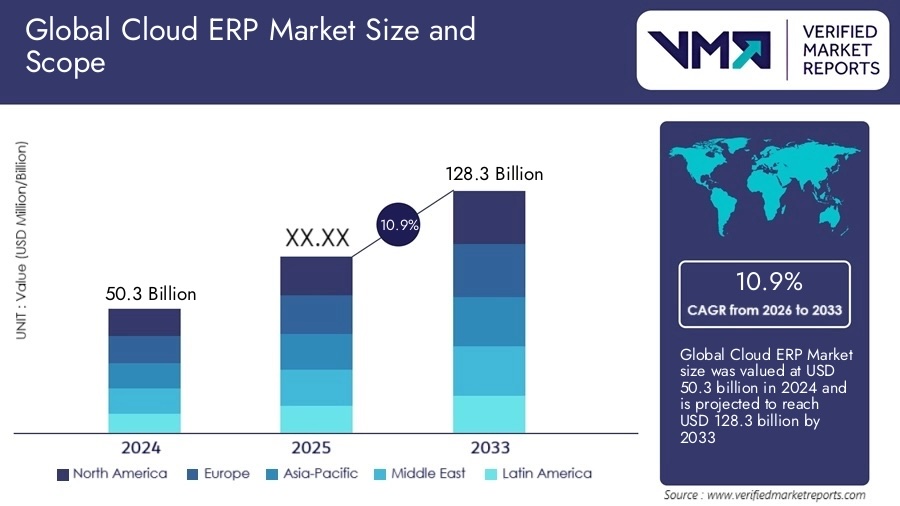

The cloud ERP market is set to grow threefold by 2032 to almost $177 billion. There is strong growth and demand in multiple industries as companies grapple with many challenges. The rise of digital transformation, AI adoption, and Industry 4.0 has companies grappling with large amounts of data that need to be synthesized and interpreted.
Speed is the name of the game and so is accuracy. The margin for error is narrowing, and companies are looking for every edge they can. In a report by DataM Intelligence, growth drivers are highlighted by market, differentiating factors, and region.
Cloud ERP Market Segmentation Analysis
Solutions vs. services. Solutions dominate with about 63% market share as of 2025, driven by demand for centralized, integrated platforms offering real-time analytics, AI-powered insights, and cross-department automation. Services hold a smaller market share, but are growing steadily with expanding cloud ERP adoption.
Finance leads business functions. Finance and accounting command the largest share among business functions, supported by automation needs and real-time financial data management. Sales, marketing, HR, and supply chain management follow, each benefiting from modular ERP capabilities enhancing operational efficiency and decision-making.
Large enterprises lead; SMEs are rising. Large enterprises hold the largest share around 74%, reflecting their need for scalable, multi-site deployments and comprehensive ERP suites. SMEs are an emerging segment with rapid adoption driven by affordable, flexible, and scalable cloud ERP solutions.
Public cloud dominates; hybrid growing fast. Public cloud leads with about 60% market share, favored for scalability and lower upfront costs. Hybrid cloud deployment is growing rapidly due to needs for flexible infrastructure, data security, and integration with legacy systems. Private cloud has a smaller but steady share.
IT, Telecom leading end users. IT & Telecom leads with about 31% market share, driven by hyperscalers and tech firms adopting cloud ERP for enhanced scalability and advanced analytics.
Six Cloud ERP Growth Drivers
- Rising adoption of cloud computing: Businesses increasingly shift to cloud platforms for scalable infrastructure, reducing upfront costs and enabling elastic growth to match demand.
- AI/ML integration: Cloud ERP systems incorporate AI/ML for predictive analytics, automation, and real-time insights, enhancing decision-making and operational efficiency.
- Remote and mobile accessibility demand: Support for hybrid workforces drives need for anytime, anywhere access via mobile devices, boosting productivity in decentralized environments.
- Cost-effectiveness and lower TCO: Subscription models eliminate heavy capital expenses, offering scalability and faster deployment compared to on-premise solutions.
- Digital transformation initiatives: Organizations pursue modernization through real-time analytics, IoT integration, and industry-specific solutions to stay competitive in the digital economy.
- Global expansion and e-commerce growth: Rapid digitization in emerging markets like Asia-Pacific fuels adoption alongside e-commerce demands for agile, data-driven operations.
Cloud ERP Regional Insights
The North American region holds the largest market share in the cloud ERP market, commanding more than 40% of the global market. This dominance is driven by advanced technological infrastructure and high adoption rates thanks in large part to manufacturing, retail and healthcare. The US plays a significant role within this region due to widespread cloud ERP implementation and hybrid cloud strategy adoption.
Asia-Pacific is the fastest-growing region in the cloud ERP market, propelled by rapid digitalization, a growing base of SMEs and increasing government support for cloud technology adoption. Asia-Pacific is expected to see accelerating growth driven by its expanding IT infrastructure and economic development.
Europe holds the next significant share in the cloud ERP market after North America and Asia-Pacific. The region benefits from solid technological advancements, increasing cloud adoption among businesses and strong presence of established ERP providers.
What This Means for ERP Insiders
Accelerating cloud ERP expansion highlights the shift toward data-driven, AI-enabled enterprise architectures. Next-generation ERP value will hinge on scalable cloud platforms that can synthesize high-velocity data with lower error tolerance. Cloud ERP vendors and system integrators must prioritize predictive analytics, cross-domain automation, and real-time decision frameworks. Companies, more than ever, must meet rising performance, integration and modernization expectations.
Evolving cloud ERP deployment and functional patterns reveal a decisive movement toward modularity and flexibility. Dominance of solutions over services highlights the demand for configurable, interoperable architectures that support legacy coexistence and cloud ERP acceleration. Enterprise architects and transformation leaders must design integration strategies that balance security, cost efficiency, and multi-cloud extensibility.
Regional trajectories indicate a new competitive landscape for the cloud ERP market. This new landscape will reshape partner ecosystems and cloud ERP go-to-market models. North America’s maturity, Asia-Pacific’s explosive growth, and Europe’s steady expansion collectively signal opportunities for differentiated industry solutions, localized compliance capabilities and strategic alliances. ERP vendors and system integrators must align regional product roadmaps to cloud-native innovation, SME adoption patterns, and sector-driven modernization priorities.