
Dataiku has launched Cobuild on Snowflake, a new offering that turns natural-language business requests into visual AI workflows, agents and applications running on Snowflake. Cobuild combines Snowflake Cortex AI’s native access to large language models with Dataiku’s orchestration layer to help enterprises move AI projects into production with greater visibility and control.
The launch targets a growing issue for enterprise teams adopting generative AI. While AI coding assistants can speed workflow creation, Dataiku and Snowflake said enterprises still need those workflows to be inspectable, governed and approved before they reach production.
How Dataiku Positions Governed AI Workflows
With Cobuild on Snowflake users can convert business intent expressed in natural language into visual Dataiku workflows for data preparation, machine learning, AI agents and applications.
Dataiku said the product is intended to widen participation in AI development by enabling domain experts, analysts and technical teams to work together in a shared environment.
Florian Douetteau, co-founder and CEO of Dataiku, told ERP Today that a common failure mode in consumer-style AI coding tools is that “the code that produced that answer sits buried inside the agent’s reasoning path.” He said the result is often logic that business users cannot read, auditors cannot trace and enterprises cannot easily validate months later.
Douetteau said Cobuild on Snowflake is intended to replace that model with a visual workflow that teams can inspect and refine before deployment. He said the resulting workflow captures lineage, versioning and approvals as part of the process, rather than leaving the logic buried inside a one-off prompt interaction.
Analysis
What This Means for ERP Insiders
Treat workflow inspectability as an architecture requirement, not a user-experience feature. If AI-generated workflows are going to touch finance, supply chain, or customer-facing decisions, ERP teams should ask how those workflows are versioned, reviewed, and traced before they ever think about scale. In practice, that means evaluating whether AI tooling fits enterprise governance models as cleanly as the data platforms underneath it.
Early Use Cases for Decision Agents
Dataiku said Cobuild on Snowflake is designed to support workflows across data preparation, machine learning, AI agent creation and application development through natural language. Douetteau said the more significant pattern is the rise of what he described as decision agents built on curated enterprise data already stored in Snowflake.
“A supply manager who wants an agent that flags inventory risks across her regions, a fraud investigator who wants an agent that triages alerts using six years of case history, a credit officer who wants an agent that explains its reasoning before a loan goes out the door — these are decision agents grounded in business logic, sitting directly on the data that already drives the business. None of these are exotic AI projects. They are the conversations domain experts have been wanting to have with their own data, and Cobuild is what lets them have it without waiting in a backlog,” Douetteau explained.
In his view, the most immediate opportunity is not experimental AI, but decision support grounded in governed enterprise data already housed in Snowflake.
Analysis
What This Means for ERP Insiders
Start with decision support use cases where governed enterprise data already exists. The strongest early candidates are not broad autonomous programs, but narrower workflows such as supply risk monitoring, fraud triage, and explainable credit support, where the data is already curated and the business owner is easy to identify. ERP leaders should prioritize use cases where governance, accountability, and operational value can all be measured quickly.
Why Transparency Matters in Enterprise AI
As AI systems become more autonomous, enterprises need clear visibility into how workflows operate, what logic is applied and whether outputs align with internal controls.
Baris Gultekin, vice president of AI at Snowflake, told ERP Today that the biggest requirement Snowflake hears from enterprises is transparency. He said organizations want to understand where an answer came from, what business logic was applied, and whether the workflow aligns with internal policies as AI systems become more agentic and more capable of taking action.
Cobuild is designed to let business users understand what was built, data teams validate the logic, and IT and governance teams apply controls before anything moves into production, the company said.
How Snowflake Supports Governed AI Execution
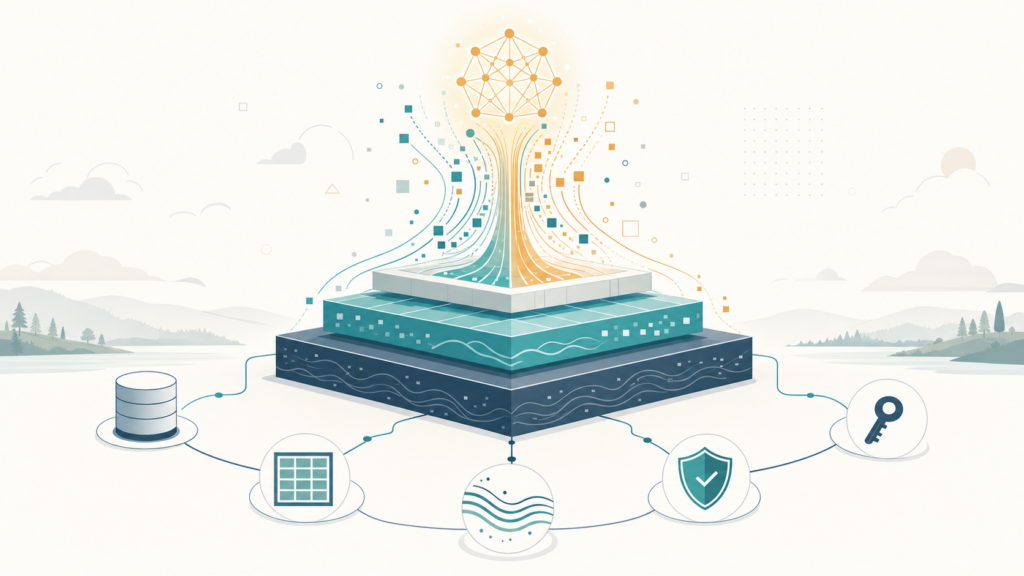
Dataiku said Cobuild on Snowflake builds on the companies’ existing technical integration and is intended to create a governed AI development environment connecting enterprise data, foundation models available through Cortex AI, and Dataiku’s orchestration layer. The company said AI generation is designed to execute within customers’ Snowflake environments through secure REST API integration.
Gultekin said that approach keeps data inside Snowflake while expanding who can build on the platform beyond technical teams alone. He said the goal is to enable analysts and business users to create governed AI systems without writing code, while maintaining governance and security as enterprises scale AI.
Cobuild on Snowflake is initially available to joint customers already building with Dataiku on Snowflake, with broader access planned for Snowflake customers interested in adding Dataiku.
Analysis
What This Means for ERP Insiders
Ask whether your AI workflow tool reduces backlog or simply shifts it. A platform that lets analysts and domain experts build on governed data can accelerate execution, but only if approval models, data ownership, and security controls are already defined. For ERP practitioners, the real test is whether business teams can build faster without creating a second governance burden for IT.