Katalyze AI has raised $10.5 million in seed funding to expand an agentic AI operating system built for pharmaceutical manufacturing and life sciences. Tech Startups reported on July 6 that the round was led by Bonfire Ventures, with participation from Inovia Capital, Ripple Ventures, Alumni Ventures, and angel investors including Gokul Rajaram and Farzad Soleimani. Katalyze plans to use the funding to expand its engineering, scientific, and go-to-market teams, grow its catalog of AI agents, and scale deployments with large pharmaceutical companies.
The San Francisco startup is targeting one of the hardest AI problems in regulated manufacturing: connecting fragmented plant, lab, quality, and enterprise data into a trusted operational layer that scientists, engineers, analysts, and AI agents can use.
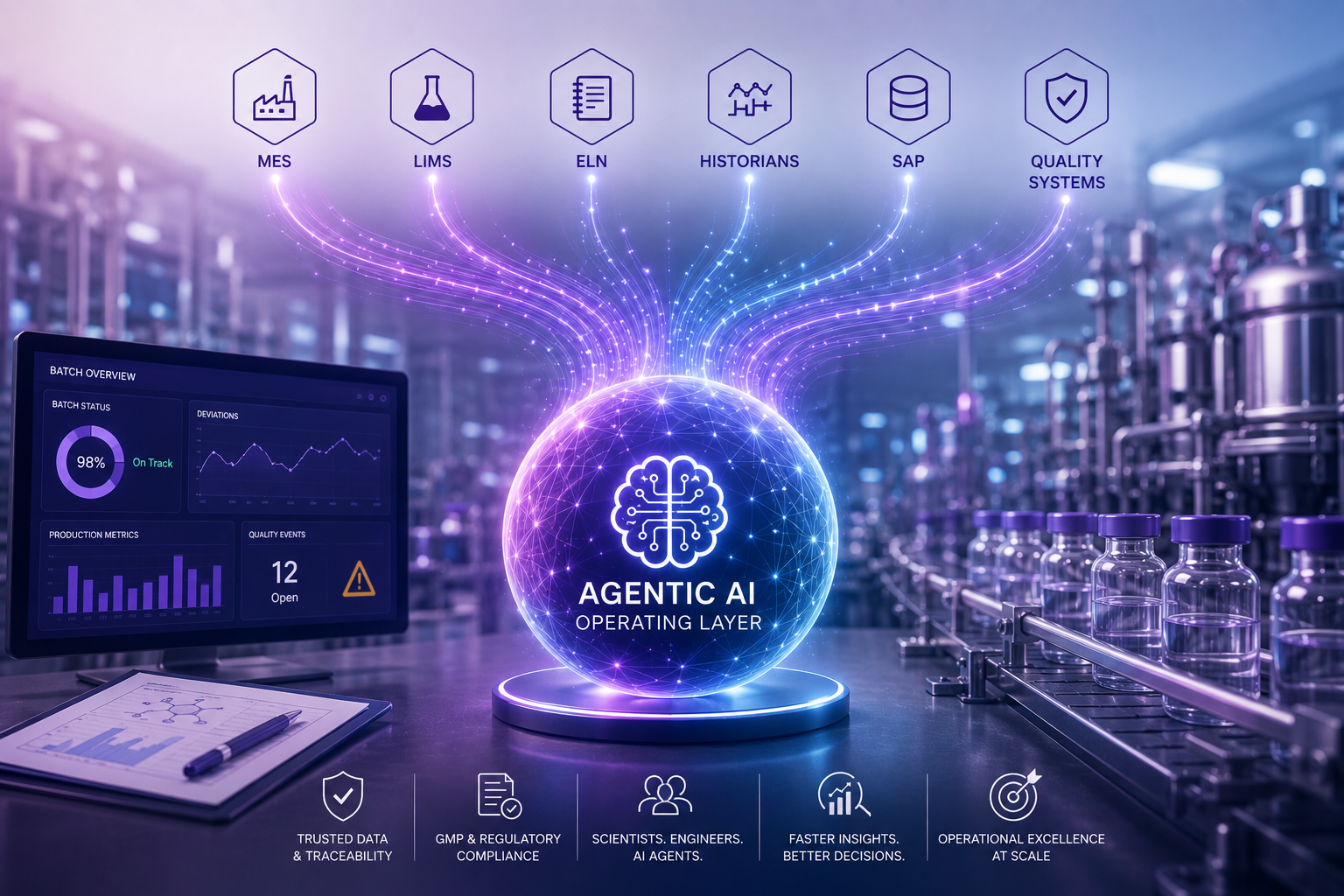
Katalyze says its platform connects systems including manufacturing execution systems (MES), laboratory information management systems (LIMS), electronic lab notebooks (ELN), historians, SAP, and other enterprise applications into a single operational record. The company’s focus is not generic AI assistance, but verified operational data, ontology, knowledge graphs, traceability, Good Manufacturing Practice needs, and quality workflows. Katalyze is reportedly being used by five of the world’s 20 largest pharmaceutical companies.
AI in the Pharma Operating Record
Katalyze’s pitch reflects a key difference between AI in drug discovery and AI in manufacturing. In pharmaceutical production, an AI-generated answer is only useful if teams can trace it back to the underlying process data, quality records, batch history, lab results, and approved systems.
That is why Katalyze is emphasizing an operations-specific ontology and knowledge graph. The company says that layer gives AI agents context for each manufacturing process and molecule, allowing them to investigate production issues, support quality teams, analyze manufacturing data, and generate results that remain linked to source records.
For pharmaceutical manufacturers, that traceability is not a technical preference. It is part of the operating environment. AI tools that support production, quality, or engineering decisions need to work within GxP expectations, protect sensitive data, and produce outputs that can be reviewed, explained, and audited.
Tech Startups reported one early deployment in which Katalyze said an analysis that would have taken roughly a year and cost between $4 million and $6 million was completed in 45 minutes using its platform. Katalyze did not disclose additional details about the project.
Regulated AI Needs More Than a Copilot
The funding comes as ERP and enterprise software providers push AI deeper into the workflows around manufacturing, quality, supply chain, and finance. For pharma, the challenge is sharper because core operational data often lives across SAP, MES, lab systems, ELN, historians, quality systems, and spreadsheets.
ERP Today recently reported on SAP’s Reltio deal, which put data quality at the center of ERP AI readiness. That same issue appears in pharma manufacturing, where AI agents cannot safely act on fragmented, duplicated, or poorly governed records.
ERP Today also covered Oracle’s work in process manufacturing, where production complexity, quality controls, regulatory expectations, and costing all shape how enterprise applications support manufacturers. Katalyze is attacking a related problem from a different angle: building an AI operating layer that can reason across pharma-specific operational systems without losing the audit trail.
The larger signal is that regulated manufacturers may not adopt agentic AI through broad horizontal copilots alone. They need systems that understand the relationship between process data, quality events, deviations, batch records, lab results, and enterprise transactions.
Get Our Free Weekly Newsletter
What This Means for ERP Insiders
Regulated manufacturers need AI that can prove its work. Pharma teams cannot rely on black-box answers when production quality, compliance, batch release, and patient safety are involved. For ERP, quality, and manufacturing leaders, the practical test is whether AI outputs remain tied to trusted source records, approved workflows, and auditable decisions.
The next AI battleground sits between SAP, MES, LIMS, ELN, and historians. Much of the value in pharma manufacturing depends on connecting operational data across systems that were not designed to behave like one unified record. For CIOs and manufacturing IT leaders in life sciences, integration strategy will decide whether agents can support real work or stay trapped in isolated pilots.
Quality workflows will shape how far agentic AI can go in life sciences. Agents that investigate deviations, analyze production data, or support engineering decisions need ontology, domain context, access controls, and human review built into the operating model. For regulated manufacturers and implementation partners, the next readiness step is to build AI around traceability first, then scale toward higher-value automation.