
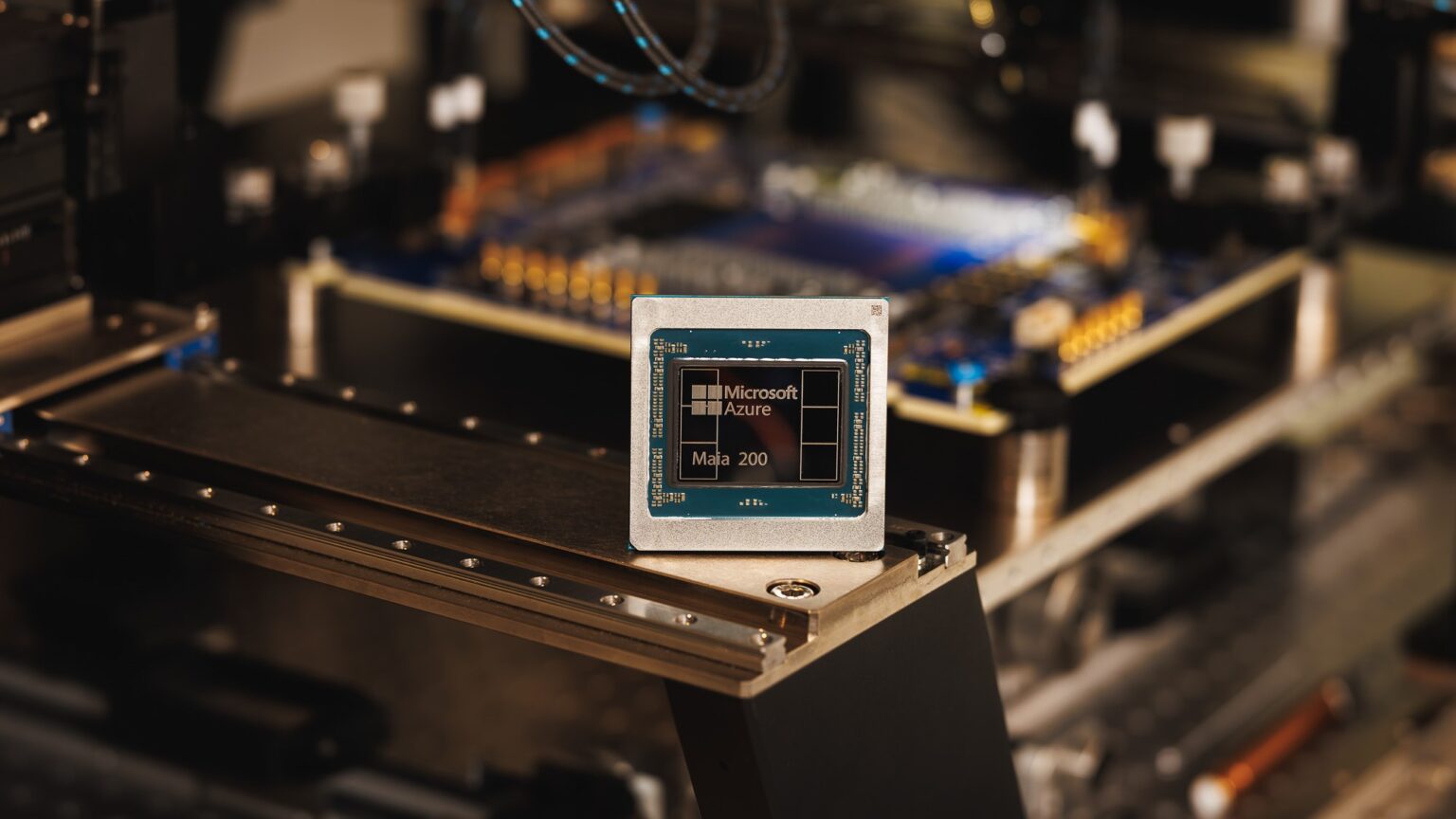
Microsoft’s Maia 200 is an inference accelerator built on TSMC’s 3-nanometer process delivering 30% better performance per dollar than previous-generation hardware in Azure’s infrastructure fleet. The custom silicon features native FP8/FP4 tensor cores, 216GB HBM3e memory at 7 TB/s bandwidth, 272MB on-chip SRAM and specialized data movement engines designed to keep large language models fed efficiently.
The chip delivers over 10 petaFLOPS in 4-bit precision and over 5 petaFLOPS in 8-bit performance within a 750W thermal design power envelope, providing three times the FP4 performance of third-generation Amazon Trainium and exceeding Google’s seventh-generation TPU in FP8 operations. Maia 200 is deployed in Microsoft’s US Central datacenter region near Des Moines, Iowa, with US West 3 near Phoenix scheduled next.
For technology executives managing ERP infrastructure costs, the economics of AI inference represent critical operational considerations as organizations scale AI-embedded workflows across enterprise applications.
The shift toward custom inference accelerators reflects broader hyperscaler strategies where workload-specific silicon optimized for specific model architectures delivers dramatically lower total cost of ownership when amortized across years of scaled deployment. Custom ASICs provide optimized performance tailored for specific tasks, reduce operational costs by avoiding third-party hardware dependencies, and improve energy efficiency critical in large-scale datacenter operations.
Inference Economics Shape Enterprise AI Deployment Patterns
Microsoft will serve multiple models on Maia 200 infrastructure, including GPT-5.2 from OpenAI, bringing performance-per-dollar advantages to Microsoft Foundry and Microsoft 365 Copilot. The Microsoft Superintelligence team will use Maia 200 for synthetic data generation and reinforcement learning to improve next-generation models.
Organizations implementing AI at scale face common bottlenecks including cost management, memory bandwidth saturation and time-to-first-token requirements that determine user experience quality in conversational AI applications. Microsoft addresses memory bandwidth constraints through Maia 200’s redesigned memory subsystem with specialized DMA engine, on-die SRAM and network-on-chip fabric for high-bandwidth data movement.
The systems-level architecture introduces a two-tier scale-up network design built on standard Ethernet with custom transport layer, delivering 2.8 TB/s of bidirectional dedicated bandwidth per accelerator and predictable high-performance collective operations across clusters. This architecture delivers scalable performance while reducing power usage and total cost of ownership across Azure’s global fleet.
Microsoft’s pre-silicon validation environment modeled computation and communication patterns of large language models with high fidelity, enabling optimization of silicon, networking and system software as unified whole before first silicon availability. As result, AI models ran on Maia 200 silicon within days of first packaged part arrival, with time from first silicon to first datacenter rack deployment reduced to less than half that of comparable AI infrastructure programs.
What This Means for ERP Insiders
Custom inference silicon economics fundamentally reshape cloud ERP pricing assumptions. Microsoft’s 30% performance-per-dollar improvement through Maia 200 demonstrates that hyperscalers pursuing vertical integration of AI accelerators achieve cost structures materially different from infrastructure relying on third-party GPU vendors. ERP vendors architecting cloud platforms must reevaluate consumption pricing models assuming GPU costs remain flat.
Inference-optimized architectures validate separation between training and production infrastructure. Maia 200’s specialization for token generation rather than model training confirms architectural bifurcation where production AI workloads require fundamentally different hardware than development environments. Enterprise architects designing ERP AI strategies must structure infrastructure investments recognizing that inference dominates operational costs at scale, prioritizing low-latency token generation, memory bandwidth and energy efficiency over raw compute throughput, creating distinct requirements for production versus development environments that traditional unified infrastructure approaches cannot optimize effectively.
Ethernet-based scale-up networks reduce proprietary fabric dependencies. Microsoft’s two-tier network design built on standard Ethernet with custom transport protocols rather than proprietary fabrics signals architectural shift toward commodity networking for AI clusters. This development reduces vendor lock-in risks for enterprises deploying on-premises or hybrid AI infrastructure supporting ERP workloads, enabling multi-vendor strategies and competitive pricing dynamics that proprietary interconnects prevent, fundamentally altering total cost of ownership calculations and creating opportunities for organizations to negotiate infrastructure investments without single-vendor dependency constraints.