EMEA

From ESG Burden to Business Edge: IFS Embeds Sustainability at the Core of Industrial ERP
At IFS Connect UKI 2025, IFS highlighted the necessity of integrating sustainability as a core business function within industrial enterprises amidst evolving regulations and stakeholder expectations, showcasing its new cloud platform modules designed to operationalize sustainability through enhanced ESG insights and data-driven decision-making.
SSTL and NTT DATA Partner for Cloud-Powered Space Innovation
Mission Ready: IFS Stays Focused on Key Verticals and Drives Innovation for Aerospace & Defense
At IFS Connect UKI 2025, IFS showcased its cloud platform and AI innovations tailored for the aerospace and defense industry, emphasizing precision, compliance, operational resilience, and security, while introducing advanced functionalities designed to meet the sector's unique challenges and regulatory requirements.
IFS CEO and CPO Offer Candid Views on Industrial AI and Speed-to-Value as the Differentiator in Enterprise Tech
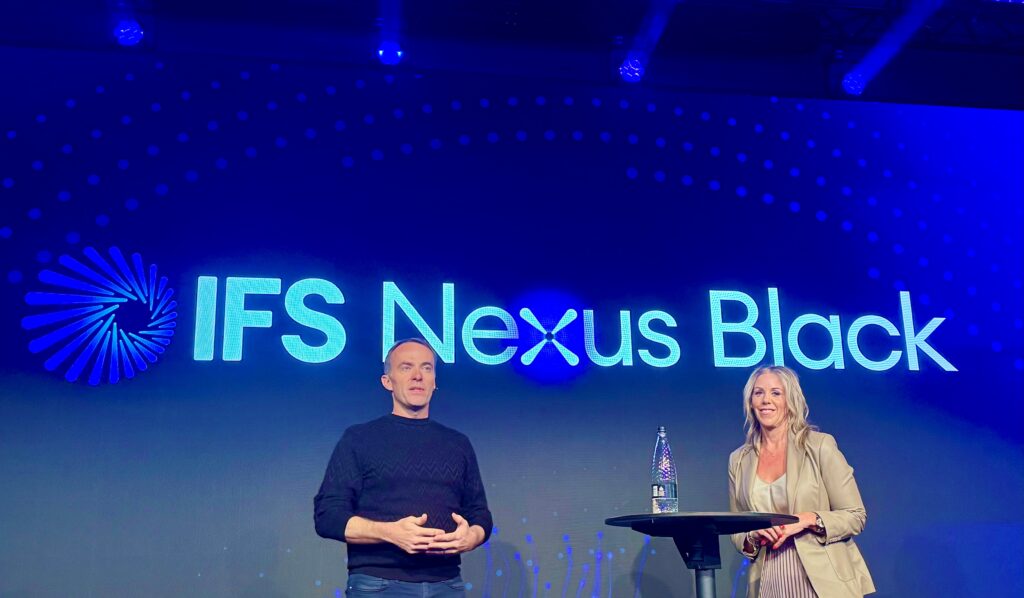
IFS is shifting towards rapid AI adoption with its Nexus Black initiative and aims to double its valuation every three years, focusing on agentic AI tailored for core industries while maintaining a commitment to practical, scalable solutions despite the challenges of industrial AI.
Inside Nexus Black: IFS Launches a Fast-Track AI Lab for Industrial Innovation
At IFS Connect UKI 2025, IFS launched Nexus Black™, an innovative AI initiative aimed at rapidly transforming industrial AI aspirations into operational advantages for sectors like manufacturing and energy, addressing the fragmentation of existing tools and emphasizing co-development with clients while integrating successful solutions into the IFS Cloud.
From Productivity to Precision: IFS Unveils Its Industrial AI Reality
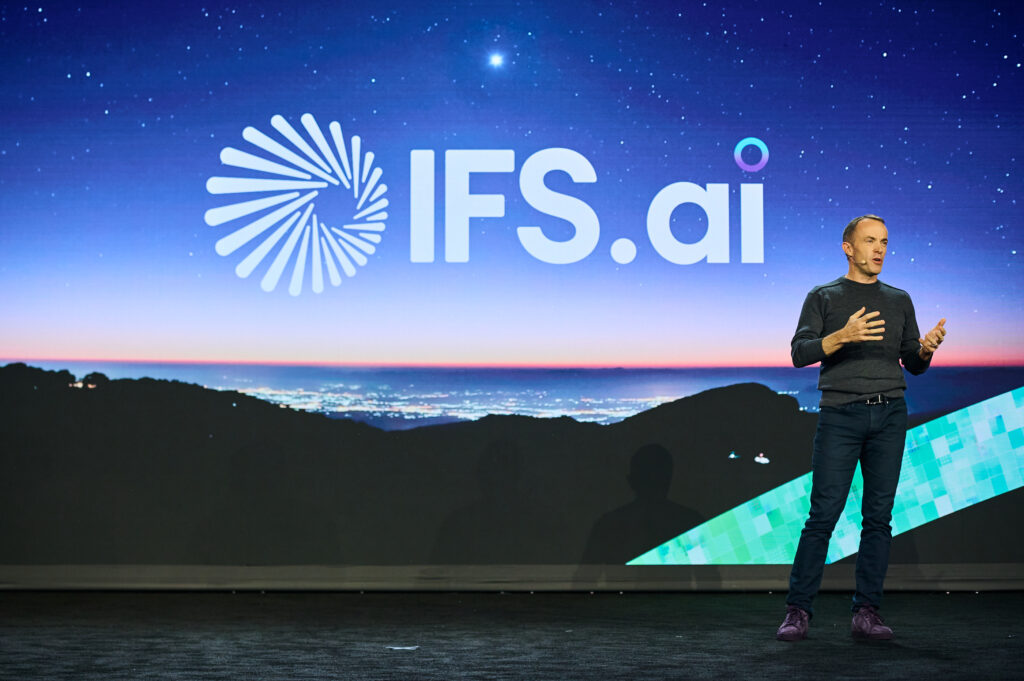
At IFS Connect UKI 2025, IFS executives Christian Pedersen and James Greaves emphasized that AI has become the core foundation of enterprise software, showcasing IFS.ai's capabilities in providing embedded, real-time intelligence for industrial businesses through over 200 integrated AI services that enhance operations and decision-making without human intervention.
IFS Valuation Soars Past €15 B on Major Investment & Strong Growth
From Birmingham, UK: IFS Bets Big on Industrial AI—and Invites Its Customers to Lead the Charge
At IFS Connect UKI 2025, CEO Mark Moffat emphasized IFS's urgent ambition to lead industrial enterprise software by 2029 through AI integration, focused R&D investments, and real-world operational value, while urging customers to embrace AI as a mindset for optimizing asset-heavy industries.
Veolia’s Invoice Processing Rehaul
Veolia found itself struggling with a Shared Service Center (SSC) serving 30 entities of the group, performing inefficient legacy operations.
Hedstrom Fitness
"When it was spun out of Hedstrom Plastics, Hedstrom Fitness, the sole distributor of BOSU kettlebell weights, balance pods, and other gear, continued to operate on Macola through its transition. But the antiquated, legacy software didn’t provide what the new company needed. Hedstrom Fitness deployed Acumatica Distribution, streamlining processes, improving inventory accuracy, and gaining insights that are helping the company thrive. KEY RESULTS • Gained a single, easy-to-use business platform with data in one system • Improved inventory management • Reduced number of accounting support people from 6 to 2 • Streamlined and reduced time to complete inventory • Improved visibility with automated accurate reporting from customizable dashboards • Brought shipping in-house, speeding order fulfillment while decreasing times out of stock • Reduced time to look up and verify orders by more than 66 percent (5 minutes to 2 or less) • Decreased fulfillment time from 4 days to same day shipping, improving customer experience • Reduced printing and paper costs"
Calculating ERP Software ROI
Explore how businesses can achieve significant ROI by implementing a modern cloud ERP platform. Discover the importance of transitioning from entry-level accounting systems or legacy ERP platforms to modern solutions. Understand critical components to calculating the total cost of ownership (TCO) as well as the importance of setting goals, capturing benchmarks, and evaluating results. Learn from real-world examples and testimonials from over 60 small and midsized companies across various industries, showcasing the tangible and intangible benefits of ERP systems.
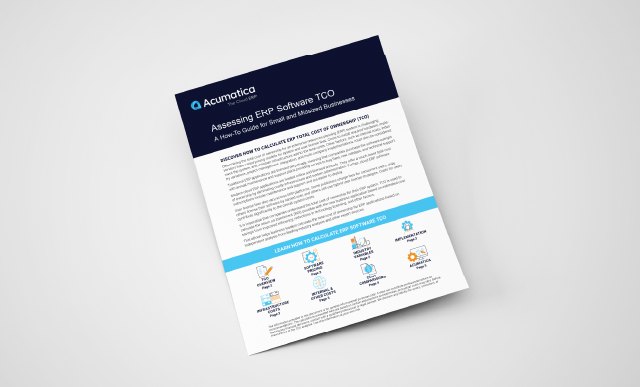
Assessing ERP Software TCO
A comprehensive guide for small and midsized businesses on calculating the total cost of ownership (TCO) for ERP systems. It highlights the challenges of determining TCO due to varied pricing models, infrastructure requirements, and implementation costs. Traditional ERP systems are licensed perpetually, while modern cloud ERP applications are hosted online and licensed annually, offering lower TCO by eliminating costly infrastructure and system administration. The document emphasizes the importance of understanding software pricing, implementation costs, infrastructure costs, and internal expenses. It also discusses industry-specific considerations and provides cost comparisons between perpetual on-premises and cloud SaaS deployments.
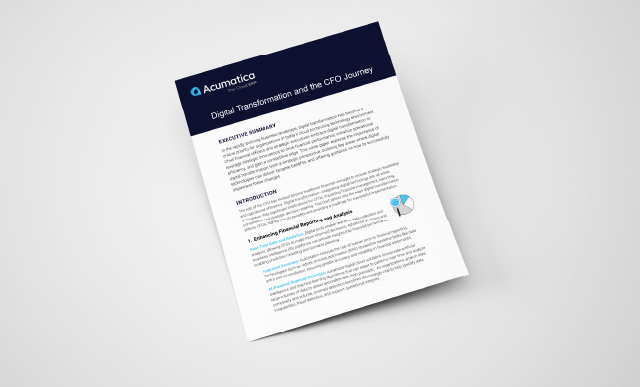
Digital Transformation and the CFO Journey
Digital transformation is crucial for organizations in today's cloud computing environment. CFOs and strategic executives leverage digital technologies to drive financial performance, enhance operational efficiency, and gain a competitive edge. This whitepaper outlines the importance of digital transformation, key areas where digital technologies deliver benefits, and guidance on a successful implementation.
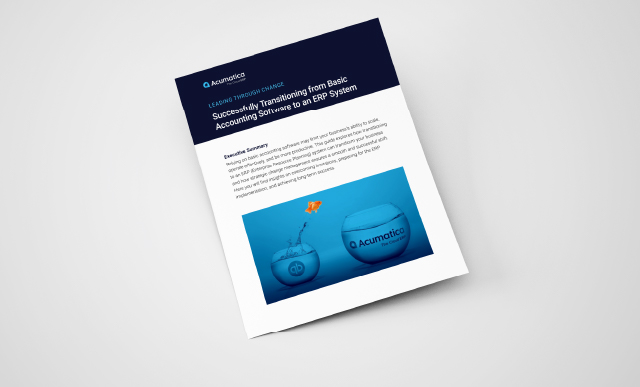
Successfully Transitioning from Basic Accounting to ERP
Relying on basic accounting software can limit your business's ability to scale and operate efficiently. This guide explores how transitioning to an ERP system can transform your business and ensure a smooth and successful shift through strategic change management.
Practical AI, Powerful Results
Discover how Acumatica is revolutionizing ERP systems with practical, industry-specific AI solutions. This blog post explores how AI can transform your business operations by prioritizing security, usability, and customer success. Learn about Acumatica's strategic approach to AI, designed to solve real-world business challenges and deliver immediate value. Dive into the principles of innovation that guide Acumatica's development of transformative technologies, ensuring that AI serves a purpose beyond just technological advancement. Ready to see how AI can work for you? Read on to find out more!
GRC and Cybersecurity: Rethinking Risk in the Era of ERP Modernization
As ERP systems become prime targets for cybercriminals, integrating Governance, Risk, and Compliance (GRC) with cybersecurity is essential for enterprise resilience and proactive risk management, utilizing layered security strategies and education to mitigate vulnerabilities and align with evolving regulatory pressures.
Extend beyond traditional ERP: How the Composable Enterprise Model Empowers Businesses to Take Control
As businesses face the looming end-of-maintenance deadline for SAP ECC, the Composable Enterprise model, aided by solutions like JiVS, offers a compelling alternative by enabling data independence, reducing migration costs, and facilitating the integration of best-of-breed applications, ultimately allowing organizations to build agile IT landscapes free from legacy constraints.
6 Steps to Build an AI-Ready Finance Team
With AI dominating the business agenda, CFOs and finance leaders are being called on to do more than crunch numbers—they're expected to steer enterprise-wide innovation. But as breakthrough technologies reshape the finance landscape, one truth becomes clear: success hinges on your team’s ability to keep up. Facing a persistent talent shortage and an evolving skills gap, there’s never been a better moment to reassess your finance talent strategy. From finding valuable AI use cases to upskilling your current team, finance leaders must take action now to ensure their departments are ready for what’s next. Join this session for practical steps to build an AI-ready finance organization—starting with the talent behind the tech. In this session, you’ll learn how to: Understand the impact of AI on the finance industry and its potential to transform daily tasks and operations. Explore talent acquisition strategies focused on the skills needed in an AI-driven environment. Discover how AI-powered tools can automate routine finance tasks, improve efficiency, and enhance overall productivity. Recognize the role of AI in enabling finance teams to focus on strategic work—including AI-generated narratives, anomaly detection, and predictive modeling. This ERP Today live session will cover how DuPont were able to substantially reduce IT costs by decommissioning legacy infrastructure, eliminate compliance and cybersecurity risks with audit-proof access to historical data, streamline global system architecture, reduce complexity, and eliminate technical debt. Despite the goals, the entire project was completed in just 12 months, an industry-record timeline for a project of this scale. In addition, the project delivered significant gains in energy efficiency in support of ESG targets. By attending this session, you will be able to: Identify the financial, compliance, and cybersecurity risks associated with continuing to run outdated SAP ECC systems. Explain how legacy system retirement can reduce IT operating costs by up to 80% while maintaining audit-proof data access. Describe the key steps and best practices in executing a large-scale SAP system decommissioning project without disrupting business operations. Assess how a platform-based approach like JiVS IMP can simplify IT landscapes and support long-term data governance and ESG goals.
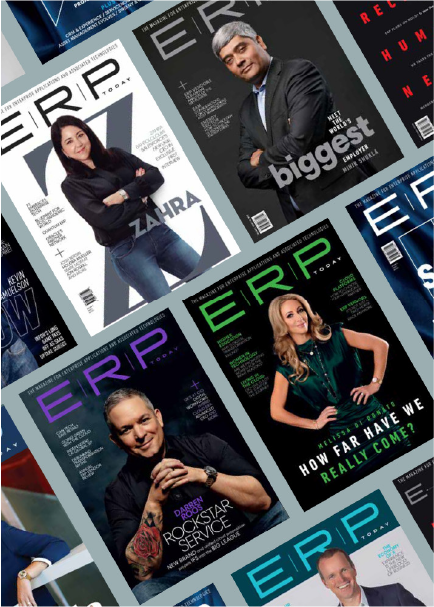
6 Steps to Build an AI-Ready Finance Team
With AI dominating the business agenda, CFOs and finance leaders are being called on to do more than crunch numbers—they're expected to steer enterprise-wide innovation. But as breakthrough technologies reshape the finance landscape, one truth becomes clear: success hinges on your team’s ability to keep up. Facing a persistent talent shortage and an evolving skills gap, there’s never been a better moment to reassess your finance talent strategy. From finding valuable AI use cases to upskilling your current team, finance leaders must take action now to ensure their departments are ready for what’s next. Join this session for practical steps to build an AI-ready finance organization—starting with the talent behind the tech. In this session, you’ll learn how to: Understand the impact of AI on the finance industry and its potential to transform daily tasks and operations. Explore talent acquisition strategies focused on the skills needed in an AI-driven environment. Discover how AI-powered tools can automate routine finance tasks, improve efficiency, and enhance overall productivity. Recognize the role of AI in enabling finance teams to focus on strategic work—including AI-generated narratives, anomaly detection, and predictive modeling. This ERP Today live session will cover how DuPont were able to substantially reduce IT costs by decommissioning legacy infrastructure, eliminate compliance and cybersecurity risks with audit-proof access to historical data, streamline global system architecture, reduce complexity, and eliminate technical debt. Despite the goals, the entire project was completed in just 12 months, an industry-record timeline for a project of this scale. In addition, the project delivered significant gains in energy efficiency in support of ESG targets. By attending this session, you will be able to: Identify the financial, compliance, and cybersecurity risks associated with continuing to run outdated SAP ECC systems. Explain how legacy system retirement can reduce IT operating costs by up to 80% while maintaining audit-proof data access. Describe the key steps and best practices in executing a large-scale SAP system decommissioning project without disrupting business operations. Assess how a platform-based approach like JiVS IMP can simplify IT landscapes and support long-term data governance and ESG goals.

How Innovation and Responsibility Drive a Sustainable Future This Earth Day
How Innovation and Responsibility Drive a Sustainable Future
Earth Day 2023 emphasizes our duty to protect the planet under the theme 'Our Power, Our Planet,' showcasing how responsible technological innovations, particularly in AI and sustainable practices exemplified by companies like IFS and Start Campus, can lead the way towards a greener future.
SAP Legacy System Retirement in Record Time: How DuPont, Accenture & JiVS Did It Fast
DuPont, a global Fortune 500 leader in science and innovation, faced a complex and fragmented IT landscape after years of mergers, divestitures, and organizational change. The challenges of maintaining 17 separate legacy SAP systems, primarily for compliance purposes, were becoming unsustainable. The operational costs involved in supporting these obsolete systems were escalating, systems faced increased cybersecurity exposure, outdated hardware was causing energy inefficiencies, new global compliance requirements needed to be met, and the amount of technical debt had resulted in an overall lack of IT agility. To address these challenges, DuPont launched a bold initiative: retire all 17 legacy SAP systems and archive more than 50 terabytes of historical data, including hundreds of ADK and archival files, without compromising compliance, auditability, or business continuity. Together with Accenture and powered by JiVS Information Management Platform (IMP) from Data Migration International, the company achieved results few believed possible. This ERP Today live session will cover how DuPont were able to substantially reduce IT costs by decommissioning legacy infrastructure, eliminate compliance and cybersecurity risks with audit-proof access to historical data, streamline global system architecture, reduce complexity, and eliminate technical debt. Despite the goals, the entire project was completed in just 12 months, an industry-record timeline for a project of this scale. In addition, the project delivered significant gains in energy efficiency in support of ESG targets. By attending this session, you will be able to: Identify the financial, compliance, and cybersecurity risks associated with continuing to run outdated SAP ECC systems. Explain how legacy system retirement can reduce IT operating costs by up to 80% while maintaining audit-proof data access. Describe the key steps and best practices in executing a large-scale SAP system decommissioning project without disrupting business operations. Assess how a platform-based approach like JiVS IMP can simplify IT landscapes and support long-term data governance and ESG goals.

Why SMBs Should Prioritize ERP Systems in Their Technology Roadmaps
Small and medium-sized businesses are increasingly adopting Enterprise Resource Planning (ERP) systems to streamline operations, improve efficiency, enable data-driven decision-making, and support growth while overcoming challenges associated with managing limited resources and complex processes.
Select Accelerating Digital Impact: Inetum and SAP Drive Future-Ready Transformation Accelerating Digital Impact: Inetum and SAP Drive Future-Ready Transformation
Accelerating Digital Impact: Inetum and SAP Drive Future-Ready Transformation
Inetum, a European leader in digital services, is enhancing its strategic partnership with SAP under new leadership to drive agile, AI-integrated business outcomes, while prioritizing clean data governance, pragmatic cloud transformation, and the importance of human-centered processes.
SAP Legacy System Retirement in Record Time: How DuPont, Accenture & JiVS Did It Fast
DuPont, a global Fortune 500 leader in science and innovation, faced a complex and fragmented IT landscape after years of mergers, divestitures, and organizational change. The challenges of maintaining 17 separate legacy SAP systems, primarily for compliance purposes, were becoming unsustainable. The operational costs involved in supporting these obsolete systems were escalating, systems faced increased cybersecurity exposure, outdated hardware was causing energy inefficiencies, new global compliance requirements needed to be met, and the amount of technical debt had resulted in an overall lack of IT agility. To address these challenges, DuPont launched a bold initiative: retire all 17 legacy SAP systems and archive more than 50 terabytes of historical data, including hundreds of ADK and archival files, without compromising compliance, auditability, or business continuity. Together with Accenture and powered by JiVS Information Management Platform (IMP) from Data Migration International, the company achieved results few believed possible. This ERP Today live session will cover how DuPont were able to substantially reduce IT costs by decommissioning legacy infrastructure, eliminate compliance and cybersecurity risks with audit-proof access to historical data, streamline global system architecture, reduce complexity, and eliminate technical debt. Despite the goals, the entire project was completed in just 12 months, an industry-record timeline for a project of this scale. In addition, the project delivered significant gains in energy efficiency in support of ESG targets. By attending this session, you will be able to: Identify the financial, compliance, and cybersecurity risks associated with continuing to run outdated SAP ECC systems. Explain how legacy system retirement can reduce IT operating costs by up to 80% while maintaining audit-proof data access. Describe the key steps and best practices in executing a large-scale SAP system decommissioning project without disrupting business operations. Assess how a platform-based approach like JiVS IMP can simplify IT landscapes and support long-term data governance and ESG goals.

IT Transformation Trends 2025
Leanne Taylor to Drive SYSPRO’s Global Growth as Chief Revenue Officer
SYSPRO has appointed Leanne Taylor as its new Chief Revenue Officer to drive revenue growth, enhance customer success, and expand international reach, aligning with the company's strategic focus on cloud solutions and innovation following its acquisition by Advent.
SAP S/4HANA
Inoapps Appoints Jens Lindenberg to Spearhead Major EMEA Expansion
Inoapps is strategically expanding its presence in Europe, the Middle East, and Africa by appointing Jens Lindenberg as Senior Vice President to drive growth in key markets, particularly targeting cloud-based Oracle ERP and HCM services to enhance operational efficiency for businesses across the region.
Why ERP Cloud Migrations Demand a New Approach to Testing
Migrating ERP systems to the cloud promises greater agility and innovation but introduces complexities that necessitate a continuous, business-driven testing strategy, which can be effectively managed with tools like Original Software that empower non-technical users and facilitate ongoing process validation.
Lift-and-Shift ERP Strategies NTT DATA and Microsoft
Strategies for Success while Navigating the ERP Journey
Webinar On-Demand Embarking on an ERP implementation can be daunting, but with the right guidance and experience, it can transform your business operations. In this webinar, we explore the critical evaluation phase of an ERP journey, addressing key questions and challenges organizations face when selecting the right vendor and systems integrator. Drawing from real customer experiences, we share practical examples, lessons learned, and how to avoid common pitfalls. By watching, you’ll receive expert advice on mitigating the risks associated with ERP projects and making informed decisions that set your organization up for success. This is an opportunity to learn from professionals who are deeply immersed in these projects every day. Watch this session to: Understand what to look for when selecting an ERP Vendor. Learn about the right questions to ask, and common questions that can lead you down the wrong path. Explore the risks associated with ERP projects, helping ensure greater success.
Lift-and-Shift ERP Strategies NTT DATA and Microsoft
Strategies for Success while Navigating the ERP Journey
Embarking on an ERP implementation can be daunting, but with the right guidance and experience, it can transform your business operations. In this webinar, we explore the critical evaluation phase of an ERP journey, addressing key questions and challenges organizations face when selecting the right vendor and systems integrator. Drawing from real customer experiences, we share practical examples, lessons learned, and how to avoid common pitfalls. By watching, you’ll receive expert advice on mitigating the risks associated with ERP projects and making informed decisions that set your organization up for success. This is an opportunity to learn from professionals who are deeply immersed in these projects every day. Watch this session to: Understand what to look for when selecting an ERP Vendor. Learn about the right questions to ask, and common questions that can lead you down the wrong path. Explore the risks associated with ERP projects, helping ensure greater success.
What Is ERP (Enterprise Resource Planning) And How Does It Work?
This article discusses the significance of enterprise resource planning (ERP) software for businesses, emphasizing its role in integrating and streamlining various departments to enhance efficiency, data visibility, and decision-making amid common organizational challenges.
Power Your Business with Aptean
The video highlights industry-specific software solutions that enhance business operations and growth across various sectors, featuring AI capabilities for precision and adaptability.
The Impact of AI in the Food and Beverage Industry: An Expert Q&A With Benny Dor and Chad Merck
The article discusses the transformative impact of AI on the food and beverage industry, highlighting its potential to automate processes, improve decision-making, and drive sustainability, while Aptean collaborates with Microsoft to integrate AI capabilities into its ERP systems and support companies in overcoming adoption challenges.