
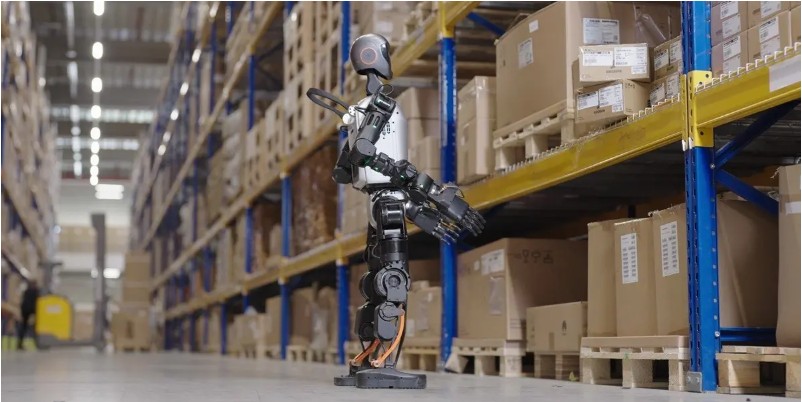
At Hannover Messe 2026, SAP, Accenture, and Vodafone Procure & Connect used a warehouse pilot in Duisburg, Germany, to make a bigger point about the future of ERP: enterprise systems are starting to move beyond tracking warehouse activity and into coordinating work on the warehouse floor itself. In the pilot, humanoid robots received inspection tasks through SAP Extended Warehouse Management (SAP EWM) and sent findings back into SAP in real time, turning SAP EWM from a system of record into a system of operational control.
SAP is testing how embodied AI, business logic, and warehouse execution can be tied together in one loop, with SAP data grounding what the robots do, when they do it, and how results feed back into auditable processes such as inventory validation and safety reporting.
Analysis
What This Means for ERP Insiders
This pilot shows SAP EWM doing more than monitoring completed warehouse tasks; it is beginning to coordinate work performed by intelligent machines. For large enterprises, that signals a shift in ERP’s role from system of record to system of operational orchestration.
Pilot Demonstrates SAP-Driven Robotics Execution in Warehouse Operations
The pilot centers on integrating humanoid robots with SAP Extended Warehouse Management (SAP EWM) to enable task orchestration directly from ERP-linked systems.
Robots receive inspection tasks through SAP EWM and autonomously execute them across the warehouse floor, performing visual inspections and reporting findings back into SAP systems in real-time.
During the pilot, robots were able to:
- Identify misplaced or damaged products
- Assess pallet stacking and weight distribution
- Detect unused storage capacity
- Flag safety risks such as obstacles or misaligned pallets
These insights are fed directly into SAP environments, enabling immediate operational visibility and decision-making.
Christian Souche, advanced robotics lead at Accenture, said, “Trained in digital twins and powered by physical AI, humanoid robots can reduce worker injuries and other warehouse safety incidents and lower overtime costs and the dependency on temporary labor. Equally important, Vodafone Procure & Connect will gather valuable data and insights on robot deployment and performance as a basis for a future humanoid workforce solutions business.”
From Visibility to Physical Execution
The pilot reflects a broader shift in enterprise systems, moving from monitoring and analytics toward autonomous physical execution.
Dr. Lukasz Ostrowski, head of embodied AI and robotics at SAP, said, “At Vodafone Procure & Connect, we are leveraging Joule, SAP’s AI execution fabric and interface for embodied AI, connecting robots to end-to-end processes and business logic and enabling them to know why, when and how to act. By grounding actions in trusted SAP data, we can automate health and safety incident reporting and real-time inventory validation to protect workers and strengthen compliance through consistent auditable workflows.”
Unlike traditional warehouse automation, which relies on fixed robotics or conveyor systems, humanoid robots operate alongside existing infrastructure and workflows. This allows organizations to extend automation without redesigning warehouse layouts.
Accenture said the approach demonstrates how physical AI can enhance productivity while improving worker safety and enabling new workforce models that blend human and robotic labor.
Analysis
What This Means for ERP Insiders
Accenture linked the pilot to safety, overtime reduction, and lower dependence on temporary labor, which makes the initiative as much about operating model change as technology experimentation. For enterprise buyers, the long-term question is how robotics reshapes labor planning, supervision, and warehouse process design.
Ecosystem-Led Approach to Physical AI
The initiative brings together multiple roles across the ecosystem:
- Accenture provides integration, AI orchestration, and industry expertise
- SAP enables process integration through ERP and warehouse management systems
- Vodafone Procure & Connect serves as the operational testbed and supply chain operator
This aligns with a growing ecosystem-driven model where robotics hardware, AI models, and enterprise software are combined to deliver end-to-end execution capabilities.
Why It Matters for Supply Chain and ERP
The pilot highlights a key inflection point for ERP systems: extending beyond digital workflows into physical operations.
Prasad Satyavolu, global lead for manufacturing, operations and physical AI at Accenture, said, “Our work in collaboration with SAP is a great example of how holistic deployment of humanoid robots, from simulation and training to warehouse deployment and integration with SAP data, creates a closed loop with transactional systems.”
By embedding robotics into SAP-managed processes, organizations can begin to close the gap between planning and execution, enabling:
- Real-time feedback loops between physical operations and ERP systems
- Continuous optimization of warehouse performance
- Reduced reliance on manual inspections and exception handling
This comes as logistics and supply chain operators face increasing pressure from labor shortages, rising complexity, and demand volatility, where AI-driven automation is becoming a strategic priority.
Analysis
What This Means for ERP Insiders
The real value is not the humanoid robot itself, but the closed loop between task creation, inspection, exception detection, and feedback into SAP. That is the kind of architecture large organizations need if they want automation that is auditable, manageable, and repeatable across sites.