Governance, Risk, and Compliance

Enterprise Resource Planning (ERP) serves as a cornerstone in ensuring effective Governance, Risk, and Compliance (GRC) within organizations. By integrating GRC modules, ERP systems provide a centralized platform to manage and monitor governance practices, identify and mitigate risks, and ensure compliance with regulatory requirements. This  approach enhances transparency and accountability across various business processes. ERP’s real-time reporting and analytics capabilities enable organizations to proactively identify potential risks and address compliance issues promptly. The integration of GRC within ERP streamlines workflows, promoting a culture of risk-aware decision-making. This synergy empowers organizations to navigate complex regulatory landscapes, mitigate risks efficiently, and uphold the highest standards of governance, ensuring a resilient and compliant operational environment.

AWS Security Hub’s Azure Move Shows ERP Security Is Now Multi-Cloud and AI-Native
AWS has expanded Security Hub to provide targeted protection for AI workloads and security monitoring for Microsoft Azure, enabling the discovery and evaluation of Azure resources alongside AWS findings, thereby enhancing visibility and governance across multi-cloud and hybrid ERP environments.
Security Patch Day
July Patch Day Gave an AI Wake-Up Call from Microsoft, ServiceNow, and SAP
July's record-breaking patch cycle from Microsoft, ServiceNow, and SAP highlights a new reality for enterprise security teams. AI is accelerating vulnerability discovery, shrinking remediation windows, and expanding the attack surface across ERP systems, cloud platforms, identity infrastructure, and business-critical workflows.
AWS agentic AI SAP ERP exceptions - MCP agentic ERP infrastructure with AgentCore
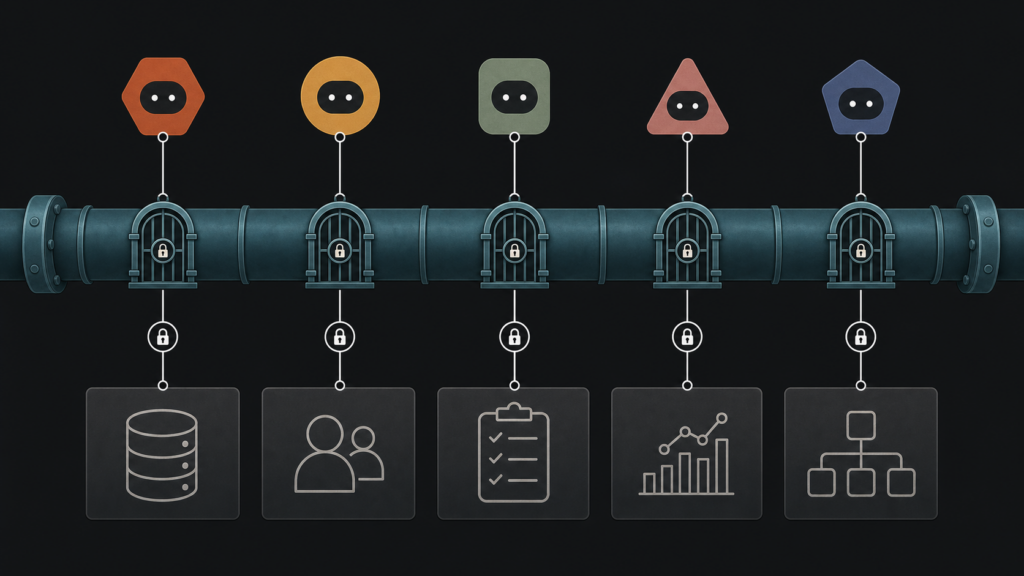
MCP Is Becoming the Plumbing of Agentic ERP—ERP Leaders Need to Understand It
MCP is emerging as the protocol layer that lets AI agents discover and call enterprise tools, data sources, and workflows. For ERP leaders, the opportunity is lower integration friction. The risk is that access control, auditability, and cost discipline move closer to the agent boundary.
Secure enterprise corridor representing Microsoft Power Platform governance and AI agent access
Microsoft Power Platform Narrows the Access Gap for ERP Agents
Microsoft's June 2026 Power Platform updates introduce Advanced Connector Policies that govern AI agent access to SAP systems at the action and MCP server level. ERP leaders must understand what the new controls mean for low-code automation, connector visibility, and enterprise AI compliance.
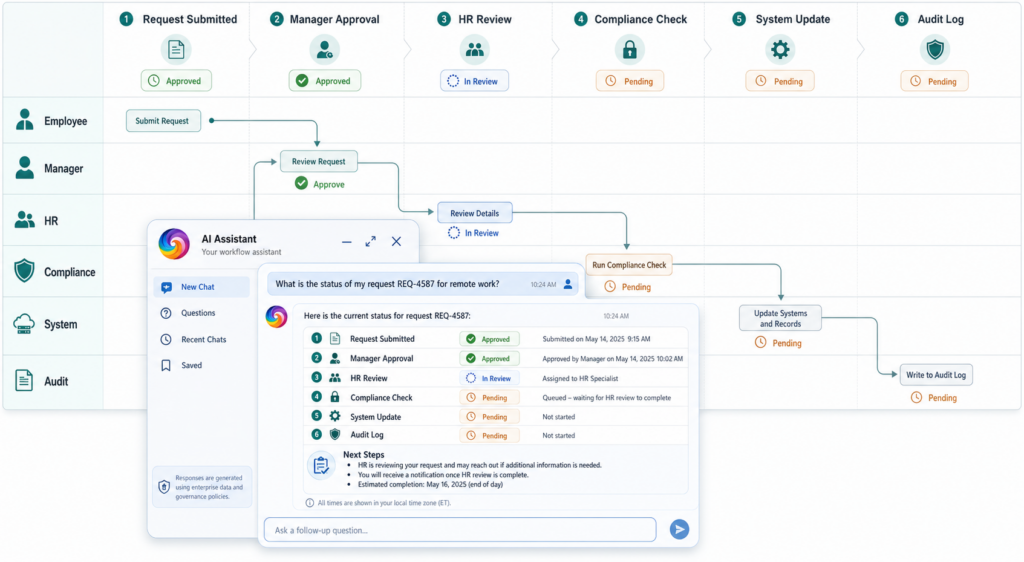
Workday Is Testing How Much Enterprise AI Should Be Allowed to Do
Workday’s Q1 results showed agent adoption momentum. The follow-up question is whether Sana, Microsoft 365 Copilot, the Agent System of Record, and federal HR automation can prove that enterprise agents can act inside governed workflows without eroding control.
IBM and Microsoft Move Identity Security from Alerts to Action
IBM Consulting has expanded its collaboration with Microsoft Security to enhance identity threat detection and remediation services, enabling enterprises to effectively manage and respond to identity-based attacks through unified security signals and governed workflows.
AI is reshaping enterprise partnerships across ERP, supply chain, governance, and ecosystem collaboration
AI Is Changing the Rules of Enterprise Partnerships: Q&A with Blue Yonder’s VP Kelley Lear
In this ERP Today Q&A, Blue Yonder’s Kelley Lear explains how AI is changing the rules of enterprise partnerships. The discussion covers agentic AI, hyperscaler and ERP alliances, supply chain disruption, data readiness, governance, and what separates outcome-focused partnerships from those that stall.
Zurich Switzerland street scene representing Microsoft Azure cloud infrastructure region supporting sovereign data and AI deployments.
SAP Business Data Cloud Expands to Azure Switzerland with EU Access Controls
SAP is preparing to launch its Business Data Cloud platform on Microsoft Azure infrastructure in Switzerland in the coming weeks, introducing a deployment designed to meet European data residency and governance requirements. The rollout includes “EU Access” availability, meaning data...
Microsoft logo displayed on a dark sign mounted on a concrete wall
Microsoft Data Security Index 2026: AI Adoption Is Outpacing Data Security Controls
Microsoft’s 2026 Data Security Index shows generative AI adoption accelerating faster than data security controls, exposing governance and visibility gaps across enterprise environments.
Brazil Probes Microsoft Cloud Licensing as UK Antitrust Findings Ripple into Latin America
Brazil's competition authority, CADE, has launched an antitrust investigation into Microsoft's cloud and software licensing practices, drawing from UK findings that suggest these practices may harm competition for local customers.
Cognizant AI
Cognizant and Microsoft Target the Last-Mile Problem in Enterprise AI
Cognizant and Microsoft have expanded their AI partnership to co-develop industry-specific solutions and integrate Microsoft's AI stack into Cognizant’s services, primarily benefiting sectors like financial services and healthcare, as they aim to enhance AI deployment and operational impacts through deeper collaboration and streamlined workflows.
SAP, Oracle Lead the Charge as AI-Driven Performance Management Market Targets USD 6.33B by 2030
The employee performance management market is expected to grow from $3.52 billion in 2025 to $6.33 billion by 2030, driven by a shift towards continuous, analytics-enabled performance cycles embraced by major firms like Adobe and Microsoft, with AI-centric platforms at the core, as organizations increasingly link performance to skills-based talent strategies and digital transformation efforts.
Microsoft Dynamics 365 Business Central
Microsoft’s Canada Investment Puts Digital Sovereignty to Work
On December 9, 2025, Microsoft announced a C$7.5 billion investment to enhance AI and cloud infrastructure in Canada, building on a broader C$19 billion program, aiming to support digital sovereignty and local AI development while contributing to sustainability.
India Digital Economy
Why Hyperscalers Are Investing $67.5B in India
Microsoft and Amazon plan to invest a total of $52.5 billion in India's AI and digital infrastructure, reflecting a broader trend of significant investments from tech giants aimed at enhancing the country's digital economy and capacity to support advanced technologies.
abstract illustrated image of cyberattacks, person wearing a hoodie is sat in front of computer screens | cyberattacks
Microsoft disables Windows feature amid flurry of cyberattacks
Microsoft has disabled a Windows feature, App Installer, which allows users to download new applications after discovering that financially motivated actors were utilizing it to spread malware.