On day 2 of the Acumatica Summit keynote in Seattle, the company unveiled its product strategy for transitioning ERP platforms from systems of record to systems of intelligence. The company is emphasizing autonomous decision-making over traditional transactional automation. Outgoing Acumatica chief product officer Ali Jani described the shift as moving from reactive processes that require human intervention to proactive systems that alert users to business context and engineer future outcomes rather than simply recording past transactions. The company released 2026R1 Beta, which features AI agents capable of understanding user context and business objectives.
For technology executives evaluating ERP modernization strategies, the distinction between automation and autonomy matters significantly for operational efficiency. Traditional ERP automation executes predefined scripts handling repetitive tasks like invoice matching or inventory replenishment, but still requires users to initiate processes and interpret outputs.
Autonomous systems analyze business context, identify anomalies requiring attention and recommend actions aligned with organizational objectives without waiting for user queries. This capability addresses persistent challenges in mid-market organizations where limited staff handle multiple functions, making proactive alerts more valuable than retrospective reporting dashboards requiring manual analysis.
Jani emphasized intelligence integrity depends on data quality, saying, “You can’t have a strategy if AI hallucinates. We need to make sure the data going in is clean in the first place. AI can help us make sure data goes in clean, but it has to be grounded on truth and not noise.”
Jani added organizations also must prioritize data governance frameworks ensuring information entering ERP systems meets accuracy and consistency standards before implementing autonomous decision capabilities. This requirement challenges mid-market companies migrating from legacy systems where data cleanup often gets deferred during implementation phases, creating technical debt undermining AI effectiveness.
Five Pillars Position ERP Platforms for Decades-Long Relevance
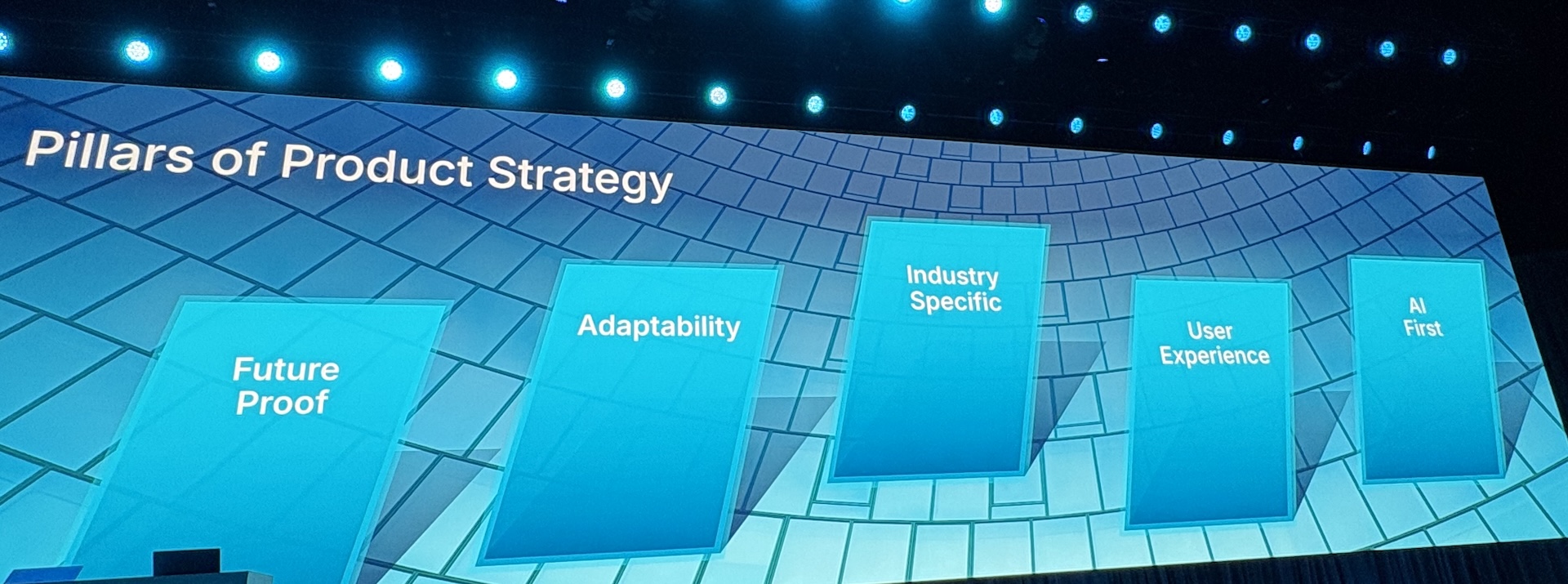
Acumatica’s product roadmap centers on five strategic pillars designed to future-proof ERP investments:
- Making their product future-proof
- Adaptability to changing business models
- Industry-specific functionality embedded in vertical editions
- Personalized user experiences
- AI-first design philosophy.
New CPO Jon Pollock emphasized deep customer empathy as the foundation for product decisions, requiring development teams to observe workflows in operational environments rather than relying solely on feature requests.
“In 2026, the businesses that win won’t have the most employees,” he says. “They’ll be the ones that empower their workers with intelligence.”
The industry-specific pillar reflects broader market momentum toward vertical cloud ERP solutions delivering pre-configured processes for manufacturing, construction, distribution and professional services.
Technology leaders evaluating ERP platforms should prioritize vendors demonstrating domain expertise through reference customers in similar industries, pre-built compliance frameworks addressing regulatory requirements and partner ecosystems specializing in vertical implementations. Generic ERP platforms adapted through consulting engagements typically require longer deployment timelines and carry higher total cost of ownership compared to purpose-built vertical solutions.
Pollock also stressed the company’s success is dependent on relationships with their customers.
“You need to have deep empathy for the customer,” Pollock says. “We have to understand pain points and work with the on getting things done. These relationships happen over years and engagement with them. We have to get outside of the four walls and walk a mile in the customer’s shoes.”
To close the keynote, Pollock announced Acumatica to return to Seattle for Summit 2027 from Jan. 24-27.
What This Means for ERP Insiders
Systems of intelligence architectures force separation between execution and decision layers. Acumatica’s transition from recording transactions to proactive decision support reveals that ERP vendors must architect platforms where AI-driven intelligence layers operate independently from core transactional systems while maintaining data consistency. Enterprise architects evaluating cloud ERP platforms should prioritize vendors demonstrating clear separation between execution engines handling financial truth and intelligence layers providing.
Data governance becomes prerequisite for autonomous ERP adoption. Jani’s emphasis that AI quality depends on data cleanliness signals industry recognition that intelligent systems amplify existing data problems rather than compensating for poor governance. ERP vendors and system integrators must shift data migration methodologies from lift-and-shift approaches tolerating legacy system flaws to structured cleansing programs establishing master data quality before autonomous features activate.
Vertical ERP specialization is accelerating. Acumatica’s five-pillar strategy emphasizing industry functionality and decades-long adaptability reflects vendor recognition that autonomous decision-making requires deep domain knowledge embedded in platform logic, not generic AI tools customized through consulting. Organizations are increasingly prioritize faster time-to-value from industry-native platforms over flexibility of general-purpose systems requiring extensive adaptation.