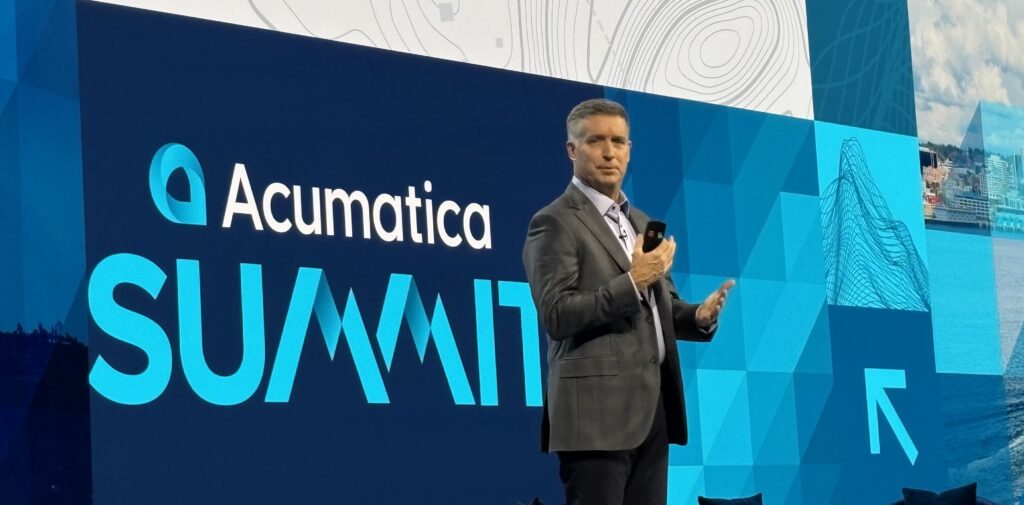
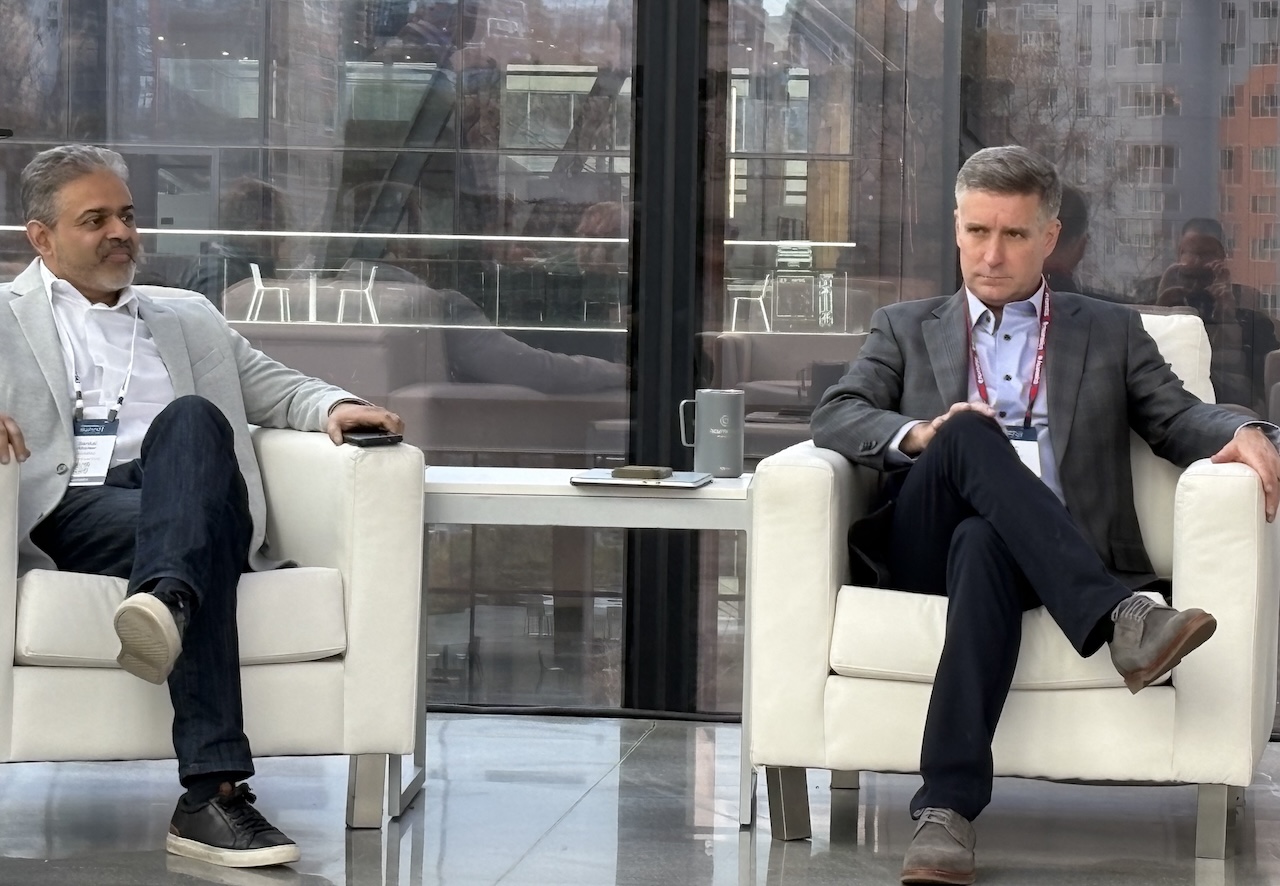
Acumatica CEO John Case and President Sanket Akerkar addressed the evolving mid-market ERP landscape at Summit 2026 on January 26, emphasizing partner enablement and customer-driven AI adoption over vendor-controlled roadmaps. The company reported record growth, with more than 10,000 customers running on its SaaS platform and expanding OEM partnerships, reflecting broader momentum in cloud ERP migration accelerated by economic uncertainty and demand for consumption-based pricing flexibility.
The executive roundtable discussion highlighted a fundamental shift in how mid-market organizations approach ERP investments, with technology decisions increasingly driven by customer initiative rather than vendor evangelism.
Case noted that while AI dominates vendor messaging across the industry, successful implementations depend on customers recognizing specific workflow problems AI can solve rather than adopting technology for its own sake.
“We help them move forward,” Case says. “Partners think about data cleanliness anyway. AI was a bigger opportunity. Every company has AI on the brain now.”
Akerkar emphasizes Acumatica’s focus on industry-specific AI features embedded within vertical editions rather than generic tools requiring extensive customization. The strategy addresses a critical evaluation criterion for technology executives: whether ERP platforms deliver pre-configured intelligence matching industry workflows or require organizations to build custom models using general-purpose AI frameworks.
“Businesses have gone up and down over the last year,” Akerkar says. “They’re often consumption-based, and we can model to their needs and provide what they need.”
For mid-market companies lacking dedicated data science teams, this distinction determines whether AI investments accelerate decision-making or create new implementation complexity.
Partner Channel Drives Customer Upscaling as Consumption Model Matures
Acumatica‘s partner-led go-to-market strategy positions channel organizations as the primary mechanism for customer education and upscaling, rather than direct vendor intervention.
Case describes partners as the “leveraging model” for demonstrating how customers using basic ERP functionality can expand into advanced capabilities like AI-driven automation and predictive analytics. This approach shifts responsibility for customer success from vendor product teams to implementation partners with direct customer relationships and industry expertise.
He adds, “We have a huge roadmap of industry-specific features coming, but there isn’t one industry that will specifically benefit. Each industry has a particular use and benefit that stands out.”
The company’s consumption-based pricing model, focused on commercial transaction volume rather than user seat counts, creates natural expansion opportunities as customer operations grow.
However, Akerkar acknowledges that most customers represent a “tiny fraction” of the installed base actively exploring advanced platform capabilities, indicating significant untapped revenue potential through existing customer upscaling. Technology executives evaluating ERP platforms should assess vendor commitment to partner enablement programs, including training curricula, customer success frameworks, and marketing resources that empower channel organizations to drive adoption beyond initial implementations.
The executive discussion revealed ongoing challenges in AI adoption, with customers often uncertain about total cost of ownership comparisons between cloud and on-premises deployments despite Acumatica’s heavy SaaS orientation. Akerkar notes that customers transitioning require education on how cloud ERP economics differ from traditional licensing models.
Acumatica plans to enhance product discoverability using telemetry data tracking how customers navigate the platform, delivering targeted education in “bite-size pieces” rather than comprehensive training programs overwhelming users. This signals broader industry movement toward embedded learning experiences within ERP interfaces rather than separate training environments disconnected from daily workflows.
What This Means for ERP Insiders
Partner enablement is the primary factor for mid-market cloud ERP users. Acumatica’s reliance on channel organizations for customer education, upscaling and AI adoption guidance reveals that vendors lacking robust partner programs cannot effectively monetize installed bases regardless of platform capabilities. ERP vendors must shift investment from feature development to partner training curricula, vertical specialization toolkits, and customer success frameworks enabling channel organizations to drive expansion revenue, fundamentally restructuring go-to-market economics around partner-led growth.
Consumption pricing models create structural misalignment. Acumatica’s acknowledgment that most customers use minimal platform capabilities despite paying for transaction volume-based tiers exposes inherent tension in consumption economics where vendors benefit from customer growth while customers seek cost optimization. Enterprise architects evaluating cloud ERP platforms should prioritize vendors demonstrating transparent consumption forecasting tools, flexible tier structures, and partner-led optimization programs.
Embedded AI discoverability challenges force ERP vendors to rethink user experience. Acumatica’s plans to use telemetry data for contextual education delivery signals industry recognition that comprehensive training programs fail to drive feature adoption in daily workflows. ERP product strategists must invest in intelligent user interfaces surfacing relevant capabilities based on behavioral patterns rather than requiring users to discover features through documentation or partner consulting.