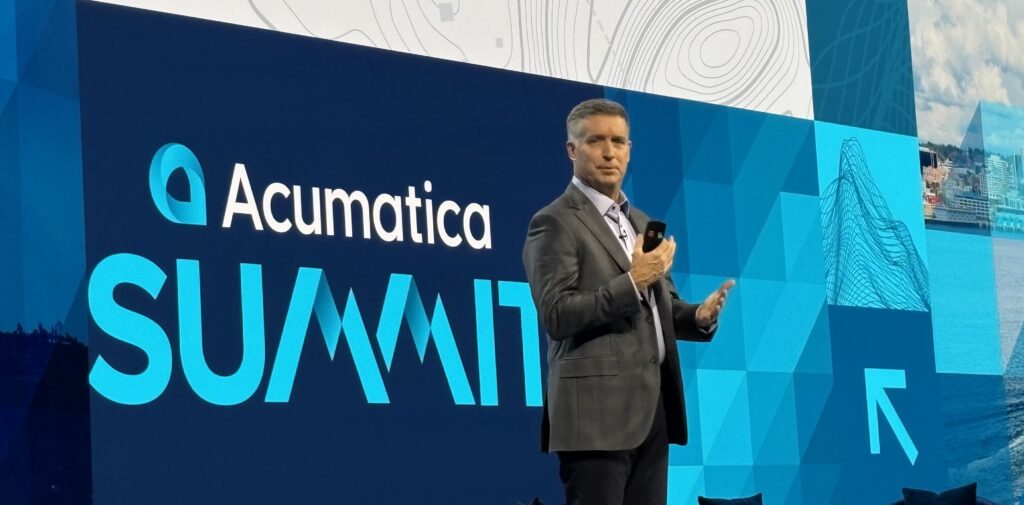

Acumatica CEO John Case opened Summit 2026 in Seattle by highlighting customer implementations where AI-enabled ERP delivered measurable operational results, rather than showcasing technology roadmaps disconnected from daily workflows.
The shift reflects broader pressure on mid-market ERP vendors to prove technology investments translate into faster decision-making, cost reduction, and revenue growth. The goal is to help companies rebuild processes around software constraints.
For example, Storm Smart, a Florida-based hurricane protection manufacturer, demonstrated how connected ERP systems address the gap between planning and execution that erodes margins in distributed operations. The company scaled from two to seven branches and doubled revenue over five years after replacing a legacy homegrown system with Acumatica, gaining visibility across manufacturing, field operations, and customer service functions that previously operated in silos.
Storm Smart CFO Brian Cassell notes the integrated platform eliminated manual reconciliation that was draining organizational capacity. Director of IT Jennifer Pellechio emphasizes that achieving 75% user adoption within weeks of go-live required change champions embedded across 430 employees, not just executive mandates.
Cassell adds it was important the buy-in came from the users and not the C-suite. “We want employees to have the buy-in,” he says. “We want them to understand it isn’t a replacement of their job. It’s about making it more efficient and productive.”
Both leaders stress disciplined data migration practices, avoiding the temptation to replicate legacy system flaws in new environments, and maintaining documented processes that enable continuous improvement after go-live rather than treating implementation as a finish line.
Embedded AI Accelerates Routine Decisions Without Disrupting Workflows
Acumatica’s product strategy centers on embedding AI capabilities directly into existing ERP workflows rather than requiring users to adopt separate tools or learn new interfaces. This approach addresses mid-market organizations lacking data science teams to build custom models, as pre-configured automation handles routine tasks like invoice matching, inventory optimization, and production scheduling without manual intervention.
Storm Smart used the platform and detected first-run production variances traced to aging machinery and staffing issues, making corrective adjustments preventing cost overruns that would have remained invisible in batch reporting systems. This real-time operational intelligence matters for executives managing compressed decision windows, as delayed visibility into production bottlenecks cascades into missed delivery commitments and customer service failures.
Storm Smart’s implementation team emphasize that successful ERP adoption requires project managers with tenacity to maintain documentation discipline, user champions advocating system benefits to frontline employees, and executive sponsorship framing technology investments as enablers of individual productivity rather than job displacement threats.
Storm Smart automated 800 jobs monthly through Acumatica’s workflow engine. The results included faster process cycle times, improved data integrity, and a focus on exception handling rather than manual data entry.
“Automation is what we all want,” Pellechio says. “We want to move faster and make things easy. We don’t want bad data. The more we can automate, the better data and integrity we can have as a whole.”
What This Means for ERP Insiders
User adoption metrics now matter more than feature completeness. Storm Smart’s emphasis on change champions, documented processes and gradual automation expansion reveals that technology executives evaluate platforms based on implementation risk mitigation rather than capability breadth alone. ERP vendors must invest in vertical-specific adoption frameworks, prebuilt training curricula and partner enablement programs addressing organizational readiness.
Embedded AI forces ERP vendors to choose between horizontal platforms and vertical process intelligence. Acumatica’s strategy of delivering pre-configured automation within industry editions directly challenges legacy ERP providers offering generic AI toolkits requiring extensive customization. As a result, mid-market organizations lacking data science capacity will favor solutions with explainable AI outputs, proven reference architectures and measurable ROI metrics over experimental capabilities.
Change management complexity becomes the primary barrier to cloud ERP ROI realization. Storm Smart’s 75% user adoption rate within weeks of go-live, achieved through embedded champions and documented process discipline, contrasts with implementations treating organizational readiness as secondary to technical configuration. Enterprise architects and system integrators must prioritize structured change programs, executive sponsorship models, and continuous improvement frameworks over technical migration planning.