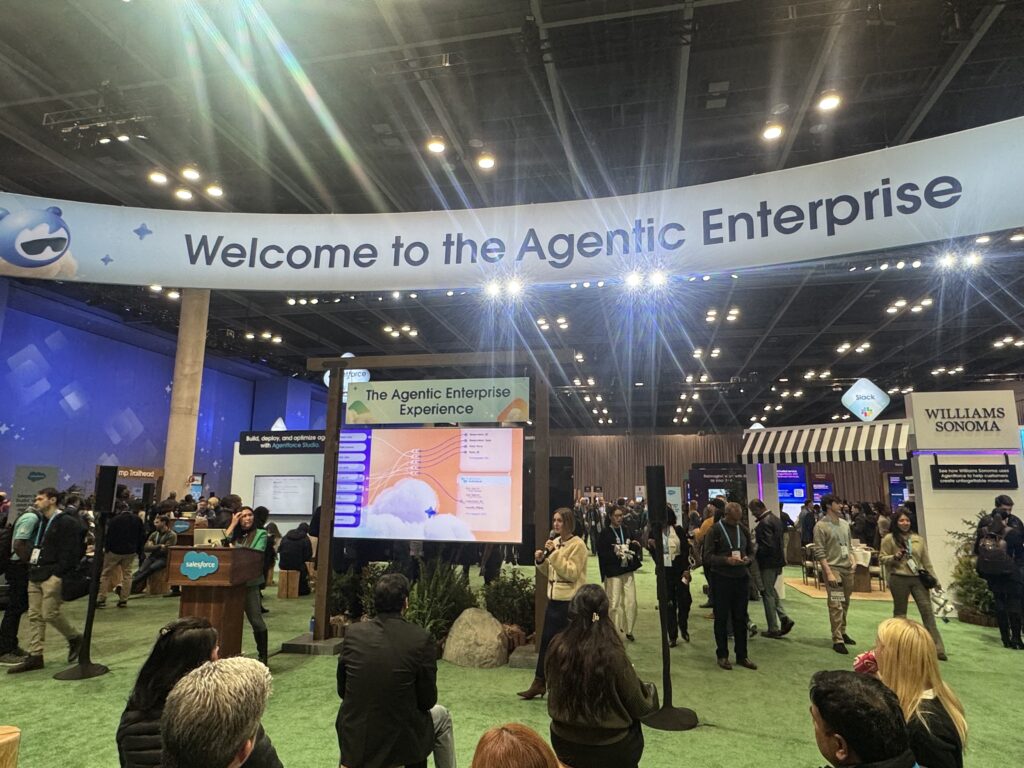
Agentforce 360, a full-stack platform unifying data, tooling, orchestration, and deployment, is Salesforce’s bid to redefine enterprise automation. The Agentforce Tour NYC keynote made clear that the next wave of AI-powered work will depend on seamless data, governed action layers, and predictable agent behavior.
Patrick Stokes, Salesforce EVP of product and industries marketing, positioned Agentforce as a structured system rather than a collection of AI features. He outlined its four defining layers:
- data and context
- workflow and action
- agent design
- multi-channel experiences.
Stokes explained this architecture allows each layer to build on the next, creating a foundation for consistent and scalable agent behavior. That led to the platform’s central premise: “You should never, ever be starting from scratch when building an AI agent,” he said. The reasoning, he added, is that most enterprises already have the components required for agentic operations embedded in their systems.
Agentforce’s core premise follows from that structure. “You should never, ever be starting from scratch when building an AI agent,” Stokes said. Most enterprises already possess the components needed for agentic operations, he explained. When those components are assembled into agents atop existing workflows and contextualized data, the resulting outputs are more reliable and transparent. Accuracy, Stokes said, improves when agents understand “not just the data, but the meaning behind it,” and transparency follows because teams can see “the way [an agent] thinks and reasons” when operating, diagnosing, or scaling tasks.
The Informatica Differentiator
Stokes noted that composable “super agents” inside Agentforce can operate across voice, web, Slack, and even external channels like ChatGPT, but only if grounded in trustworthy enterprise context.
That set the stage for Informatica’s chief product officer, Krish Vitaldevara, who described the goal as having “every system, every workflow, and every agent operate with the same shared systemic understanding.” Vitaldevara called it “trusted context,” which Informatica provides through a metadata catalog functioning as a “unified map” of enterprise systems, capturing lineage, relationships, and quality so agents never guess at meaning.
Once that trusted context is in place, Stokes added, Salesforce’s activation layer can operate confidently. As Vitaldevara put it, “Informatica as a system of record, combined with Salesforce as a system of activation, is what creates that magic.”
Real-World Use Cases
With data and context explained, the keynote shifted to how Agentforce operates in production environments.
Williams Sonoma
Williams Sonoma used the platform to deploy its first AI agent, “Olive,” in 28 days; the agent now resolves “over 60% of the cases” on its website. The transformation centered on Agentforce Service and the rebuilt AI Agent Builder, which now supports Agent Script to turn natural language into deterministic instructions for consistent behavior. Traditional prompts often produce inconsistent results, but Agent Script reportedly ensures a customer experience that is “reliable and predictable every single time.”
Agentforce Voice extended the experience further, enabling Olive to field live phone calls, recognize returning customers “just by calling in,” and handle interruptions mirroring human conversation. The demo emphasized continuity across channels and seamless escalation. When a caller asked for more support, Olive handed the session to a human specialist who had the full context of the conversation preserved “right in the flow of work.”
FedEx
“Customers signing up is not the same as a customer actively shipping,” which is from where true revenue comes, explained the presenter. Plus, disconnected systems made it difficult to reengage dormant accounts. FedEx demonstrated how Data 360, intelligent context, and Agentforce revived dormant accounts by unifying customer and shipping data and turning “dormant customers into active shippers.”
Data 360 also stores Agentforce interactions to “give agents memory.” Intelligent context preserved the structure of a 200-page PDF normally flattened into raw text, enabling the agent to reason over tables and rules instead of redirecting users to the full document. When internal contact details surfaced, a masking policy created in natural language ensured future outputs remained “accurate and appropriate.” The presenter summarized the effect as the ability to “take raw data, convert it into context, then context into intelligence.”
PepsiCo
PepsiCo rounded out the customer examples with a focus on lead nurturing, sales activation, and field service. Half of its sales come from small businesses, and limited hours and high demand often made it difficult for teams to “keep up.” PepsiCo uses Agentforce Sales to ensure “no lead [is] left behind.” AI agents qualify prospects and deliver personalized recommendations based on business size, region, and intent, essentially having a conversation with prospects.
In the field, Agentforce Field Service provides a “crisp summary” of each job and uses unified knowledge to guide technicians through repairs. If issues arise onsite, technicians can access past troubleshooting history and product manuals to guide resolution. Agentforce also analyzes uploaded photos to detect upsell and merchandising opportunities, showing how “sales and service come together out in the field.”
The keynote closed with Agentforce Vibes, a development environment that generates contextual, organization-aware prototypes using metadata, code, semantic models, and existing integrations. Salesforce reported more than 23 million lines of agent-generated code accepted into production in the six weeks since launch, positioning Vibes as a co-development partner that accelerates application and automation delivery.
What This Means for ERP Insiders
AI agent platforms are redefining architectural baselines. Salesforce’s framing of Agentforce as a structured, multi-layer stack reinforces a market shift toward platforms that centralize context, orchestration, and deployment. ERP providers and partners will operate in an environment where deterministic agent behavior, governed data access, and standardized action layers become expected capabilities for automation.
Data governance and metadata management are operational prerequisites for AI agents. The emphasis on Informatica’s catalog and Data 360’s intelligent context illustrates how tightly managed data semantics are the foundation for reliable agent execution. ERP teams building next-generation processes need to assume that agents depend on unified, high-fidelity metadata rather than system-specific interpretations.
Agent-based development is entering mainstream enterprise tooling. Agentforce Vibes signals acceleration toward co-generated application and automation code, supported by models grounded in organizational context. ERP product and ecosystem leaders should expect rising expectations for metadata-aware development workflows, faster prototype cycles, and tighter alignment between integration assets and AI-driven interactions.