
The Asia Pacific region is projected to become the largest data center market outside North America by 2030. Hyperscale operators are expanding capacity to support AI, cloud platforms, and enterprise workloads that require far larger and more energy-intensive facilities than earlier generations of enterprise computing.
Within that expansion, Southeast Asia has emerged as one of the fastest-growing corridors for new data-center development. Power availability, regulatory frameworks, and geopolitical pressures are shaping where large facilities can be built, turning the region into a distributed infrastructure landscape. That geography increasingly influences where cloud platforms expand and where enterprise workloads operate across the region.
The Geography of Southeast Asia’s Data Center Expansion
Southeast Asia’s data center expansion is spreading across a set of interconnected markets that each play a distinct role in the region’s infrastructure landscape. Singapore remains the region’s established connectivity hub, while Malaysia, Indonesia, Thailand, Vietnam, and the Philippines are emerging as scale-out locations for new capacity.
Singapore: The Regional Anchor
Singapore continues to function as Southeast Asia’s premium infrastructure anchor.
The city-state hosts more than seventy operational data centers and maintains one of the region’s most sophisticated connectivity environments, linking major subsea cable systems and regional cloud networks.
After imposing a moratorium on new data-center developments between 2019 and 2022 to address energy and land constraints, Singapore resumed approvals under stricter efficiency and sustainability requirements.
New facilities must now meet higher performance standards around energy efficiency and resource use, reinforcing the country’s role as a high-value hub focused on connectivity, governance-sensitive workloads, and specialized compute environments.
Those constraints are pushing hyperscale operators to expand much of the region’s next generation of data center capacity beyond Singapore.
Malaysia and Indonesia: The Scale-Out Markets
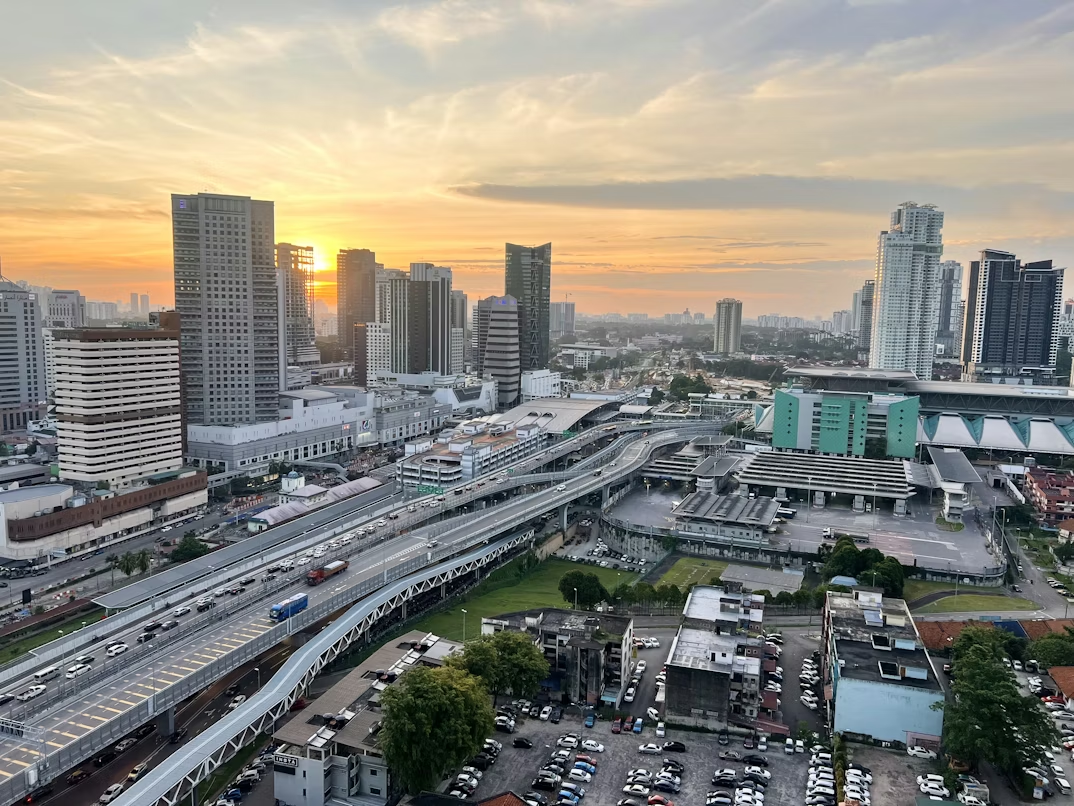
Malaysia has emerged as the primary scale-out location for data center expansion in Southeast Asia. Land availability, relatively lower power costs, and proximity to Singapore’s connectivity infrastructure have made Johor a focal point for hyperscale investment and large campus-style developments.
YTL Power’s Nvidia‑backed AI campus, AirTrunk’s hyperscale facility, and Microsoft’s land acquisitions and planned cloud region in Johor all show how large, power‑intensive infrastructure is shifting just across the Singapore border.
Indonesia represents a different type of scale market, driven primarily by domestic demand. With one of the largest internet populations in the region and a rapidly expanding digital economy, data center investment has concentrated around Greater Jakarta, where connectivity, enterprise demand, and cloud adoption are strongest.
Infrastructure constraints remain a factor in Indonesia’s development trajectory. Grid reliability, permitting timelines, and the country’s coal-heavy power mix have slowed some projects, but hyperscale providers continue to expand capacity in major urban hubs as demand for cloud and AI infrastructure grows.
Thailand, Vietnam, and the Philippines: Emerging Data Center Nodes
Thailand, Vietnam, and the Philippines represent the next tier of Southeast Asia’s data center expansion. Each market is attempting to attract hyperscale investment while addressing structural constraints around power, permitting, and regulatory frameworks.
Thailand has positioned itself as an increasingly attractive destination for large-scale infrastructure. Government incentives, improved access to land and power, and investments in subsea cable connectivity have drawn commitments from hyperscale providers including Google, Microsoft, and Amazon.
The country’s location and relatively stable power grid have strengthened its appeal as a regional compute hub capable of supporting AI-ready facilities.
Vietnam is widely viewed as a high-demand market where regulatory reform will determine the pace of development. Strong digital growth and data sovereignty requirements have created incentives for domestic hosting, but complex permitting processes and regulatory uncertainty have slowed some projects.
Industry analysts expect multinational investment to accelerate if new rules around market access and infrastructure approvals prove workable in practice.
The Philippines presents a more contested hub narrative. The country’s large and digitally engaged population has driven rapid growth in cloud demand, yet high electricity prices, climate risks, and a coal- and gas-heavy energy mix continue to shape the economics of large-scale data center investment.
Operators argue that improvements in renewable deployment, grid resilience, and permitting coordination will determine whether the country can compete with neighboring markets for hyperscale infrastructure.
Regulation, Data Sovereignty, and Geopolitics Are Shaping Data Center Investment
Infrastructure capacity is only one factor shaping Southeast Asia’s data center landscape.
Regulatory frameworks, data sovereignty rules, and geopolitical pressures are also influencing where facilities can be built and what types of workloads they can host.
Governments have taken different approaches to regulating data infrastructure. Some countries have introduced strict localization requirements that require certain categories of data to be stored within borders, while others have focused on attracting international cloud providers through investment incentives and more flexible regulatory regimes.
Vietnam represents one of the more sovereignty-driven regulatory environments.
The country’s cybersecurity and data governance laws require certain types of data generated within Vietnam to be stored locally, and foreign technology companies may need to establish local infrastructure to serve the domestic market. These requirements have created incentives for new facilities while also complicating entry for foreign operators.
Singapore and Malaysia have taken a more infrastructure-oriented approach.
Rather than mandating blanket localization rules, regulators have focused on managing the environmental and resource impacts of large-scale data-center development. Singapore’s post-moratorium approval process emphasizes energy efficiency and sustainability standards, while Malaysian authorities have introduced measures such as dedicated tariffs and resource-use requirements for large data center projects.
Geopolitical dynamics are also beginning to influence infrastructure decisions.
Southeast Asia hosts one of the largest concentrations of Chinese-owned data center investments outside mainland China, particularly in Malaysia. At the same time, tightening export controls on advanced semiconductors and growing scrutiny around technology supply chains are adding complexity to where AI-capable infrastructure can be deployed.
These overlapping regulatory and geopolitical pressures mean questions about data governance, ownership, and technology supply chains are shaping where hyperscale infrastructure can operate and which markets are positioned to host AI-ready facilities.
What Southeast Asia’s Data Center Geography Means for ERP and Cloud Workloads
The geography of Southeast Asia’s data center expansion will increasingly shape how enterprise platforms operate across the region. As hyperscale providers distribute infrastructure across multiple markets, organizations running cloud-based applications and ERP environments will encounter a more fragmented infrastructure landscape.
Some workloads will remain anchored in highly connected markets such as Singapore, where regulatory stability, mature connectivity, and established cloud regions support governance-sensitive systems. ERP platforms, financial data environments, and other compliance-heavy applications often benefit from these characteristics.
At the same time, many of the most power-intensive AI capabilities that enterprises are beginning to integrate into business applications will depend on infrastructure located outside traditional hubs. Large-scale AI training clusters and GPU-accelerated analytics environments are increasingly deployed in markets that can support hyperscale campuses with sufficient land, power availability, and regulatory flexibility.
This emerging division creates a more distributed architecture for enterprise computing across Southeast Asia. Core systems of record may remain anchored in mature infrastructure hubs, while compute-heavy AI services and analytics platforms operate from neighboring markets designed to support large-scale capacity.
Enterprise technology buyers will increasingly see these infrastructure dynamics reflected in cloud availability, pricing, latency, and sustainability reporting.
As power constraints, energy sourcing requirements, and regulatory frameworks shape data-center development across Southeast Asia, the underlying geography of cloud infrastructure will become a more visible factor in how enterprise applications and ERP workloads are deployed across the region.
What This Means for ERP Insiders
Infrastructure geography will shape enterprise architecture decisions. Distributed data center growth across Southeast Asia will increasingly influence how enterprises design cloud and ERP deployments. Organizations may need to architect applications across multiple locations to balance compliance, performance, and AI compute availability.
Energy policy is becoming a cloud infrastructure variable. Power availability and renewable sourcing will increasingly determine where hyperscale capacity expands across Southeast Asia. Enterprise cloud pricing and AI service availability may therefore fluctuate across regions depending on local energy constraints and sustainability requirements.
AI infrastructure will create an uneven compute geography. AI clusters require power and land at scales that traditional connectivity hubs cannot easily support. Market forces may push large AI compute facilities toward power-rich markets while governance-sensitive enterprise systems remain anchored in established connectivity hubs.