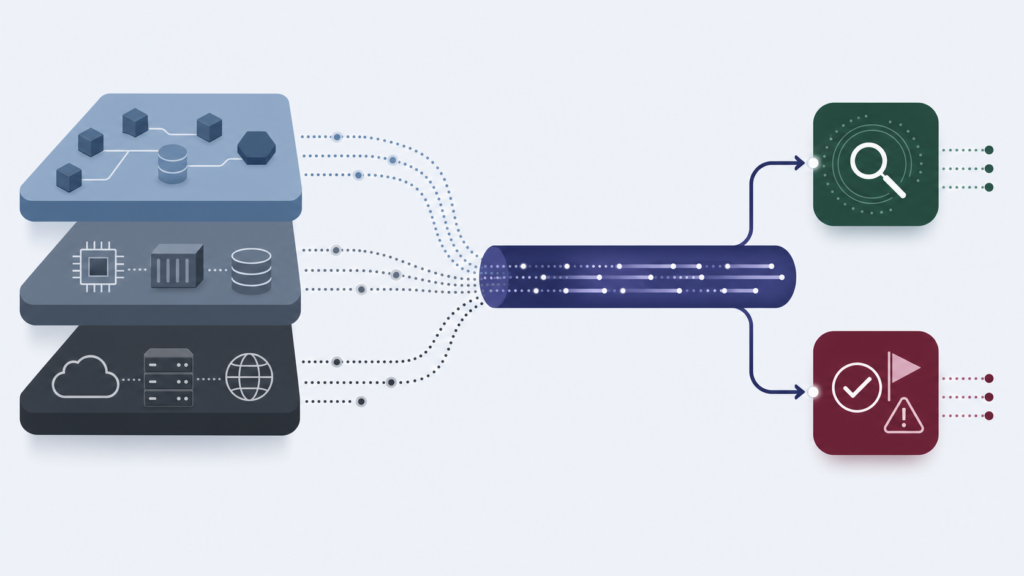

BlackLine announced on June 25 the expansion of the Agentic Financial Operations Platform with new governance and observability capabilities designed to help finance teams manage AI agents without losing control of the financial record. It includes a preview program for Finance Control Console, a centralized command center for AI-powered financial operations. The console is designed to give finance leaders visibility, policy enforcement, risk monitoring, and audit-ready records across BlackLine-native, partner, customer-developed, and third-party AI agents.
The announcement builds on BlackLine’s April launch of Agentic Financial Operations, which positioned the company around a finance operating model where AI agents can execute work across record-to-report, invoice-to-cash, and other CFO-owned processes.
AI Governance Moves into the Office of the CFO
A handful of AI agents can be supervised manually. A larger ecosystem of agents acting across close, reconciliation, invoice, cash, and reporting workflows creates a different risk profile. Finance leaders need to know what each agent did, why it acted, which policy applied, who reviewed exceptions, and how the action affected the financial record.
BlackLine is positioning Finance Control Console as that oversight layer. The console is expected to provide real-time visibility into AI-driven financial operations, centralized governance and policy management, end-to-end audit trails, explainable decision records, human-in-the-loop risk monitoring, and exception management.
That matters because the Office of the CFO cannot treat AI governance as a general IT control. Finance processes carry reporting, compliance, audit, and accountability requirements that require deterministic guardrails even when AI is used to accelerate work.
Agentic Finance Needs More Than Automation
BlackLine’s Agentic Financial Operations Platform is powered by Studio360 and Verity AI. The company describes the platform as having two foundational layers: a system-agnostic data layer that connects financial data, workflows, policies, controls, and operational context across enterprise systems, and a financial operating system that orchestrates workflows, AI agents, and services within finance-defined controls.
That structure is important. Finance AI needs access to data and workflow context, but it also needs limits. An agent that supports reconciliation, cash application, variance analysis, or close management must operate inside approved policies and leave a record that auditors and controllers can understand.
Owen Ryan, CEO of BlackLine, said the next era of finance will be powered by AI but governed by finance. That is the core proposition behind the console: Finance teams can adopt more AI only if accountability remains with the CFO organization.
Get Our Free Weekly Newsletter
Trust Becomes the Finance AI Differentiator
BlackLine is previewing the Finance Control Console with enterprise customers and strategic partners, giving them early access to capabilities and a role in shaping governance frameworks and best practices.
That preview approach is a practical signal. Agentic finance is still early, and CFO teams are unlikely to hand sensitive workflows to AI systems without proof that controls, evidence trails, policy enforcement, and exception handling work in practice.
For ERP and finance technology leaders, the BlackLine announcement fits a broader market shift. Vendors are no longer competing only on whether AI can automate financial work. They are competing on whether AI can be monitored, explained, governed, and trusted inside the processes that produce financial results.
That will matter as finance departments move from AI assistants toward agents that act across systems. The more AI touches the books, the more CFOs will need a control model that makes every action visible, reviewable, and defensible.
Sponsor Industry‑Grade Research
What This Means for ERP Insiders
Finance AI needs CFO-grade controls. BlackLine’s Finance Control Console preview shows that finance teams cannot scale AI agents without visibility, policy enforcement, audit trails, and human review. ERP leaders should treat AI governance in finance as a core control requirement, not an optional platform feature.
Agentic finance will test enterprise data architecture. BlackLine’s platform connects financial data, workflows, policies, controls, and operational context across systems so AI can act with more precision. Organizations should expect finance AI programs to expose gaps in data quality, process ownership, and cross-system control design.
Trust will separate finance AI tools from finance AI platforms. BlackLine is trying to position governance and observability as the foundation for AI adoption across the Office of the CFO. Finance leaders should evaluate vendors by how well they preserve accountability over the financial record, not only by how much work their agents can automate.