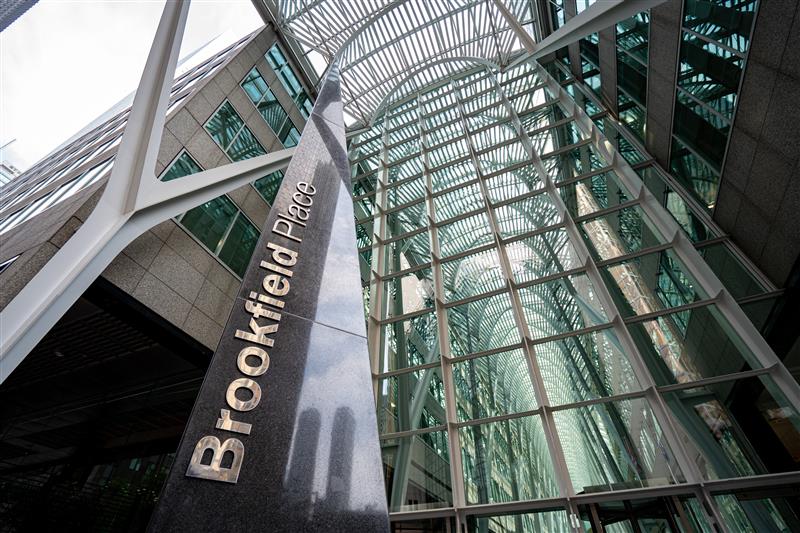
Brookfield Asset Management is entering the cloud computing arena with the launch of Radiant, a new subsidiary. The new company will lease AI chips in data centers directly to developers and enterprises.
Brookfield is positioning itself as a new type of cloud infrastructure provider, leveraging its renewable energy, real estate, and infrastructure assets to deliver predictable, high-capacity computing power and meet increasing AI workload demand.
The move is part of a broader $100 billion global AI infrastructure program. Brookfield will use the fund to provide vertically integrated solutions that combine land, power, and compute in ways hyperscalers cannot easily replicate.
Brookfield Enters Cloud Market with AI-Focused Subsidiary
Radiant will operate with priority access to data centers financed through Brookfield’s $10 billion Artificial Intelligence Infrastructure Fund, the initial anchor commitment for the company’s broader $100 billion AI infrastructure program.
Initial facilities are planned in Qatar, France, and Sweden, providing regional coverage and helping meet data residency requirements. The company will target workloads that require high-capacity, reliable, and energy-efficient compute.
Brookfield’s renewable energy portfolio and $5 billion investment in Bloom Energy fuel cells will allow Radiant to deliver stable, low-carbon power, addressing a gap in AI infrastructure.
Unlike hyperscalers, which operate full cloud stacks, Radiant focuses on leasing AI chip capacity and infrastructure services, emphasizing predictable performance and vertical integration. By controlling these inputs, Brookfield can position Radiant to serve the growing demand for specialized AI workloads.
Radiant Integrates Compute, Power, and Land for AI Workloads
Radiant will offer enterprises a flexible, cost-efficient option for AI workloads.
The subsidiary will be able to leverage Brookfield’s energy, real estate, and infrastructure assets to address emerging bottlenecks in AI compute and energy-intensive operations. It does not appear to compete directly with hyperscalers’ full cloud stacks, instead focusing on delivering accessible infrastructure services for developers and enterprises.
Enterprise vendors may use it as an alternative infrastructure partner for specific AI workloads or adopt a hybrid strategy, running AI processes on Brookfield infrastructure while maintaining core ERP on existing cloud platforms.
This could help vendors achieve cost leadership, as well as market sustainability through Brookfield’s renewable investments, and an expanded geographic reach.
Radiant creates a new infrastructure services category, giving Brookfield influence over AI compute economics and enabling end users to access lower-cost AI capabilities, more predictable cloud pricing, faster feature adoption, and improved sustainability outcomes.
What This Means for ERP Insiders
Radiant will expand AI options for vendors. Brookfield’s Radiant will provide high-performance AI compute for enterprises and developers. ERP users will gain access to specialized infrastructure outside traditional hyperscaler environments, supporting energy-intensive workloads with predictable performance. This will give vendors greater flexibility to run AI initiatives while maintaining core ERP on existing cloud platforms.
Regional coverage supports digital residency compliance. Radiant’s planned facilities in Qatar, France, and Sweden will offer ERP users localized compute options. Multinational organizations will be better positioned to meet digital sovereignty and sector-specific data regulations without moving core ERP systems. Vendors, meanwhile, may run AI workloads on Radiant’s regional infrastructure, reducing latency and supporting compliance.
Vertical integration strengthens the sustainability of AI deployments. Brookfield plans to leverage land, power, and compute to provide low-carbon, high-capacity infrastructure. This model may allow vendors and ERP clients to run AI workloads more efficiently, explore new capabilities, and potentially reduce operational costs.