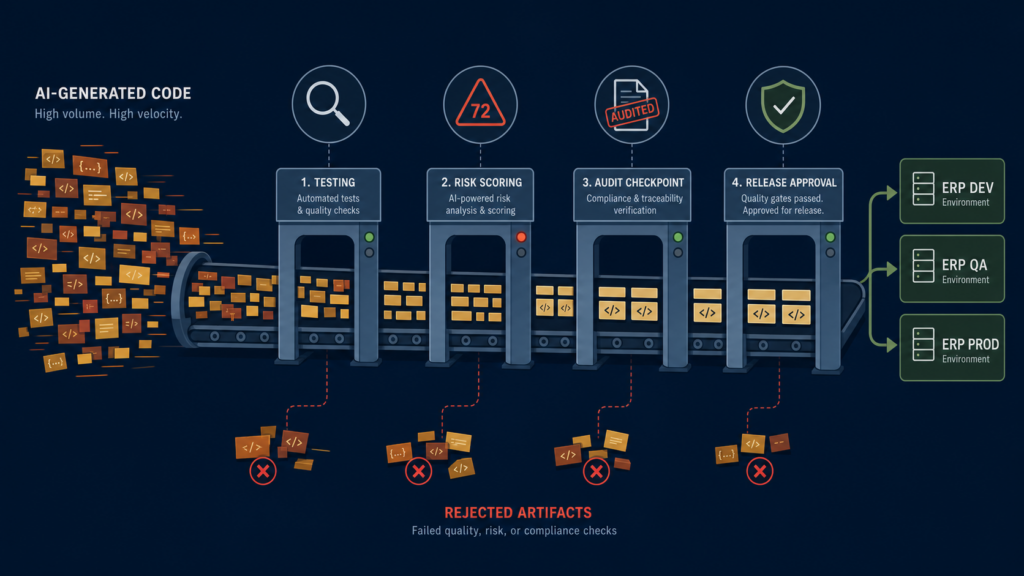

Copado is moving Salesforce DevOps beyond code assistants with Agentia, a platform that embeds context aware AI agents directly into the software delivery lifecycle for Agentforce. For technology executives, this is less about another chatbot and more about introducing governed digital team members that can plan, build, test and release alongside human DevOps engineers.
“The shift from DevOps to AgentOps marks a significant evolution in software delivery that requires we reinvent the platform powering it,” says Copado CPO Rajit Joseph in a press release. “With Agentia, we are moving beyond simple assistants to an orchestrated system of intelligence where specialized agents and humans co-create within a single, governed lifecycle. By leveraging our unique context graph, we are providing the guardrails and deep metadata awareness necessary to safely transition development teams from manual processes to fully autonomous execution.”
Analysis
What This Means for ERP Insiders
Agent-aware DevOps will influence ERP delivery expectations. By embedding governed AI agents in Salesforce delivery, Copado is setting a benchmark that ERP teams will feel as stakeholders begin to expect similar automation, risk prediction and policy controls in SAP, Oracle and other enterprise application pipelines.
Context-Aware Agents Inside the Delivery Pipeline
Most AI tools sit outside delivery workflows and generate code or test ideas without understanding the specifics of an organization’s Salesforce org. Agentia aims to fix that by adding a Context Hub that connects to Salesforce environments and ingests metadata, dependencies, pipelines, historical deployments and customer documentation. The result is a set of agents that understand how an org is wired, what policies apply and how changes move through environments.
This means agents can do real work rather than just answer prompts. Lifecycle aware agents inside Agentia generate and refactor code, create and execute tests, diagnose failures and propose or perform rollbacks while respecting governance rules. A primary orchestration agent coordinates these activities, interacts with users and manages multi step workflows so humans are not stitching together separate AI outputs.
Copado positions Agentia as the foundation for what it calls AgentOps. Instead of ad hoc experiments with generic LLMs, organizations get a platform where agents operate within policy controlled boundaries, and their actions are logged for audit and compliance. That is a critical consideration for regulated industries and global enterprises.
Agentia is available in Advanced and Pro editions through Copado and its partner ecosystem, building on the company’s existing DevOps automation agent released on Salesforce AgentExchange.
Analysis
What This Means for ERP Insiders
Context hubs become essential for safe enterprise AI. Agentia’s focus on a Context Hub that understands org specific metadata, history and policies shows that successful AI delivery will rely on platforms that combine technical and business context, not generic models, reshaping how architects design data and knowledge layers.
Positioning the Platform for Advanced Governance, Management
For CIOs and platform owners, Agentia changes the questions they ask about AI in development. They need to consider how agents will be governed, what context they require and how their actions fit into existing change management processes. Agentia’s Context Hub and policy aware design are intended to give central teams the levers to approve where and how agents operate, while still allowing DevOps squads to customize workflows.
Agentia Studio provides a workspace where teams can design their own agents and workflows that run on top of Salesforce Agentforce and the Copado platform. DevOps leads can combine Copado’s Plan, Build, Test, Release and Operate agents into patterns tailored to their release processes, then reuse those patterns across programs. That makes AI driven delivery a configurable capability instead of a collection of isolated scripts.
Evaluation criteria for buyers now extend beyond traditional DevOps features like pipeline templates and test automation. Enterprises should assess how deeply a platform understands Salesforce metadata and dependencies, how it enforces policies and separation of duties, how agent actions are logged and how easily teams can adapt agents to organization specific standards.
There are also cultural and skills questions. Moving from DevOps to AgentOps means engineers will spend more time supervising and tuning agents than manually running deployments or tests. Organizations will need to define new roles for agent governance, update risk frameworks and train teams to think in terms of orchestration and oversight rather than individual tasks. Copado argues that its experience with AI powered DevOps and backing from investors such as Salesforce Ventures and IBM give it the depth to guide that transition.
Analysis
What This Means for ERP Insiders
Developer roles will shift toward supervising intelligent pipelines. As agents handle planning, coding and continuous testing, Salesforce and ERP engineers will pivot toward monitoring agent performance, refining guardrails and managing exceptions, driving new competency needs and partner opportunities around AgentOps operating models.