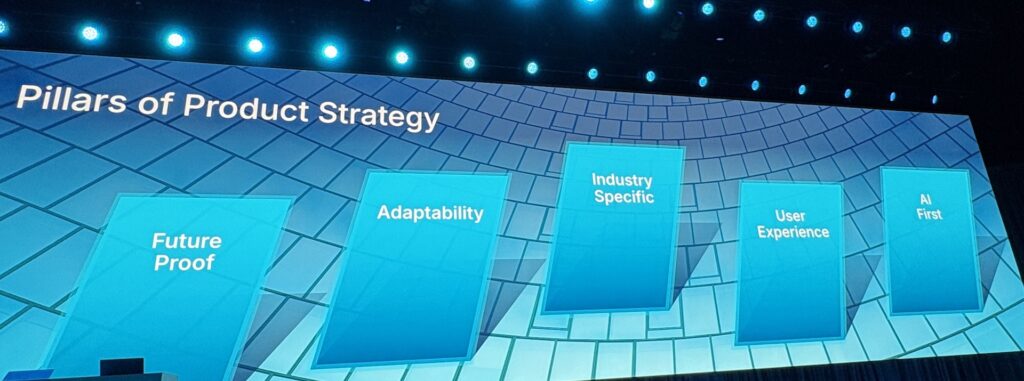

Manufacturing technology executives are facing a crucial decision: Move to autonomous AI agents now or watch competitors seize operational advantages measured in hours, not quarters. The launch of agentic AI platforms by Oracle and Infor represents a fundamental shift from passive copilots to autonomous workers that execute end-to-end workflows without human prompts.
Oracle announced its Agentic Finance initiative, deploying pre-built agents for payables, planning and payments within Oracle Cloud ERP. The Payables Agent autonomously processes multi-channel invoices, reconciles transactions and flags compliance risks, intervening with humans only for exceptions.
Infor followed with its Agentic Orchestrator in October, embedding industry-specific agents across CloudSuite applications for manufacturing, supply chain and finance. These agents coordinate across Infor and non-Infor systems using Amazon Bedrock for model choice and LangChain for orchestration, maintaining transparency and auditability at every step.
How This Changes Jobs in 2026
Plant managers and finance directors will supervise AI agents, which will have a measurable impact. Manufacturing executives will have inventory cost reductions and production efficiency gains from real-time replanning. They also will improve their planning cycles, allowing for same-day adjustments.
As a result, procurement managers will no longer cut purchase orders manually. Instead, they will audit decisions made by an AI agent that noticed a potential delay. From there, they can contact the supplier for an updated ETA, adjust the production schedule and notify stakeholders without a prompt.
Agentic AI for predictive maintenance also delivers measurable returns: Manufacturers deploying these agents reduce unplanned downtime by staging parts automatically and scheduling interventions during low-impact windows.
The manufacturing ERP market reached $23 billion in 2025, representing 32% of total ERP spending and growing at 8% CAGR driven by Industry 4.0 and IoT integration. The batch and process manufacturing ERP segment alone is projected to reach $2.14 billion by 2032. This growth stems from operational efficiency demands and cloud adoption that reduces upfront costs while ensuring regulatory compliance.
Early integration with MES and IoT devices ensures seamless data flow from shop floor to ERP. Real-time MRP calculations leverage machine learning to convert sales orders into production plans automatically, maintaining supply-demand balance.
Overcoming ERP Implementation Barriers
The primary adoption challenge is governance, not technology. Agentic systems require transparency-first design using frameworks that show decision chains and allow human review before irreversible actions. Every agent step must be logged, timestamped and explainable. Successful implementations establish central agent registries defining clear ownership for creation, deployment, monitoring and decommissioning.
Enterprise surveys show over half of generative AI adopters now run agents in production, though only 14% successfully scaled pilots to full production by mid-2025. The barrier is not technical capability but establishing approval workflows, action logging and exception-handling protocols that satisfy audit requirements while preserving the speed advantages that justify agent deployment.
What This Means for ERP Insiders
The co-pilot era is ending. Agentic AI represents architectural disruption, not feature enhancement. System integrators must retool delivery methodologies around agent orchestration frameworks. Oracle and Infor deployments signal that 2026 ERP implementations will architect for autonomous agents executing multi-step workflows, not chatbots summarizing reports.
Manufacturing ERP is becoming a system of autonomous operations. Real-time processing shifts from differentiator to baseline requirement. Enterprise architects must prioritize MES integration and IoT connectivity as agents require machine-level data feeds to execute predictive maintenance and dynamic scheduling autonomously.
Governance, not algorithms, determine scalability. Survey data showing only 14% pilot success rates reveals implementation discipline gaps. The differentiator for transformation leaders is not selecting superior AI models but deploying transparent decision chains, logged actions and human-approval workflows that satisfy audit requirements. Product strategy must embed governance frameworks as core platform capabilities.