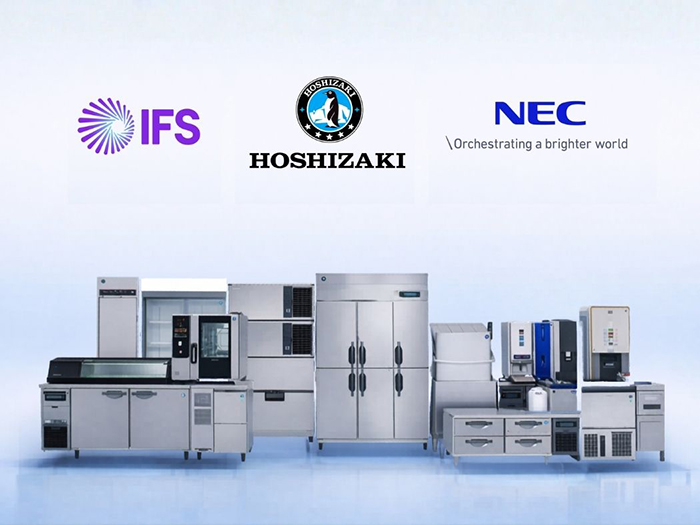
Hoshizaki, a global leader in commercial foodservice equipment, is replacing their customized legacy systems with IFS Cloud as its next generation core platform. For technology leaders, the project shows how fit to standard ERP and industrial AI readiness now sit at the heart of modernization agendas.
Analysis
What This Means for ERP Insiders
Standardized ERP cores will enable industrial AI at scale. Hoshizaki’s move to IFS Cloud in standard configuration shows how reducing customization and consolidating processes builds the clean data foundation that industrial AI needs, pushing vendors and customers toward fit to standard strategies rather than bespoke stacks.
Moving From Customized Legacy ERP to Cloud Backbone
Hoshizaki is deploying IFS Cloud to support more than 700 users across two major production sites and to consolidate order management, production planning, manufacturing execution and inventory control into a single system. Today those processes run on an ERP environment that depends on extensive customization and fragmented ancillary systems, which limits agility and advanced data use.
By shifting to IFS Cloud, the manufacturer aims to reduce excessive customization, optimize investment costs and establish a scalable ERP platform that can support future growth and product diversification. For CIOs and enterprise architects, this is a practical example of a clean core strategy. Hoshizaki intends to use IFS standard configuration wherever possible so it can stay aligned with current releases and avoid another generation of hard to upgrade modifications.
Day to day, that means IT teams will spend less time maintaining custom code and more time enabling new capabilities, integrations and analytics. Business leaders gain access to consistent data and shared workflows across plants, which reduces reconciliation work and makes it easier to roll out common processes to new facilities or product lines.
The implementation is being delivered with NEC, which has supported Hoshizaki’s core systems for years and is co-developing a Japan based IFS Cloud infrastructure that meets domestic economic security requirements. That local cloud, often referenced as IFS Cloud Kaname, gives operations and security teams assurance around data residency while still providing the flexibility of a global SaaS platform.
Analysis
What This Means for ERP Insiders
Local cloud partnerships will influence vendor selection. The joint IFS and NEC initiative to operate IFS Cloud in Japanese data centers illustrates how data residency, economic security and managed services capabilities are becoming decisive factors in ERP decisions, especially for manufacturers in regulated or strategic sectors.
Building a Platform for Industrial AI, Manufacturing Efficiency
Hoshizaki stated goal is to create a standardized platform that can power future enhancements in manufacturing efficiency and more advanced decision making through AI and other digital technologies. IFS Cloud’s integrated industrial AI capabilities and composable architecture are central to that plan.
By unifying transactional data for orders, production, inventory and service, the new platform will give Hoshizaki the real time visibility that AI driven analytics and optimization require. As IFS continues to roll out industrial AI features such as predictive maintenance, quality analytics and planning optimization, Hoshizaki will already have the standardized data infrastructure to take advantage of them without another major replatforming.
For operations leaders, this translates into more accurate production planning, better inventory positioning and faster response when demand shifts or supply disruptions occur. Supervisors will be able to manage exceptions and constraints from a single view rather than juggling reports from multiple systems. Finance teams gain clearer cost and margin insights across product lines, which supports faster investment decisions.
NEC will provide implementation support and managed services. This includes the infrastructure and application operation, which is designed to reduce the burden on Hoshizaki’s internal teams during the transition process.
Analysis
What This Means for ERP Insiders
ERP modernization is becoming a manufacturing strategy lever. By tying its next generation core system to goals for product diversification, efficiency and AI enabled decision making, Hoshizaki underlines that ERP programs are now central to competitive positioning, not just IT refresh cycles, reshaping how boards and partners view these investments.