Oracle announced on July 14 the introduction of a new AI-native builder experience for Oracle AI Agent Studio for Fusion Applications, giving customers and partners a way to build and run agentic applications natively inside Oracle Fusion Cloud Applications.
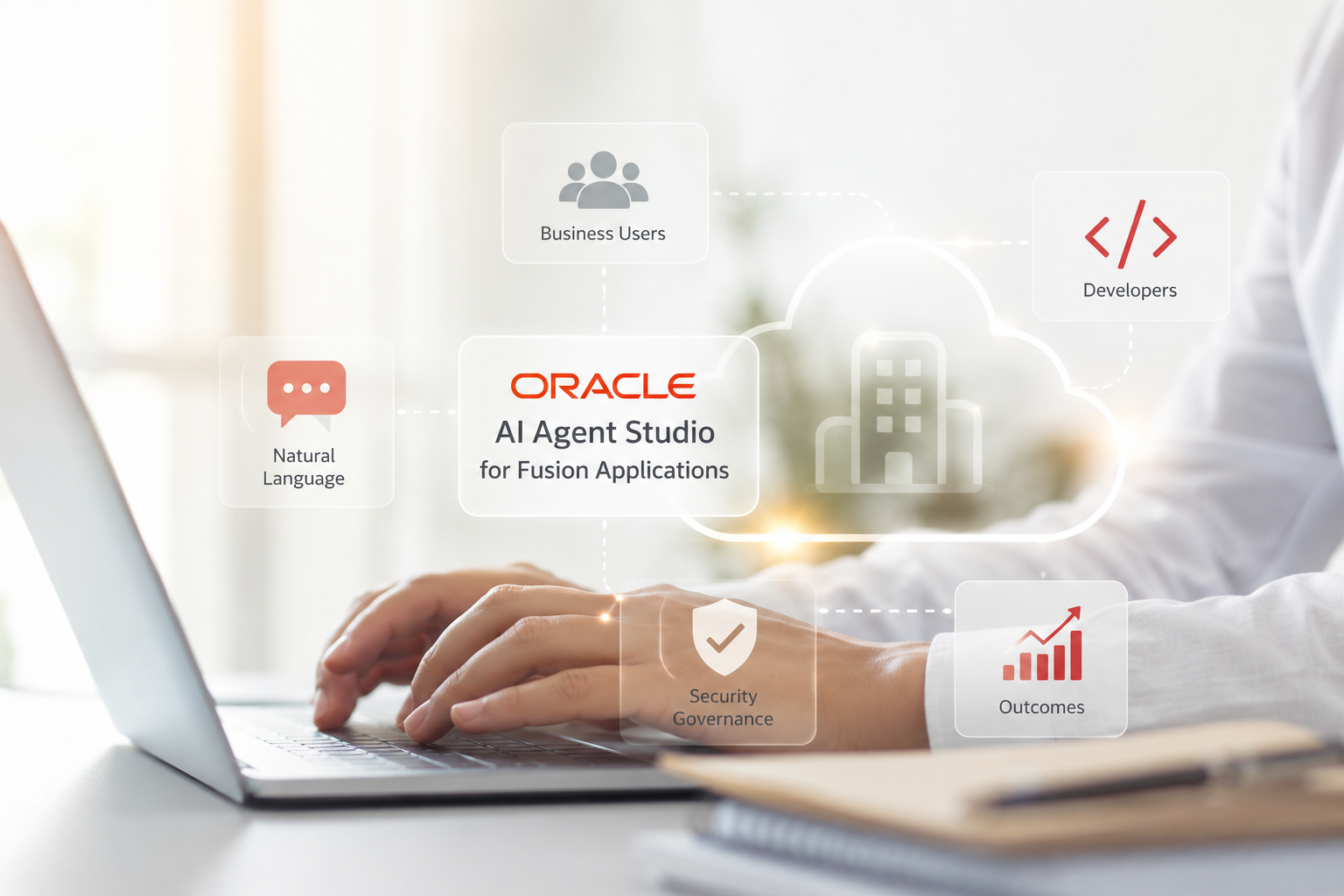
The new builder experience reportedly supports no-code, low-code, and pro-code development for Fusion Agentic Applications. Business users can start with natural language through the Agentic Applications Builder, while developers and partners can use the new AI Studio Skill with tools such as Visual Studio Code, standard command-line interfaces, Git-based workflows, and AI coding assistants including OpenAI Codex and Claude Code.
The central point is that Oracle is not positioning these applications as standalone agents or disconnected AI automations. Fusion Agentic Applications run inside Oracle Fusion Applications, inherit Fusion security and governance controls, act against Fusion business objects and workflows, and log actions for auditability.
Chris Leone, EVP of Applications Development at Oracle, said enterprise software is moving beyond systems that “record work” to systems that “actively drive and execute outcomes.” He added that the new builder experience lets customers and partners build agentic applications where business objects, workflows, security, approvals, and auditability already exist.
From Agents to Agentic Applications
Oracle is drawing a line between individual AI agents and full agentic applications. The company describes Fusion Agentic Applications as outcome-driven systems backed by teams of specialized AI agents that reason, coordinate, decide, and execute work through business objects, workflows, tools, policies, approvals, and logged actions.
That distinction matters because many enterprise AI efforts stall between prototype and production. When AI applications are built outside the enterprise system, organizations still have to solve identity, data access, approvals, audit trails, observability, governance controls, and lifecycle management.
Oracle’s argument is that those controls should exist in the runtime from the start. The new builder experience lets organizations create agentic applications that operate as Fusion runtime artifacts rather than separate automations sitting around the edges of the application suite.
Builder Model Expands Who Can Create AI
The new experience widens the builder audience. Business users can describe what they want in natural language, while professional developers can use familiar engineering workflows, local validation, debugging, CI/CD practices, and Git-based lifecycle management.
Oracle also said a new public GitHub repository will provide templates, starter projects, sample applications, reusable assets, and reference architectures to help developers and partners build and validate Fusion Agentic Applications.
The ecosystem piece is also expanding. Oracle said AI Agent Marketplace, part of Oracle AI Agent Studio for Fusion Applications, will support a catalog of agentic applications in addition to AI agents. The company also said more than 80,000 certified experts have been trained in Oracle AI Agent Studio.
Available at no additional cost, Oracle AI Agent Studio for Fusion Applications includes orchestration, testing, validation, and built-in security. Oracle said customers and partners can use the same platform Oracle uses to create its own AI agents and Fusion Agentic Applications, extend the 1,000-plus AI agents already delivered through Fusion Applications, and build on the 22 Fusion Agentic Applications launched earlier this year.
Get Our Free Weekly Newsletter
Broader Push Toward Execution Inside Fusion
Oracle introduced Fusion Agentic Applications for finance and supply chain in April, describing them as systems that can make and execute decisions inside business processes by securely accessing enterprise data, workflows, policies, approval hierarchies, permissions, and transactional context.
Reuters reported in March that Oracle was reworking its Fusion software suite around agentic applications, with executives arguing that AI agents should gather data, make recommendations, and carry forward execution while humans focus on judgment and business tradeoffs.
The July builder update extends that strategy from Oracle-delivered applications to customer- and partner-built applications. The question for Fusion customers now becomes less whether Oracle will embed agents into the suite, and more how far customers want to customize, extend, and govern agentic execution inside their own business processes.
Sponsor Industry‑Grade Research
What This Means for ERP Insiders
Enterprise AI development is closer to the system of record. Customers want AI that can act on real business objects, policies, approvals, and workflows without creating another disconnected automation layer. For CIOs, application leaders, and ERP architects, the next design choice is whether to build agents outside core systems or inside the controls that already govern enterprise work.
No-code and pro-code AI will force new governance models. Business users, developers, partners, and AI coding assistants can now participate in building agentic applications, which increases speed but also raises questions about testing, permissions, lifecycle management, and accountability. For Oracle customers and systems integrators, the practical priority is to define who can build, approve, deploy, monitor, and retire agentic applications before adoption scales.
Agentic applications will compete on execution trust, not just automation speed. Enterprises will not judge these systems only by how quickly they complete tasks, but by whether they produce traceable decisions, respect approvals, surface exceptions, and operate within security boundaries. For ERP vendors, the broader market test is whether agentic AI can become a governed application layer rather than a collection of impressive but isolated assistants.