Sage is betting AI can eliminate some of the most painful parts of ERP and financial system projects with the acquisition of Doyen AI, an implementation specialist that embeds AI into migration and go live workflows. For SMB technology and finance leaders, the deal points to a near future where AI helps design, configure and validate new Sage environments so teams reach steady state faster and with less disruption.
Analysis
What This Means for ERP Insiders
AI will become standard in ERP implementations. Sage’s acquisition of Doyen AI signals that AI support for migration, mapping and configuration will soon be an expected feature of ERP projects, not an experiment.
AI Moving Into the First Mile of Implementation
Doyen AI has focused on using AI to automate key stages of cloud ERP and finance deployments, including data assessment, mapping, configuration recommendations and test preparation. By bringing that capability in house, Sage plans to apply Doyen’s tooling to Sage Intacct, Sage X3 and other products so that AI is present from the first day of an implementation, not just in the live system.
In practical terms, this changes daily work for Sage project teams and customer stakeholders. Rather than building mapping rules and configuration templates from scratch, consultants will use Doyen powered models to propose structures based on legacy data, industry patterns and Sage best practices. Finance and IT teams then validate and refine those proposals, shortening early design cycles and reducing manual errors that typically surface late in testing.
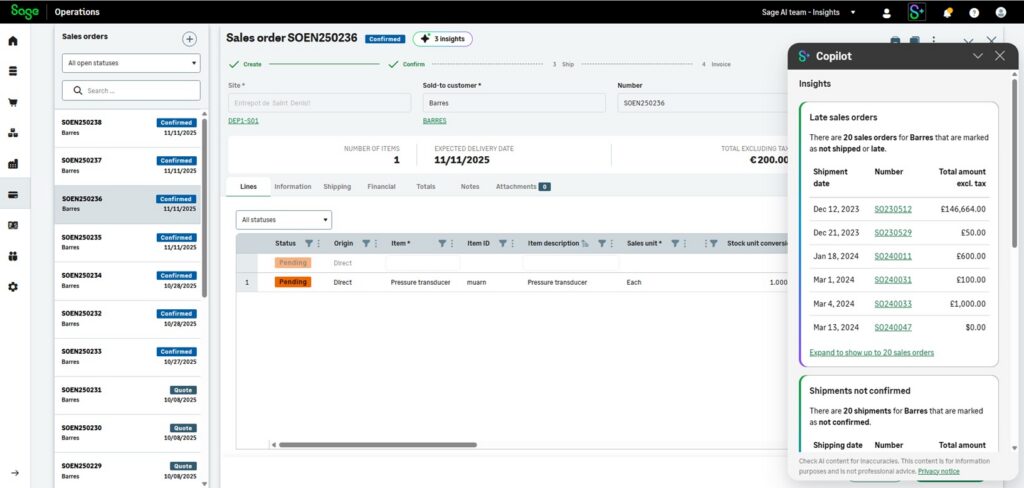
The acquisition also aligns with Sage’s broader agentic AI strategy, which includes Sage Copilot and finance specific AI services built on a proprietary LLM. Doyen’s technology gives Sage another mechanism to embed that intelligence into end to end workflows, including implementations, data migration and user onboarding, so AI support is present across the entire customer lifecycle.
Sage positions the move as a way to help SMBs migrate from legacy systems and go live on Sage platforms more quickly and confidently, which in turn accelerates time to value for AI features already available in products like Sage Intacct and Sage X3. For implementation partners, Doyen’s capabilities are expected to augment existing methodologies rather than replace them, providing standardized AI tooling they can apply across multiple engagements.
Analysis
What This Means for ERP Insiders
Governed AI tooling will influence vendor selection. The need for transparent data handling and auditable AI decisions during implementations will push buyers toward platforms and partners with clear governance models and domain tuned models.
Governance, Evaluation and Daily Impact for SMB Leaders
For CFOs, CIOs and ERP sponsors, the Doyen acquisition changes how implementation risk and vendor selection may be evaluated. AI enabled implementations promise shorter timelines and potentially lower costs, but they also introduce new questions around data access, model behavior and governance in the project phase. Executives will want clarity on how legacy data is processed, how configuration suggestions are generated and how auditability is maintained for decisions influenced by AI.
Sage emphasizes that its AI approach, including Doyen’s capabilities, is grounded in transparency and domain specificity rather than generic LLM outputs. That means AI models are tuned on financial and operational data structures and operate within defined rules and approval workflows rather than making opaque changes. For day to day project work, that should translate into AI assisting with repetitive design and validation tasks while humans retain control over final system design.
Case examples from Sage’s AI programs show that AI features in production have already delivered measurable gains, such as tripling monthly transaction value through accounts payable automation and saving hundreds of hours on manual finance processes with Sage Copilot. Doyen’s technology aims to bring similar efficiency to the implementation stage so customers can start benefiting from AI infused applications sooner and with more predictable outcomes.
Best practice for SMBs considering Sage in this new context will be to align AI enabled implementation promises with explicit success metrics. These might include reduced time from contract to first close on the new system, lower defect rates in UAT, smoother data reconciliation at cutover and faster adoption of AI features post go live. Vendors and partners that can tie Doyen style automation to those measurable outcomes will have a stronger story than those relying on generic claims of AI acceleration.
Analysis
What This Means for ERP Insiders
Time-to-value becomes a competitive background. By using AI to shorten migration and go live timelines, Sage is raising expectations that ERP vendors must prove how quickly customers can reach productive use of new AI powered capabilities.