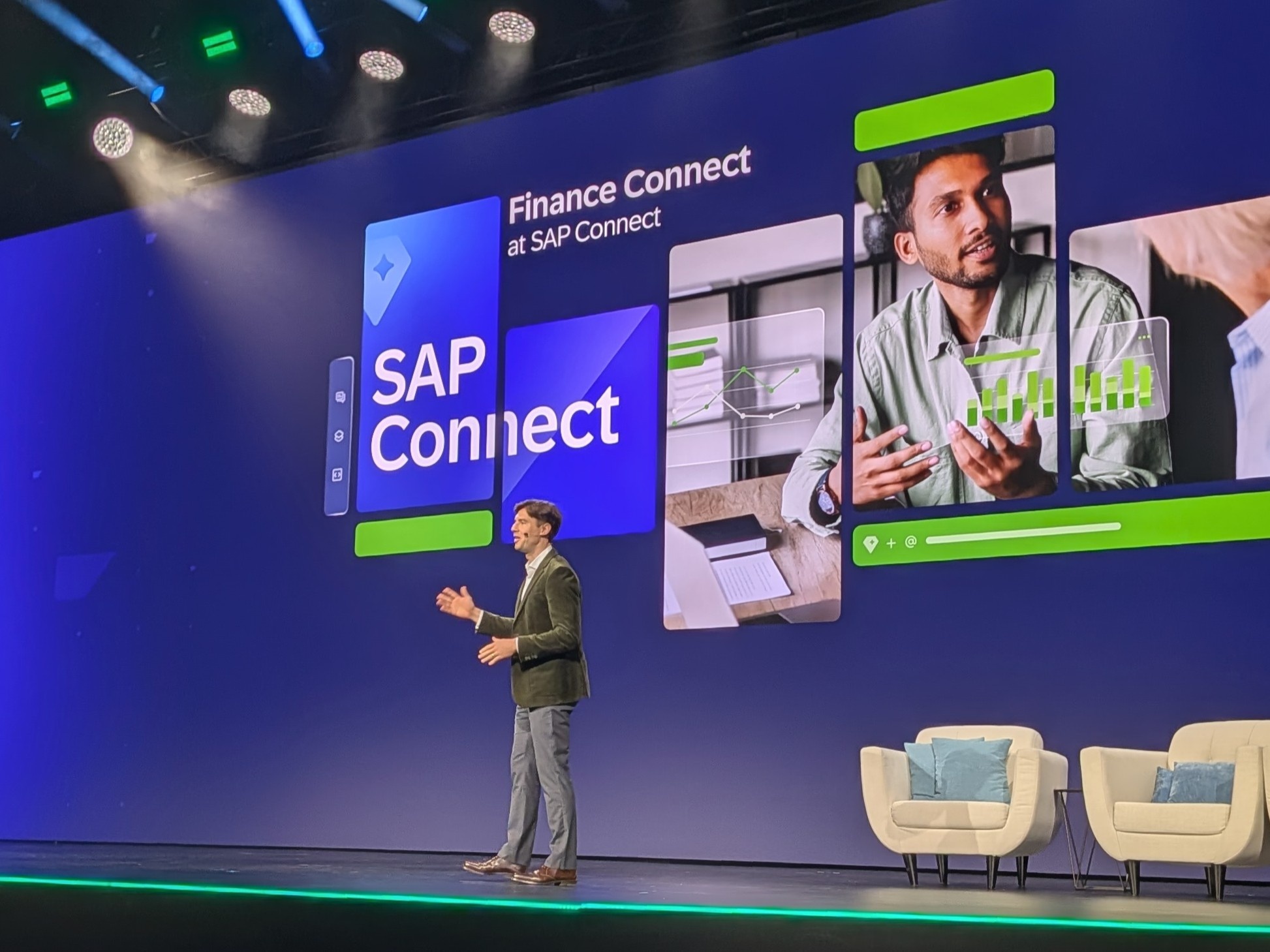
SAP used its Finance keynote at SAP Connect to show where its Autonomous Finance portfolio stands since the company introduced it at SAP Sapphire in May. The session, “Autonomous Finance: From road map to reality,” centered on accurate, reliable, and compliant finance outcomes, covering customer results, new products, and governance.
Customer results came first. PwC and ITOCHU described their first finance AI deployments. PwC projects that the Billing Assistant it built with SAP could deliver millions of dollars in value, while ITOCHU reported a reduction in operation hours in its initial use cases. Both tied those outcomes to ERP standardization work they completed first.
The keynote’s roadmap shows 10 existing Joule Assistants across planning, close, revenue, treasury, expense, tax, and governance. SAP said it has added 50 agents to those assistants since Sapphire. The new product is SAP Pay, a payment service embedded in SAP Cloud ERP, which SAP marked as generally available.
The roadmap also places Enterprise Financial Consolidation in Q1 2027 and dates the new accounting, revenue, and project assistants to Q4 2026 or Q1 2027, depending on the assistant, with each opening first to early adopters.
What SAP Customers Put in Place First
PwC’s starting point was its migration from a highly customized SAP ECC system to SAP S/4HANA Cloud Public Edition, said Jill Notz, chief accounting officer and business services leader for PwC US and Mexico. She said PwC’s later work, including the Billing Assistant, would not have been possible without that foundation.
PwC worked with SAP on the Billing Assistant to address user adoption. Notz said the S/4HANA implementation succeeded technically, but getting people to use complex systems consistently remained a challenge. The assistant guides users through billing in place of rigid menus and multiple steps, with the aim of faster billing and improved working capital and days sales outstanding.
“We are not a SaaS company,” Notz said, explaining that custom software built for internal use gives PwC no competitive advantage and is costly to maintain and evolve. The firm prefers commercial providers with the scale and long-term commitment to keep improving their products, she said. PwC now also helps clients build agents on SAP’s platform, and the two companies plan to expand their joint AI work.
ITOCHU took a similar path. Shusaku Harada, IT strategist and CSO of CISD at ITOCHU Corporation, said the trading company’s legacy system carried about 3,000 modifications, which the company had to overcome to be ready for innovation. ITOCHU also set up an in-house innovation center and joined SAP’s Business AI Platform center of excellence program to build internal capability.
ITOCHU started with finance because the function is critical to the business, has high operational impact, and runs on structured processes, Harada said.
The company does not run proofs of concept and moves directly to production. Its initial use cases automate accounting data entry, with AI proposing entries from uploaded documents such as invoices for staff to review, and let users query data in natural language. Harada reported a reduction in operation hours from that work.
Consolidation, Migration Paths, and Embedded Payments
Lawrence Martin, general manager and chief product officer for SAP Finance & Spend, introduced SAP Enterprise Financial Consolidation during the keynote’s enterprise performance management (EPM) segment.
The product covers statutory and management consolidation and runs on SAP Business Data Cloud. It includes a Financial Consolidation Assistant and a Disclosure Assistant, which drafts narrative for financial reporting. SAP said the product, together with SAP Enterprise Planning, completes its vision for a single-platform EPM solution. Martin presented that vision as Autonomous Performance Management.
Martin outlined separate paths for existing EPM customers. SAP’s keynote slides direct BPC and BFC customers to migration services planned from Q1 2027. Group Reporting customers can add the new Financial Consolidation Assistant on top of Group Reporting or upgrade to Enterprise Financial Consolidation, and SAP Analytics Cloud for Planning customers can upgrade to Enterprise Planning.
Commercially, Joule Assistants are consumed through AI units, and the EPM applications are packaged with SAP Business Data Cloud core capacity.
The keynote also gave a more detailed view of SAP Pay, which SAP announced earlier that day. The service is embedded in SAP Cloud ERP. SAP said it carries out and reconciles payments in the same workflow once an invoice comes due, which reduces manual file handling, reliance on outside processors, and payment costs. It supports a range of payment methods, including stablecoin-based settlement, and is powered by Tereina, an SAP company.
SAP named Winncom Technologies, a networking distributor based in Solon, Ohio, with more than $100 million in annual revenue, as the first SAP Pay customer.
Winncom CFO Vladimir Fedoroff, speaking with Peter Graulich, chief revenue officer for SAP Finance & Spend Management, said the company adopted SAP Pay because SAP had consistently delivered innovations Winncom found useful, including Joule and WalkMe. He said the service simplifies international payments and frees accountants from handling individual wire transfers, giving them more time for the close and strategic work.
Fedoroff described the implementation as quick, taking a month, and said results came immediately because the service works like the SAP software Winncom already uses.
How SAP Is Building Governance Into Agentic Finance
Martin also presented the keynote’s governance segment. He described most enterprises as under-connected in governance, risk, and compliance (GRC), with fragmented processes and data silos. Business leaders need continuous monitoring in place of delayed reports and after-the-fact audits, along with end-to-end visibility, he said.
SAP’s approach centers on two agents. The GRC Signal Analysis Agent detects GRC signals, works out what they mean, and decides on a response; the GRC Signal Remediation Agent carries out the fix and learns from the result. SAP presents the pair as agent-to-agent intelligence, and its slide places them alongside its GRC assistants, including the Governance Assistant’s agents for risk identification, internal controls, continuous control monitoring, issue analysis and remediation planning, and audit.
The International Trade Assistant covers sanctions screening, product classification, and import declarations. SAP reports that early deployments reduced trade classification effort by up to 50%, and its roadmap dates the assistant to Q4 2026.
SAP is also adding access governance capabilities. The Access Governance and Security Assistant adds agents for access reviews, user authorization requests, firefighter log reviews, and security threat processing. It appears on the roadmap and is not yet available. SAP’s press release states that Joule Assistants work within existing authorizations and audit trails, that customers set the level of autonomy, and that SAP’s AI governance architecture is independently certified to ISO/IEC 42001.
What This Means for ERP Insiders
Autonomy starts with ERP architecture. PwC and ITOCHU both reached their finance AI outcomes after moving off heavily customized systems, which suggests the condition of the ERP environment may increasingly limit what agents can do. Organizations carrying heavy customization could face a widening autonomy gap with peers that standardized first.
Individual finance tools increasingly come as a system. SAP is linking consolidation, planning, payments, and governance through SAP Cloud ERP, SAP Business Data Cloud, and AI-unit consumption. Finance leaders may increasingly evaluate these products as one operating architecture instead of separate application purchases.
Governance could determine how far autonomy scales. SAP’s GRC agents are designed to detect issues and carry out fixes, which moves finance from assistants that recommend actions to agents that take them. Competitive advantage may come from how confidently companies can delegate authority to those agents.