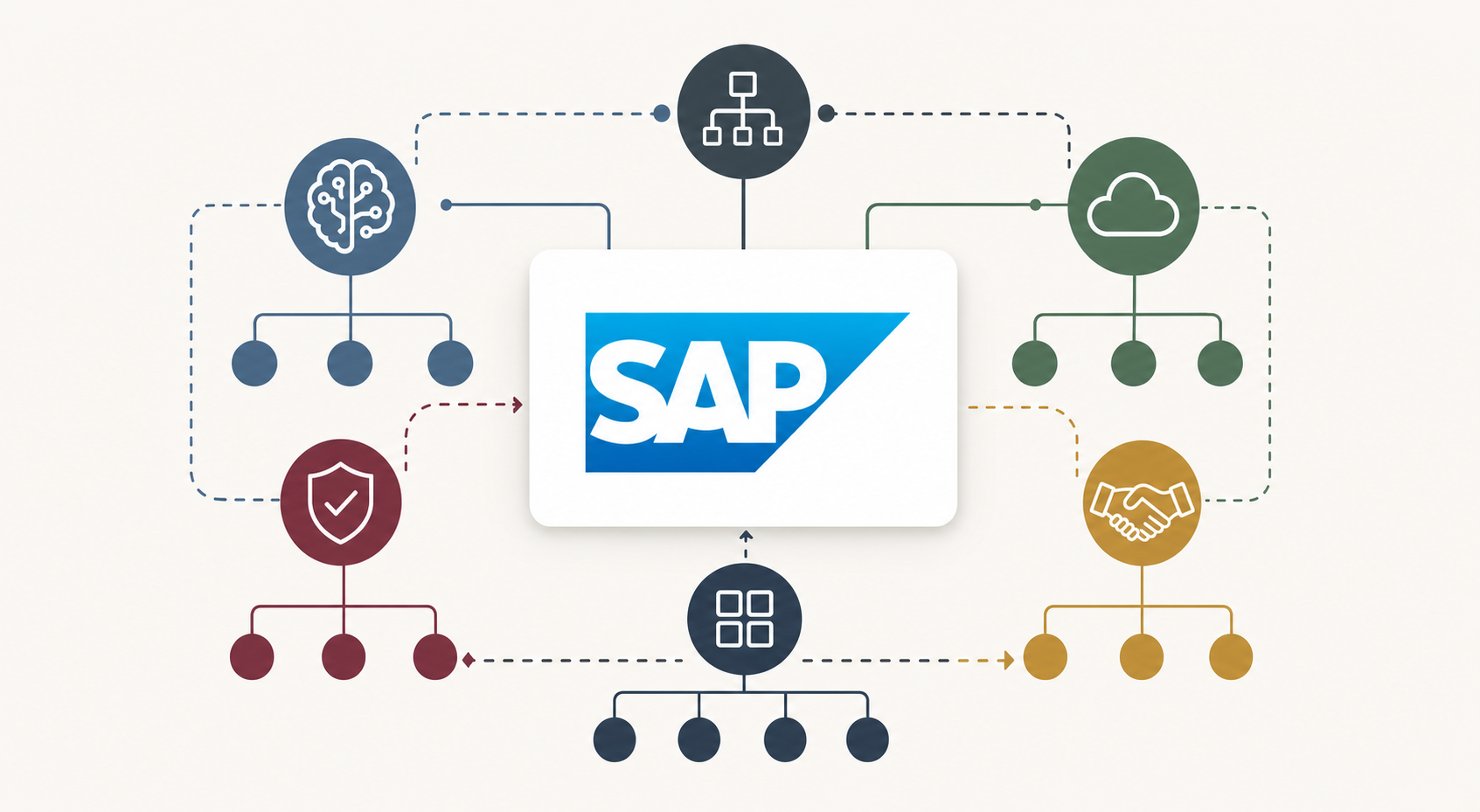
SAP is reorganizing major parts of its product and engineering leadership as it pushes SAP Business AI Platform and the Autonomous Suite deeper into its cloud ERP roadmap. The management changes, reported by SAPinsider and taking effect July 1, move key AI, platform, application, security, support, partner, and product-marketing functions into a new leadership model designed to accelerate SAP’s “going all in on AI” strategy.
For ERP customers, the significance is not the internal reporting chart alone. SAP is trying to align product development, platform architecture, customer success, and commercialization around a clearer AI execution model. The company’s autonomous enterprise message now depends on whether SAP can deliver consistent agents, data services, applications, governance, and customer support across finance, procurement, supply chain, HR, customer experience, and cloud ERP.
Changes Follow Wider Commercial Reset
SAP had already shifted its commercial organization earlier this year by appointing Executive Board Member Thomas Saueressig as Chief Customer Officer. That move centralized customer success functions under the Customer Value Group, bringing together senior leaders across customer engagement, adoption, regional customer success, and the Americas.
The product-side restructuring follows another known transition. Muhammad Alam, SAP’s Head of Product & Engineering, previously said he would not renew his contract in 2027 for personal reasons. According to SAPinsider, SAP CEO Christian Klein said Alam will remain on the Executive Board through the end of his term and continue advising Klein and the board on the company’s AI strategy. But SAP is transferring some operational responsibilities earlier to reduce distraction during the transition.
The timing is strategic. SAP used Sapphire 2026 to place the Business AI Platform and Autonomous Suite at the center of its next product cycle. Those announcements raised the stakes for product execution, because SAP now has to make its AI platform, agents, applications, customer data models, and suite strategy work together in ways customers can actually deploy.
AI Platform, CTO Functions Under Philipp Herzig
A big change is the creation of a new board area for the Business AI Platform and CTO organization, led by SAP Extended Board Member Philipp Herzig.
That organization brings together the teams SAP sees as central to its unified AI platform, including Data and Analytics, Business Transformation Management, Platform and AI, parts of the former SAP Business Technology Platform organization, and CTO functions.
The move gives SAP a more explicit leadership center for AI architecture and platform consistency. For customers, that could help reduce fragmentation across SAP’s AI stack, particularly as SAP expands Joule, agent orchestration, Business Data Cloud, BTP services, analytics, and industry-specific AI capabilities.
It also comes with leadership churn. Michael Ameling, Chief Product Officer for SAP BTP and an SAP Extended Board member, is leaving the company. That departure will be watched closely because BTP has become one of the main technical foundations for SAP’s extensibility, integration, data, automation, and AI strategy.
Autonomous Suite Gets Own Leadership Track
SAP is also creating a new Autonomous Suite organization led by Manoj Swaminathan, another member of SAP’s Extended Board.
This group brings together Finance and Spend Management, Supply Chain Management, Human Capital Management, Customer Experience Management, and Cloud ERP Private. The structure is meant to support SAP’s push to turn the Autonomous Suite into a more unified application experience rather than a collection of separate cloud products.
For ERP buyers, that is the part of the restructuring with the clearest product implication. SAP has been positioning the Autonomous Enterprise as a future operating model in which agents work across core business processes. That requires more than shipping agents into individual applications. It requires aligned data models, user experiences, process logic, security, extensibility, and commercial packaging across the suite.
Herzig and Swaminathan will both report to Klein during the transition. That gives the CEO direct oversight of SAP’s two most important product execution threads: the platform layer and the application-suite layer.
Analysis
What this means: ERP leaders should track product execution, not job titles. SAP’s restructuring matters because it concentrates AI platform, CTO, and Autonomous Suite responsibility under clearer leadership. Customers should watch whether this produces faster roadmap decisions, more consistent product experiences, and fewer gaps between SAP’s AI strategy and deployable functionality.
Security, Support, Partners, Marketing Also Shift
SAP’s Global Customer Support Organization and Global Security and Cloud Compliance teams are moving from Saueressig’s Customer Value Group to Product & Engineering, reporting to Klein on an interim basis. Product Experience will continue to report to Alam but will work with Herzig, Swaminathan, and the Customer Value Group.
SAP is also creating a new Industry AI Unit led by Dominic Metzger, reporting to Chief Operating Officer Sebastian Steinhaeuser as part of the Strategy and Operations board area. The move signals that SAP wants industry AI to become a more formal product and strategy function, not a set of scattered use cases across business units.
On the go-to-market side, the Partner Ecosystem Success Unit led by Karl Fahrbach will move from Strategy and Operations into the Customer Value Group under Saueressig. Product marketing teams will move into the Global Marketing Unit under Chief Marketing Officer Ada Agrait, including Business AI Platform Marketing, Joule Product Marketing, and Autonomous Suite Marketing.
Analysis
What this means: SAP customers need clarity on roadmap ownership. The reorganization shifts key responsibilities across platform, suite, support, security, partner, and marketing teams. CIOs and ERP program leaders should press SAP and implementation partners for explicit guidance on who owns the customer-facing roadmap for Joule, Business AI Platform, BTP, Business Data Cloud, and Autonomous Suite capabilities.
Get Our Free Weekly Newsletter
Further Leadership Changes, Spend Discipline
SAPinsider’s Chief Research Officer Robert Holland noted the reshuffle appears to be continuing beyond the initial Product & Engineering announcement. Dan Beck, General Manager and Chief Product Officer for SAP SuccessFactors, is leaving the company while SAP SuccessFactors CRO Maryann Abbajay is staying as Global Head of Strategic Customer Engagements for SAP HCM. Siva Sundaresan is set to replace Beck after previously serving as interim SuccessFactors leader. Etosha Thurman, Co-Business Lead and Chief Marketing Officer for Finance and Spend Management, is also departing.
Holland also pointed to a broader push for spend discipline inside SAP, including more selective hiring (especially for AI-related roles), reduced third-party spend, and the creation of a spend council to manage external costs more tightly. He said SAP is also expected to monitor token usage and related costs in its own AI spending, a sign the company is paying closer attention to the operating cost of AI consumption as it scales.
That adds a financial layer to the reorganization. Some measures, such as pausing internal travel, may be routine, but Holland said the combination of AI spending scrutiny and cost controls will put more focus on SAP’s Q2 results when they are released later this month.
Execution Risk in Focus
Customers may not feel the restructuring immediately. Day-to-day interactions with account teams, support contacts, and product teams are likely to remain stable in the near term.
The risk sits elsewhere. Reorganizations of this size can create uncertainty inside product teams, slow decisions, or distract employees during a period when SAP is trying to accelerate its AI and cloud roadmap. SAPinsider also noted SAP CFO Dominik Asam has previously discussed “continuous optimization” of the workforce, potentially equivalent to 1% to 2% of SAP’s global workforce. SAP has not announced a major restructuring tied to these management changes, but customers and partners will be watching whether reporting changes lead to staffing shifts, delivery delays, or changes in product priorities.
The more important test will be execution. SAP has spent the past year sharpening its message around Business AI, Joule, Business Data Cloud, the Autonomous Suite, and cloud ERP. The new structure should make ownership clearer. It also makes accountability easier to measure.
For ERP leaders, the question is whether SAP can now deliver a more coherent product experience across platform, applications, AI, data, integration, and support. A cleaner internal structure only matters if it improves the roadmap customers see.
Analysis
What this means: Partners should prepare for suite-level delivery pressure. SAP’s new structure pushes the market toward integrated AI and business-suite execution rather than product-by-product implementation. SIs and GSIs will need to show how finance, procurement, supply chain, HR, CX, data, security, and AI governance fit together inside one transformation plan, because that is the operating model SAP is now organizing around.
Sponsor Industry‑Grade Research
Editor’s note: This article was updated on 7/2 to include Robert Holland’s comments and on 7/6 to correct an error regarding Maryann Abbajay’s appointment.