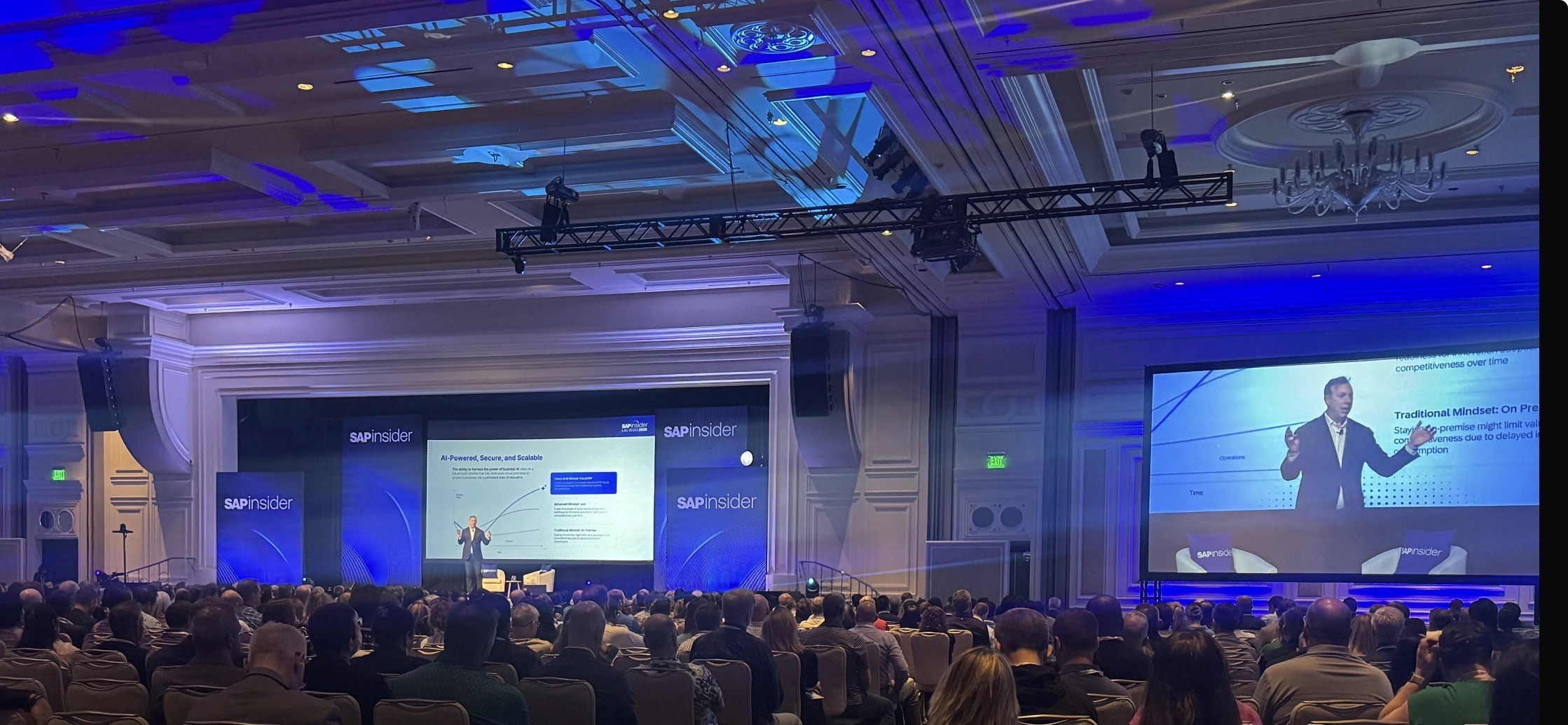

- technical debt has become a strategic barrier
- standardized core processes must be separated from differentiated innovation
- the real goal is not project completion but a persistent state of innovation.
In a Q&A that followed his keynote, Robison alongside SAPinsider Chairman and CEO James Bedard translated the above into more practical terms, focusing on project pace, delivery models, fit-to-standard, shadow IT risk, and career advice for the next generation of SAP professionals.
Q: Many organizations still think about migration as a large, monolithic project. Roughly half this audience either has not yet moved or is in the process. What is SAP doing to help them manage cost, manage expectations, and most importantly move more quickly?
DR: It’s really a combination of a lot of things coming together. We talk about the tool chain and bringing an aligned tool chain that makes that mundane, repeatable, low-commodity work less cost, less time, less risk. A lot of the new capabilities, including the generative AI support we’re embedding across development, consulting, and delivery, are coming directly from customer feedback.
The other point is, this doesn’t have to be a big-bang transformation. What I described [during the keynote] doesn’t need to be a 24-month project. You can start now. You can make the right decisions on architecture, on governance, on how IT aligns with the business. There are opportunities to demonstrate quick wins in the near term, and those wins accumulate. They create new muscle memory, they let you experiment with new ways of working, and over time that becomes the new operating model.
Analysis
What this means: SAP is signaling that modernization should become more incremental and more continuous. Robinson’s answers suggest the company sees smaller wins, faster iterations, and AI-assisted delivery as more realistic and effective than traditional all-at-once transformation programs.
Q: One of the ideas that stood out was your distinction between total cost of ownership and total cost of innovation. What is SAP going to do over the next few years to reduce the total cost of innovation and accelerate that pace?
DR: I think about it in terms of standardization and differentiation. In the old world, SAP would say, tell us your requirements, we’ll build it into standard, and then in a couple of years you’ll get it through an upgrade. That model is broken. It’s too slow.
Now, the idea is you deploy the standard that exists today for what’s common. For what’s differentiating, you extend using our platform and the partner ecosystem. Over time, if that capability belongs in standard, it will find its way there. But you don’t wait for that.
That’s where the flywheel starts. It’s not one and done. It’s one, five, twenty. You differentiate, you commoditize, you extend, and you repeat. That’s what reduces the cost and friction of innovation over time.
Analysis
What this means:The ecosystem is under pressure to modernize its own services model. Robinson’s criticism of conventional project proposals indicates that partners will increasingly be judged not just on implementation quality, but on whether they can materially reduce time, cost, and risk using newer tool chains and delivery methods.
Q: In the CIO program, there was discussion about fit to standard. But there was also concern that as AI tools proliferate, there could be a new wave of shadow investment, just with different tooling. What can SAP do to put more power in the hands of functional users without creating another uncontrolled sprawl problem?
DR: It comes down to the IT operating model. It’s the right resources, the right governance, and the right tools. Those tools need to sit in what I think of as an innovation plane—the place where differentiating capability happens. They need to be familiar, consistent, secure, easy to use, and available in a way that lets organizations adapt quickly.
Customers don’t want to repeat the same mistakes they made before, just with faster or more efficient tools. This isn’t only about technology. The operating model is outdated; that’s what needs to change.
Analysis
What this means: Governance is becoming as important as technology choice. Robinson’s comments on shadow tooling and customer proximity point to a future where enterprise success depends less on centralizing every decision and more on enabling distributed innovation inside a secure, well-governed architecture.
Q: One of the things I hear from customers is that they want to move quickly, but they also want to avoid another cycle of complexity. How do you prevent that?
DR: We have to think differently about architecture and governance—how we design versus how we oversee. The goal is not just to move to a new platform, but to create a model where you can continuously innovate without rebuilding technical debt every time there’s a new business need.
That means understanding what is standard and what is differentiating. It means building extensions in a way that protects the clean core while still allowing you to react quickly, incorporate a new AI model, and bring in new innovation without disrupting the underlying transaction chain. It’s not what you employ, it’s how you deploy.
Q: SAPinsider has a large and growing community, and many younger professionals are coming into this world for the first time. What advice would you give to those members who want to build their careers in this ecosystem?
DR: I would say two things. First, stay curious. Take risks, even small ones, that help you learn and expand. That builds network, experience, confidence, and perspective.
Second, stay as close to the customer as possible. That’s where the value is and where the innovation happens. We all have customers. Our customers have customers. That’s where the actual business happens.
Whether you’re at SAP or in IT, your customer might be internal or external, but those connection and long-term relationships that you build before you need them are what make projects successful and careers meaningful.