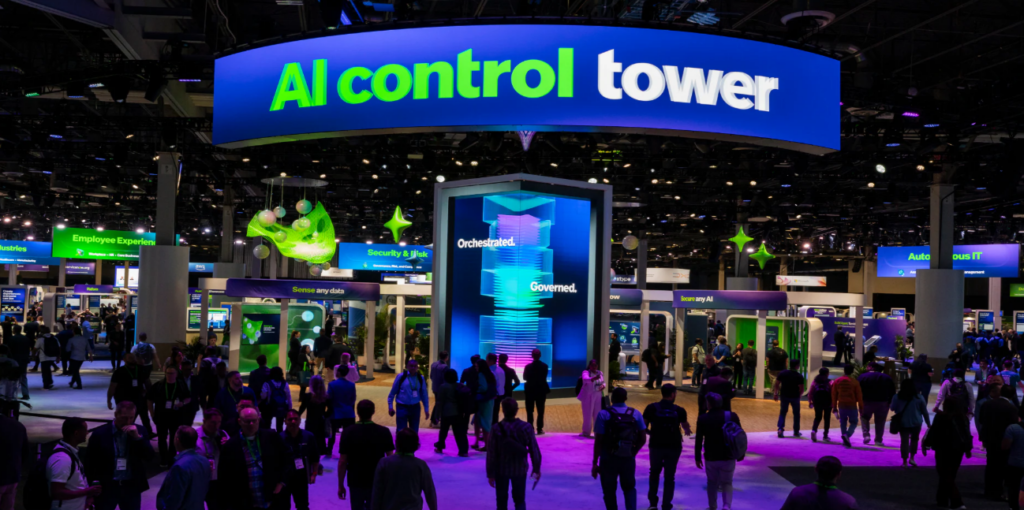

ServiceNow reported on July 22 stronger than expected second quarter 2026 results and said its AI business crossed $1 billion in annual contract value, giving the company a clearer financial proof point for its AI Control Tower strategy.
The company said subscription revenues reached $3.88 billion in Q2, up 24.5% year over year, or 23% in constant currency. Total revenues reached $3.99 billion, up 24% year over year, or 22.5% in constant currency. Current remaining performance obligations reached $13.20 billion, up 21% year over year, while remaining performance obligations reached $29.0 billion.
ServiceNow also raised its full-year subscription revenue outlook to between $15.76 billion and $15.78 billion. ServiceNow said Q2 subscription revenues exceeded the high end of guidance by 150 basis points, driven by net-new annual contract value outperformance and stronger on-premise revenue mix tied largely to US federal demand.
Bill McDermott, chairman and CEO of ServiceNow, said agentic deployments of ServiceNow AI increased ninefold in nine months. President and CFO Gina Mastantuono said AI net-new annual contract value continues to outpace expectations and that AI Control Tower is strengthening the company’s security and risk business.
AI Control Becomes a Commercial Story
ServiceNow’s results show how quickly AI governance is becoming part of enterprise software buying decisions. The company had 123 transactions over $1 million in net-new annual contract value during Q2, up nearly 40% year over year, and ended the quarter with 658 customers above $5 million in annual contract value.
The financial momentum is tied closely to ServiceNow’s platform narrative. At Knowledge 2026, the company positioned ServiceNow as an AI platform for governing, deploying, and scaling AI across the enterprise. The company said AI Control Tower expanded with discovery, observation, governance, security, and measurement capabilities designed to give enterprises control over AI systems, agents, and workflows regardless of where they run.
That positioning is relevant for ERP leaders because AI agents increasingly operate across systems rather than inside one application. Enterprises need to understand which agents exist, what they can access, which workflows they touch, how they are measured, and how exceptions are governed.
ServiceNow is also tying AI control to data foundations. Mastantuono pointed to strong IT operations management demand, saying the configuration management database is serving as an essential governance and data foundation. ServiceNow’s Context Engine and Autonomous Data Analytics are intended to give enterprises governed data for autonomous AI by mapping people, assets, and policies in real time.
Get Our Free Weekly Newsletter
From Workflow Platform to Agentic Control Plane
ServiceNow’s product updates also show how the company is expanding from workflow automation into agent orchestration. ServiceNow Otto launched as a unified AI experience combining Now Assist, Moveworks, and AI Experience to understand intent, route work to the right agent, and execute tasks within enterprise guardrails.
The company also introduced ServiceNow Action Fabric, allowing ServiceNow and third-party AI to take secure action through ServiceNow workflows. Anthropic became the first design partner, connecting Claude directly to ServiceNow workflows and actions.
The partner ecosystem reinforces the same direction. ServiceNow said it deepened partnerships with NVIDIA, Microsoft, AWS, and Accenture, including efforts to extend AI Control Tower into NVIDIA Enterprise AI Factory designs, Microsoft Agent 365, AWS architectures, and cybersecurity modernization programs.
For enterprise buyers, the question is becoming less whether AI can automate individual tasks and more whether the operating environment can govern agents across models, systems, identities, assets, and workflows.
Sponsor Industry‑Grade Research
What This Means for ERP Insiders
AI governance is becoming a revenue engine. ServiceNow’s $1 billion AI annual contract value milestone shows that enterprises are willing to spend on control, orchestration, and trusted execution, not only on generative AI features. For ERP vendors, systems integrators, and platform teams, the commercial signal is clear: customers want measurable AI outcomes with governance attached from the start.
Agentic workflows will intensify cross-system accountability. AI agents rarely respect application boundaries, especially when work spans IT, finance, HR, risk, customer service, procurement, and security systems. For CIOs and enterprise architects, the next design challenge is deciding which platform governs actions when agents move across ERP, SaaS, cloud, and third-party systems.
Data foundations will decide how far autonomous work can scale. ServiceNow’s emphasis on CMDB, Context Engine, and real-time mapping of people, assets, and policies points to the infrastructure underneath trusted AI. For ERP and IT leaders, the practical priority is to connect workflow governance with reliable system, identity, asset, and process data before expanding agentic execution.