ERP Strategy and Planning

AI in higher education
Drivestream Opens AiPEX University to Show Higher Education What Agentic AI Can Actually Change
Drivestream has launched AiPEX University, a new immersive experience center built with Oracle to help higher education leaders see how agentic AI could operate across enrollment, financial aid, academic planning, student engagement, HR, and finance.
Oracle Database@AWS Reaches 12 Regions, Broadening Multicloud Database Footprint
Oracle Database@AWS has expanded to 12 regions across North America, Europe, and Asia Pacific, increasing deployment flexibility and high-availability support for enterprises seeking to migrate on-premises applications while addressing locality and regulatory requirements.
Oracle’s AI Pivot Is Reshaping How It Builds Software, Staffs Teams, and Funds Growth
Oracle is transforming its operational and financial strategies by shifting focus to AI as a core element of its enterprise framework, resulting in significant layoffs while simultaneously investing heavily in infrastructure and automation to enhance product development efficiency.
Inside the Global Data Center Investment Surge and Why It Matters for ERP Leaders
Recent massive investments in data centers by major tech companies signify a transformative buildout of global computing capacity, driven by the demands of enterprise AI, geographic strategic importance, and energy constraints, reshaping how cloud and AI services will be delivered in the future.
Oracle Database@Google Cloud
Oracle Beats Estimates as AI Cloud Demand Surges, Lifts 2027 Revenue Outlook to $90B
Oracle's shares surged 10% after reporting strong fiscal third-quarter results, with higher-than-expected earnings and revenue driven by cloud and AI infrastructure demand, while also raising its 2027 revenue outlook amid significant new contracts and a plan to expand its data center capacity.
Data Sovereignty, Latency, Trust: Why ERP AI Cannot Live in the Public Cloud Alone
As AI integrates into ERP workflows, the need for robust governance, data residency, and operational control is rising, leading organizations to seek infrastructure strategies that ensure consistency and reliability in the face of regulatory demands.
High angle shot of doctor working with keyboard typing.
Alrajhi Medicine Replaces Legacy Systems with Oracle Cloud ERP and EHR
Alrajhi Medicine has selected Oracle to consolidate its clinical and enterprise systems, linking EHR, ERP, and workforce applications as the Saudi healthcare provider expands
Oracle Database@Google Cloud
Oracle Showcases Sovereign HR Analytics, AI-Driven Finance Automation with e& and Avis Partnerships
Oracle's deployments at e& and Avis Budget Group demonstrate its Fusion AI Data Platform and Fusion Cloud ERP/EPM as key drivers for integrating AI, analytics, and cloud infrastructure in HR analytics and finance automation, respectively, emphasizing the shift from traditional analytics to embedded AI in core workflows.
Public Sector ERP and AI Are Running on Two Clocks: Will That Gap Become a Strategic Risk?
Public sector technology strategy is conflicted by the slow, methodical pace of legacy system modernization, exemplified by the UK's Defence and Bank of England initiatives, contrasted with the rapid, high-profile push for AI and advanced computing, leading to a widening gap between ambition and execution.
Boutique Firms, GSIs, and Emergence of Reinforcement Models in Enterprise ERP Delivery
Enterprise ERP delivery is evolving from single-provider models to collaborative partner ecosystems, utilizing a mix of large global systems integrators, staffing firms, and boutique consultancies to address the complexities of multi-year initiatives.
Oracle AI World’s IBM Sessions: What Enterprises Must Build Before AI Can Deliver
At Oracle AI World, IBM emphasized that successful AI adoption in enterprises relies not on flashy models but on robust foundational preparations, governance, and aligned business processes, showcasing that scalable AI implementations require clean data and integrated workflows.
Year in Review: Testing, Transformation, and the Race to AI-Ready ERP in 2025
In 2025, the conversation around cloud migration shifted from why to how. According to SAPinsider’s 2025 research report on SAP S/4HANA deployment, for instance, 31% of the organizations who responded to the survey have transitioned to SAP S/4HANA, while another 27% are in implementation. Additionally, 54% of respondents said they plan to incorporate AI or...
Epic’s Healthcare-Native ERP, AI Gambit: Disruption or Long Game Against Major Players?
Epic's development of a healthcare-native ERP aims to integrate seamlessly with its EHR and AI features, potentially disrupting the market by consolidating operational functions while forcing health systems to reflect on their existing application frameworks, though full capabilities are not expected until 2027.
Oracle Database@Google Cloud
Oracle Database@Google Cloud Expands to Canada and India in Digital Sovereignty Push
Oracle has launched its Database@Google Cloud service in Canada and India, using a standardized multicloud model that integrates directly with Google Cloud data centers, highlighting a strategic approach focused on data sovereignty and operational flexibility for enterprises across diverse regulatory environments.
AWS Enters the AI Factory Race, Raising Stakes for Cloud-Data Sovereignty, Enterprise Architecture
Amazon Web Services (AWS) is launching on-premises AI factories that integrate advanced hardware and managed service offerings into customer data centers, enabling organizations to develop and deploy AI applications while addressing data sovereignty concerns and enhancing their existing ERP systems.
When Formula One Meets ERP: Oracle Red Bull Racing’s Strategic Move to the Cloud
Oracle Red Bull Racing is transforming its finance and HR operations through the Oracle Fusion Cloud Applications Suite to enhance efficiency and comply with Formula One's cost cap regulations, highlighting a broader trend among high-performance organizations toward integrating AI and comprehensive cloud solutions for operational excellence.
migration
The ERP Elephant in the Room: Why Legacy System Decommissioning is Business Critical
Modern enterprises face significant challenges with legacy ERP decommissioning, as maintaining outdated systems poses financial, security, and compliance risks, making it imperative for organizations to strategically sunset these systems to unlock the full potential of their digital transformation efforts.
The OG Group’s Strategic Appointment Signals Market Maturation in UK’s Booming ERP Landscape
The OG Group's strategic appointment of Oracle veteran Rob Gibney as Non-Executive Chief Innovation Officer highlights their focus on evolving the ERP landscape towards outcome-driven partnerships, amidst a rapidly growing UK ERP software market projected to expand significantly by 2035, underscoring the importance of cloud-based solutions and specialized advisory services to navigate complexity and drive business transformation.
Build Smarter, Not Slower: How Rossera and Oracle Are Reinventing Custom ERP
In an era of hyper automation, enterprise leaders are shifting from 'build or buy' to 'how to build smarter' by utilizing Rossera's modular, AI-powered accelerators on Oracle Cloud Infrastructure, which streamline bespoke processes and enhance user experiences while maintaining operational efficiency and data governance within the existing Oracle ecosystem.
From SAP Sapphire 2025: Fluence Commits to ‘Speed Over Perfection’ on Hypergrowth Trajectory with SAP
Fluence rapidly grew from $900 million to nearly $4 billion in two years under Dean Crounse's leadership by implementing a 99.7% clean core SAP deployment for digital transformation and supply chain orchestration, enabling them to manage large-scale energy storage projects while focusing on sustainability and AI integration.
Oracle and AWS Cloud Database
Unlocking Efficiency for Public Education: Chicago Public Schools Goes All-In on Oracle Fusion
Chicago Public Schools is transitioning to Oracle Fusion Cloud Applications to enhance its operational efficiency and resource allocation by moving from outdated systems to a unified, AI-driven cloud platform that will streamline finance, HR, and supply chain management.
How to Select the Right ERP for You
Discover what to consider when choosing an enterprise resource planning system for your organization.
Finding the Right ERP Systems for Small Businesses in 2025
To thrive in the fast-paced landscape of 2025, small and medium-sized enterprises (SMEs) need an adaptable, cloud-first ERP system that enables rapid implementation, offers intelligent insights, and provides clear pricing, with solutions like GROW with SAP, Microsoft Dynamics 365 Business Central, and Oracle NetSuite emerging as top contenders.
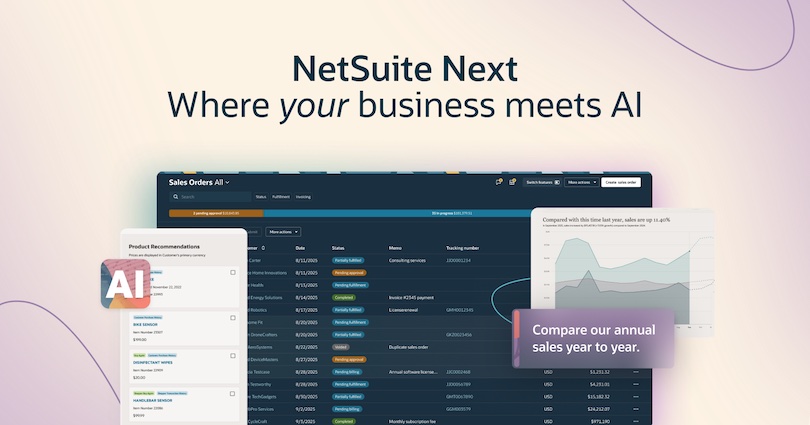
NetSuite ERP
NetSuite ERP is an integrated business management system with embedded AI that delivers powerful accounting, financial management, supply chain, customer experience, project management capabilities and more that helps organizations operate more effectively by automating core processes and providing real-time visibility into operational and financial performance.
Streamlining Critical Upgrades: How ViaSat Lowered Risk and Raised Quality with Intelligent Testing
ViaSat's strategic use of Original Software's user-friendly testing platform for their Oracle EBS R12 upgrade significantly reduced risks, improved audit readiness, and enhanced software quality by enabling comprehensive documentation and automation, positioning the company for future efficiency gains.
Sage building | Sage and Lockstep
Sage and Tractics partner to deliver cloud solution for heavy civil contractors
Sage and Tractics have partnered to integrate Sage Intacct Construction with Tractics' cloud-native platform, enhancing operations and financial management for heavy civil contractors by providing real-time project data access and streamlined business processes.
Accelalpha
Alpha acceleration in digital transformation: The IBM-Accelalpha deal
What synergies will IBM’s recent acquisition of Accelalpha bring to clients and the Oracle ecosystem?