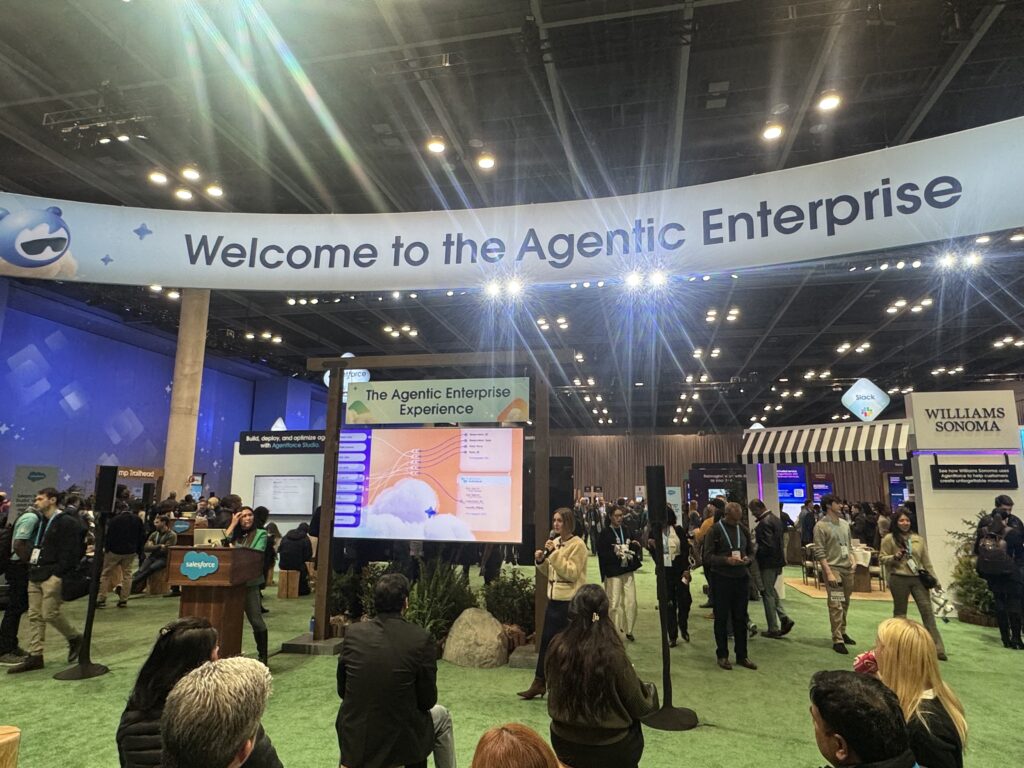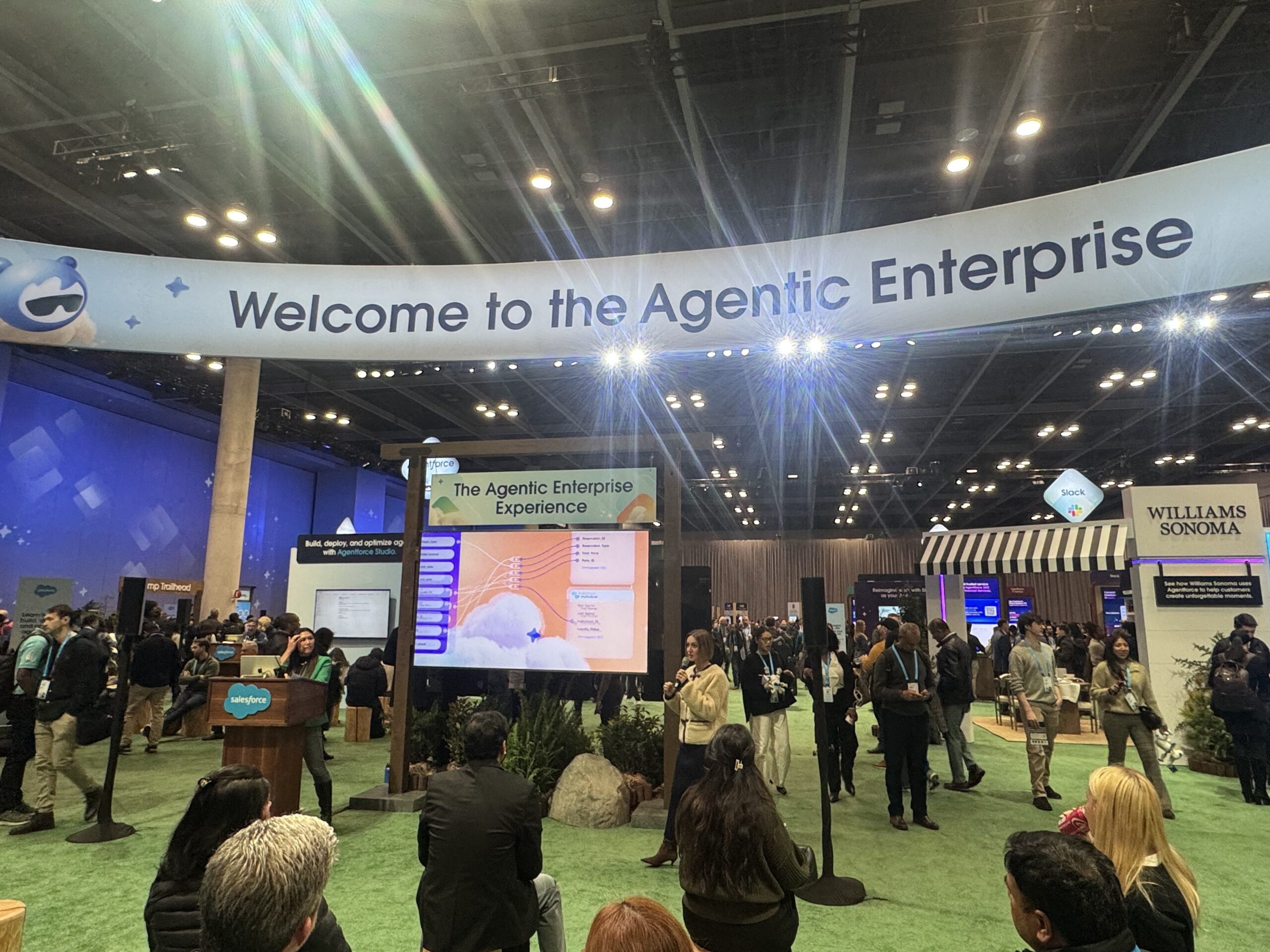
At the close of an exclusive executive roundtable during the Salesforce Agentforce Tour on December 10, leaders from Salesforce, Accenture, Deloitte, and Vivint turned away from product roadmaps and marketing milestones to address a more consequential question: What changes when AI agents stop being experiments and start becoming operational infrastructure?
The discussion focused on organizational behavior, delivery models, and where enterprise systems—especially CRM- and ERP-adjacent processes—will feel pressure first. The common thread across the predictions was consequence for companies that move decisively as well as for those that do not.
Below are five predictions the roundtable panel made for 2026.
1. The year will expose a hard divide between enterprises that operationalized agents and those that stalled.
Several executives described 2025 as a year of experimentation but framed 2026 as the point when experimentation stops being defensible. Stephanie Sadowski, senior managing director leading the Global Salesforce Business group for Accenture, says some companies still view agentic AI as an incremental evolution of generative AI, while others recognize it as a fundamentally different operating model. That gap, she argues, will no longer be theoretical.
“We’ll see who’s really in this and who’s kind of stuck their head in the sand and is hoping this just blows over,” Sadowski says.
The divide is rooted less in technology maturity than in organizational intent. Companies that continue to treat agents as side projects risk more than efficiency losses; they face growing challenges in attracting talent, meeting customer expectations, and sustaining legacy process models. By 2026, executives expect agents to be embedded deeply enough in daily work that opting out will feel increasingly untenable.
2. Voice will be the first channel where agentic AI forces large-scale ‘replatforming.’
While much of the industry’s attention has centered on chat-based agents, the roundtable participants consistently point to voice as the most immediate and disruptive frontier. Traditional IVR systems are described as structurally incompatible with contextual, agent-driven interactions.
“The IVRs of the past are dinosaurs. We have to completely rethink service, and we’ll see that happen at scale,” Sadowski says.
Executives expect service organizations to replace menu-driven call trees with voice-native agents capable of maintaining context, reasoning across systems, and handing off seamlessly to human agents. This shift is being treated as a core architectural change rather than a surface-level interface update.
For enterprises, voice becomes a forcing function. Once customers experience conversational service that works, back-end systems supporting billing, orders, returns, and service eligibility must respond in real time. Voice surfaces data fragmentation and integration gaps faster than any other channel.
3. Forward-deployed engineering will become the dominant delivery model for enterprise AI.
Jennifer Cramer, SVP of customer success for AI products at Salesforce, describes the rise of forward-deployed engineering as a structural shift in how enterprise AI is delivered, particularly in environments where iteration and real-world feedback are constant.
“The forward-deployed engineering model—sitting side by side with customers to understand the value they’re trying to get from the technology—is the future. Compared to a year ago, 83% more people list ‘forward-deployed engineer’ in their titles, and job postings for those roles have increased by roughly 800% since June,” says Cramer.
The executives argued that agentic AI requires embedded teams that understand both business processes and technology deeply enough to iterate in production. By 2026, they expect this approach to become standard for large enterprises with complex CRM and ERP environments, turning implementation into an ongoing operating model rather than a discrete project phase.
4. Multi-agent systems will replace single-agent thinking, but only with governance.
Karl Rupilius, principal at Deloitte and US lead alliance partner for the Salesforce Alliance, predicts that enterprises will move beyond single-agent deployments toward coordinated systems of specialized agents operating across processes.
“We’re going to see more agents that act autonomously across systems and processes. And governance will shift from optional to mandatory. Trust and control will matter more than ever,” says Rupilius.
As agents gain the ability to trigger real business actions—approvals, refunds, scheduling, provisioning—governance becomes foundational. By 2026, executives expect trust frameworks, observability, and deterministic guardrails to be embedded directly into agent architectures.
5. Agents will stop feeling like AI and will start feeling like assistance.
Ryan Gee, SVP of engineering at Vivint, suggests that 2026 will mark a shift in how people experience agents day to day. Instead of being viewed as novel or experimental, agents will be judged the way coworkers are judged: by reliability, usefulness, and their ability to remove friction.
“People will start to think, ‘This agent is actually helping me,’ in the same way you appreciate someone opening a door for you. Once those interactions are consistently good, that switch flips, and we’re already seeing that with customers,” Gee says.
As agents earn trust through consistent performance on well-defined tasks, expectations across enterprise systems will rise. Users will become less tolerant of complex workflows that exist only to accommodate system limitations.
What This Means for ERP Insiders
Voice-first agents will surface ERP data quality issues faster than dashboards ever did.
As service organizations adopt voice-native agents, ERP systems will be expected to deliver real-time order status, billing context, entitlement rules, and inventory availability. Inconsistent master data, slow integrations, and batch-oriented processes will become visible constraints, increasing demand for real-time APIs, shared session context, and tighter CRM–ERP synchronization.
Co-innovation models will redefine ERP implementation success. The rise of forward-deployed engineering and co-designed agent use cases suggests that ERP projects tied to AI will no longer succeed through static requirements alone. ERP leaders should plan for continuous iteration, shared ownership with AI platform teams, and closer collaboration with systems integrators who understand both enterprise processes and agent behavior.
Agent-first experiences will reset expectations for ERP usability. As employees grow accustomed to agents that summarize, guide, and execute within front-office systems, tolerance for form-heavy, manual ERP workflows will erode. ERP platforms that expose business logic cleanly to agent interfaces, particularly for approvals, exceptions, and operational decisions, will be better positioned to remain relevant as agents become the primary interface layer.