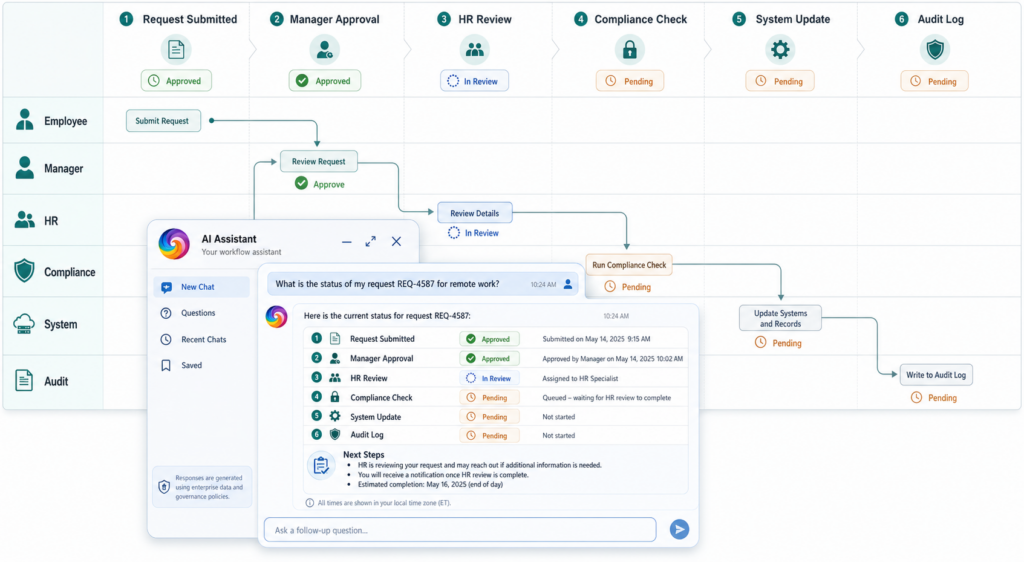


Automating routine finance and HR work depends on the records and processes behind it. Accounting data needs to be ready for review, managers need consistent information, and employee services need to work across markets. Those requirements also shape the foundation on which businesses can introduce AI agents.
Adyen, a global financial technology company providing payments, data and financial services, uses Workday for both HR and finance. Its HR team supports employees internationally through the platform, while finance uses it to close the books, manage spending and report on the business. The company has built on that shared platform to automate accounting work, centralize information for managers and develop employee applications, according to Workday.
Moving Routine Work Away From Spreadsheets
Adyen’s finance team wanted to standardize processes within its existing technology environment. Some accounting work depended on employees manually processing data in spreadsheets on their laptops before it could enter the company’s books. The team needed to move that work into a consistent process that could also support new entities and regions.
HR had a related goal: make employee processes easier to use as the company scaled, while giving the team more time for work involving judgment and personal interaction. That meant investing in self-service, automation and integrations, with managers able to access information from different sources in one place.
Combining Data Flows With Custom Employee Applications
Using Workday Data Cloud and Workday Accounting Center, Adyen built data flows to automate journal bookings and tasks within the month-end close. Information that previously required spreadsheet processing now moves into Workday and into the company’s accounting records.
Workday Data Cloud also combines information from different sources into a centralized view for managers. In HR, Adyen has used Workday Extend to develop custom applications around its employee processes, alongside automation and integrations supporting onboarding. Workday reports that these applications simplified the employee experience and gave HR staff more time to support people.
The finance work follows the company’s preference for standardizing processes within the platform it already uses. According to Workday, the resulting foundation also supports opening new entities and entering additional regions with consistent governance.
More Than 10 Finance Use Cases Automated
Adyen has implemented more than 10 use cases in Workday Accounting Center. Work that previously took hours can now be triggered at the start of the close, allowing employees to move directly to review on the first day, according to Workday. Workday does not quantify how much these workflows shortened the full month-end close.
The reported changes also include centralized manager information and custom employee processes built with Workday Extend. These are established parts of Adyen’s use of the platform; broader adoption of agentic AI remains a further step.
Preparing for Additional AI Agents
Adyen has identified collecting audit evidence and matching bank transactions to journal postings as processes where it wants to use AI. It also sees Sana Agent Builder as a way to build agents for company-specific needs.
The company’s approach starts with identifying the business problem before deciding where AI could add value. It distinguishes work that should remain with people, including sensitive conversations and judgment calls, from tasks suitable for automation with human oversight or full automation. Its next steps build on the finance standardization, centralized data and employee applications already in use.
What This Means for ERP Insiders
Start with the spreadsheets that feed the ledger. Adyen’s close improvements came from moving laptop-based data processing into automated journal flows. List every close task where data is reshaped in a spreadsheet before posting, with its owner, hours and source system, and automate the highest-volume tasks first. Those flows also become the inputs any later reconciliation agent will depend on.
Judge close automation by when review can start. Adyen’s workflows now run at the start of the close, letting staff move to review on day one. For each automated workflow, track when its output is ready and how many exceptions reviewers must clear. Early output with heavy exception volume points to a data quality problem upstream.
Sort tasks into three tiers before building agents. Adyen keeps sensitive conversations and judgment calls with people, automates some work with human oversight and fully automates the rest. Apply that sort to each candidate process, then document for every agent its data access, its human reviewer and the log auditors will check. Bank-to-journal matching is a contained place to start.