
Something unusual happened in the ERP community this July. Infor, in two blogs that were published within days of each other, said three things that enterprise software vendors rarely say out loud:
- AI features have commoditized
- Adoption failures are common and expensive
- The agent itself represents just 5% of the actual work
In an industry drowning in agentic AI announcements, that level of candor deserves scrutiny for what it concedes and where the argument ends.
An Arms Race?
In the first of the two posts, Alan Young, Infor’s VP of Product Management for Hospitality, described the current market as an “AI adoption arms race” and cataloged the wreckage with the viral story of a company that accidentally spent roughly $500 million on AI tokens in a single month. He also cited examples such as Uber COO Andrew Macdonald’s admission that AI costs were outpacing productivity gains, and a Pizza Hut franchisee whose AI-driven delivery platform caused an operational collapse that wiped out more than $100 million in business and enterprise value.
Young’s diagnosis of the Pizza Hut episode showed that though the system was not poorly designed, it was a poor fit for the location’s DoorDash-dependent operation and was implemented without adequate adaptation, training, or support. His conclusion: “AI that works in theory but fails in practice is still a failure, and someone has to pay for it no matter how steep the cost.”
That framing matters because it relocates the failure mode. The problem was related to everything surrounding the model, including context, implementation, change management, and accountability. This is a point independent analysts have been making for two years, and one that surfaced in our recent examination of agentic AI claims versus substance in manufacturing ERP. However, it is notable to hear this from a vendor whose peer group is still leading with model capabilities in press releases.
The Commoditization Concession
The more consequential admission came when Young stated that the hospitality technology landscape has flattened, and that feature sets once considered proprietary, including natural language capabilities and property management system integrations, are now widely available at roughly comparable price points.
When read through a buyer’s lens, it means that every AI-led marketing claim in this segment, including Infor’s own, should be evaluated on the surrounding factors Young lists instead: industry experience, security and governance architecture, implementation methodology, and “the accountability structure that stays in place long after the contract is signed.”
That is, in effect, a scoring rubric for AI due diligence, supplied by Infor. It is also an implicit warning that any provider still selling the sophistication of its underlying model is selling something the market has already commoditized.
The 95/5 Problem
Infor’s second post pushes the argument further. Recapping a HITEC 2026 session by David Poprawka, Innovation Strategist at Infor Hospitality, the piece describes an industry “where artificial intelligence is everywhere, but meaning is nowhere,” with leaders facing fragmented systems, disconnected data, and technology that creates more friction.
Poprawka’s Architecture of Intent framework rests on three pillars:
- Defined intent
- A unified data layer he calls the Portico
- Contextual understanding of each property’s rules and workflows
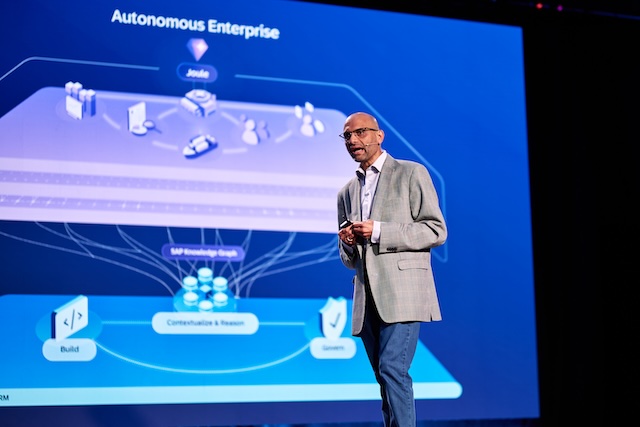
He adds that even with intent, data, and language, users still haven’t built an AI agent. And that’s the point. The agent, chatbot, automation, and AR overlay account for only 5% of the work. The foundation is the other 95%.
The post explicitly positions this as the opposite of how most vendors approach AI, resonating with operators who are yearning for clarity over hype. Strip out the hospitality specifics, and this is a general statement about the state of agentic AI in enterprise software: the demos are the 5%. Data unification, contextual grounding, and governance are the 95%, and they are precisely the components that announcement-driven coverage never inspects.
The prescription still points home.
Fairness requires noting where the candor ends. Young’s argument, having diagnosed commoditization and adoption failure, concludes that “a great demo from a new entrant, no matter how compelling, cannot substitute for hard-won institutional experience,” and that only “a short list of enterprise technology providers” possess the compliance architecture and track record buyers should demand. Infor, unsurprisingly, sits on that short list. Poprawka’s framework, similarly, is described as “an approach that Infor is putting into practice.”
Honest diagnosis, self-serving prescription. That is not a criticism so much as an observation about how even the most refreshing vendor commentary should be read. The diagnosis can be validated independently; the prescription cannot be taken on faith. Buyers applying Young’s own rubric should apply it to Infor with the same rigor as to any new entrant, asking for evidence of the 95%: data architecture in production, documented governance, and referenceable post-go-live accountability, not session recordings.
The Subtext
There is a second story running underneath both posts. The Architecture of Intent is not just an adoption philosophy; it is a competitive position. Palantir, ServiceNow, Microsoft, Salesforce, and a growing cohort of horizontal players are converging on an agentic system-of-action layer that sits above transactional systems of record, promising to orchestrate work across whatever ERP lies beneath.
Infor’s counterargument, embedded in both pieces, is that this layer cannot be bolted on from outside. Intelligence must reside within the industry-specific stack, grounded in unified data and the organization’s operational language, because hospitality is a deeply contextual industry. Additionally, AI projects fail when they assume that intelligence is universal. Young’s dismissal of the compelling demo from a new entrant reads the same way: a defense of vertical depth against horizontal breadth.
Whether that defense holds is one of the defining competitive questions in enterprise software right now. The horizontal players would respond that context can be learned, and that owning the action layer matters more than owning the record infor bets that institutional knowledge, built over years of operating, cannot be acquired through research and hiring. Neither claim has yet been settled by outcomes, which is exactly why it warrants continued tracking rather than a verdict.
What This Means for ERP Insiders
Rewrite your AI evaluation criteria around the 95%, not the 5%. If feature sets have genuinely commoditized, then scoring vendors on demo quality or model sophistication measures the wrong thing. ERP Insiders should weight their RFPs toward data architecture in production, governance documentation, implementation methodology, and contractual post-go-live accountability. They must ask every vendor to show the foundation, not the agent.
Price the failure modes before the software is developed. The $500 million token bill and the Pizza Hut collapse show that nobody modeled what happens when AI meets real operations without adaptation, training, and support. Before signing, quantify your exposure to runaway consumption costs, workflow mismatches, and change-management gaps. A pilot that includes a deliberate stress test of these failure modes will tell you more than any reference call.
Treat the vertical-vs-horizontal question as an architecture decision. Whether intelligence should live inside your industry-specific ERP stack or in an orchestration layer above it will shape your integration costs, data strategy, and vendor leverage for a decade. Neither camp has settled the question with outcomes yet, so preserve optionality: insist on open APIs, portable data models, and exit clauses that do not strand your context inside one vendor’s foundation.