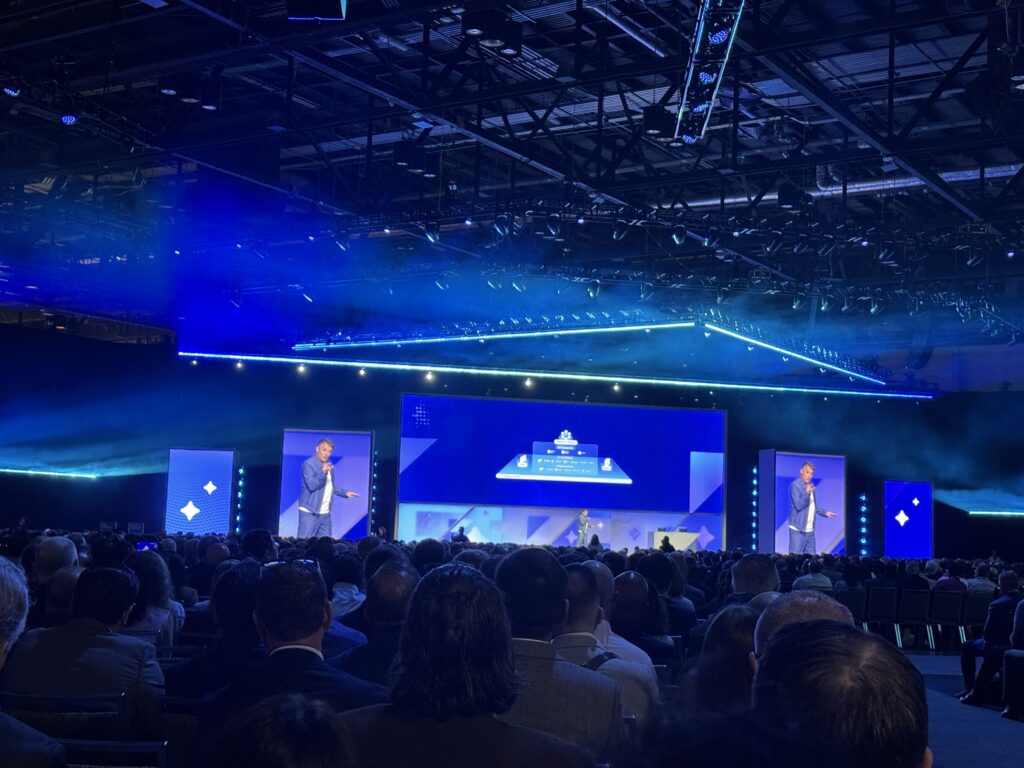

Agentic AI has become the mandatory adjective of manufacturing ERP. While SAP is positioning Joule and its Business AI Platform as the core of an autonomous enterprise, Epicor recently unveiled an agentic AI stack at Insights 2026, spanning its Lux design system, Prism Agent Foundry, and a wave of vertical agents.
Syspro’s June platform release embedded rules-driven automation into core workflows while teasing a “significant step forward in applied AI” still weeks away. On the other hand, QAD is pushing its Champion AI agents across its adaptive manufacturing stack, promising action rather than analysis, and Oracle continues to thread AI-assisted orchestrations through JD Edwards for customers not ready to leave it.
In July, IFS signed a multi-year agreement with Chelsea FC to run finance and procurement operations under the Premier League’s new in-season spending scrutiny, a deployment in which an AI failure would be publicly visible. Its June partnership with Siemens was framed around closed-loop models that will not hallucinate in active operations, which is itself an admission of where the industry’s credibility problem sits.
Although these announcements arrive weekly, the delivered functionality arrives on a very different schedule. That gap is now the most important due diligence challenge in enterprise software.
The Numbers Behind the Skepticism
This skepticism is something that ERP users, especially in the manufacturing space, have been reporting so far this year. SAPinsider’s Technology Leaders’ Strategic Agenda for 2026 found that 70% of technology leaders cite operational efficiency and cost reduction as their top priority, 40% plan to deploy Joule or embedded AI in SAP applications, and 53% identify integration of AI into existing SAP processes as their biggest adoption challenge. Meanwhile, SAPinsider’s ERP Migration and Transformation 2026 benchmark found only 34% of organizations report a complete SAP S/4HANA transition, meaning most manufacturing AI initiatives will land on hybrid landscapes where trusted data and consistent governance are hardest to guarantee.
The supply chain picture is more challenging, with industry leaders saying technology investments have not fully delivered the expected results. Moreover, poor data quality has cost organizations an average of $12.9 million annually. These statistics show that layering agents on fragmented data does not fix that failure mode but amplifies it.
The Scorecard To Apply
For ERP users, every AI Reality Check should score vendor claims against these five consistent criteria:
- Is the capability generally available or on the roadmap?
- Are there named customers in production?
- Are outcomes quantified and independently verifiable?
- Can agents show their work through audit trails and governance guardrails?
- Is the AI embedded in execution workflows or bolted on as analytics?
Even when applied loosely, the criteria already separate the field. Epicor’s Prism reached general availability across UK and European markets in June with 18-plus pre-built agents and a claimed 60% reduction in customization build time, while several agents announced at Insights 2026 remain forthcoming. QAD’s Champion AI has been generally available since November, and its expanded AWS and TCS collaboration now offers a 60-day proof of concept on live production lines, a testable claim by design. Syspro’s CEO told this publication that agents recommend while humans confirm high-risk transactions, a governance posture worth crediting even as its flagship AI announcement stays pre-release. And Oracle’s JD Edwards team took the most candid position of all at BLUEPRINT 4D 2026, declining to promise embedded AI everywhere and focusing instead on connecting Orchestrator to external AI services.
Now, consider IFS, a company that spent the month putting its agentic story in front of various audiences. The company recently placed its Industrial AI showcase, a packaging-line failure scenario handled end-to-end by an autonomous Digital Worker, inside Microsoft Experience Centers in Munich, Silicon Valley, and Singapore. At these invitation-only events, senior executives stress-tested the company’s AI deployments.
What Substance Actually Looks Like
This also illustrates the test that ERP providers face when deploying agentic AI within their systems. As ERP Today reported when IFS launched Digital Workers, customer Kodiak Gas saved 90,000 hours in under two months, a named customer with a quantified outcome. Our earlier analysis of IFS’s Softeon, 7bridges, and EmpowerMX acquisitions made the same point from the other direction: industrial AI will be judged by execution inside real workflows, not positioning. Peer-review signals matter too; Gartner’s 2026 Voice of the Customer for Cloud ERP for Product-Centric Enterprises placed only one vendor in the Customers’ Choice quadrant, a reminder of how rarely marketing intensity and customer satisfaction align.
SAP, to its credit, can point to substance of its own. SAPinsider’s July analysis of SAP Digital Manufacturing documents manufacturers like Raumedic, Topsoe, King’s Hawaiian, and Bühler, running AI-adjacent cloud MES in production, though the article notes the MII retirement means customers are migrating partly under deadline pressure rather than pure conviction.
What This Means for ERP Insiders
Score announcements, not adjectives. Vendor-syndicated coverage rewards volume; buyers should reward evidence. Demand general availability dates, named production customers, and quantified outcomes before shortlisting any agentic AI capability.
Fix the data before buying the agent. With supply chain leaders reporting unmet technology expectations and $12.9 million lost annually to poor data quality, agents inherit whatever integrity problems the landscape already has. Audit master data and integration flows first.
Make auditability a procurement gate. Agents that cannot document every step to their decisions will fail security review and regulatory scrutiny alike. Require decision trails, governance guardrails, and human escalation paths as contractual conditions, not roadmap promises.