
Four ERP Today stories tell a coherent and uncomfortable story: The gap between wanting enterprise AI agents and having the infrastructure to run them safely is larger than most organizations have acknowledged.
- Databricks’ $134 billion valuation signals the real battleground is the data layer beneath the models, not the models themselves.
- Jentic’s API scoring tool surfaces the more granular problem that most enterprise APIs were never built for agents to discover and execute against.
- The US data center compute crunch shows the physical infrastructure underpinning AI workloads is itself under supply pressure, with domestic spend up nearly 70% in a single year.
- Anthropic’s expansion of Project Glasswing into power, water, healthcare, and communications shows the security stakes around AI-connected enterprise systems are now critical-infrastructure-level.
Collectively, these developments answer a question every ERP and IT leader should be actively investigating: What does enterprise AI infrastructure actually require before agents can work reliably and safely?
The following FAQ list offers a practical roundup of the major lessons discussed in the above stories.
Frequently Asked Questions: Infrastructure Checklist
Q: What does “enterprise AI infrastructure” mean, and why is it different from deploying a chatbot?
A chatbot sits on top of enterprise data and responds to prompts. An AI agent acts inside enterprise systems. An AI agent queries APIs, triggers workflows, writes records, and hands off to other agents. That difference in execution capability demands a fundamentally different infrastructure foundation.
The Databricks story makes this concrete: Databricks CTO of Neural Networks Hanlin Tang said companies are already deriving real value from agentic AI—a claim he said he could not have made a year earlier. The infrastructure required to get there includes governed data platforms, API layers that agents can discover and execute against, compute capacity at scale, and security architecture designed for systems that act rather than just advise.
Q: Why is the data layer the critical prerequisite, and who controls it?
Agentic AI cannot function on disconnected or poorly governed data. It requires current operational context, access to structured and unstructured information simultaneously, and the ability to interact safely with live business processes.
That is precisely what the Databricks-Snowflake rivalry is being fought over—which platform gets to sit beneath the agent stack as the enterprise data layer. Databricks reached a $5.4 billion annual revenue run rate growing more than 65% year-over-year, built on its early bet that most enterprise data is unstructured and that structured data tools alone would not be enough for AI. Promotional planning, inventory, pricing, and supply chain data all need to run from a single trusted foundation before agents can be trusted to act on them.
Q: What is API readiness for AI agents, and how is it different from having working APIs?
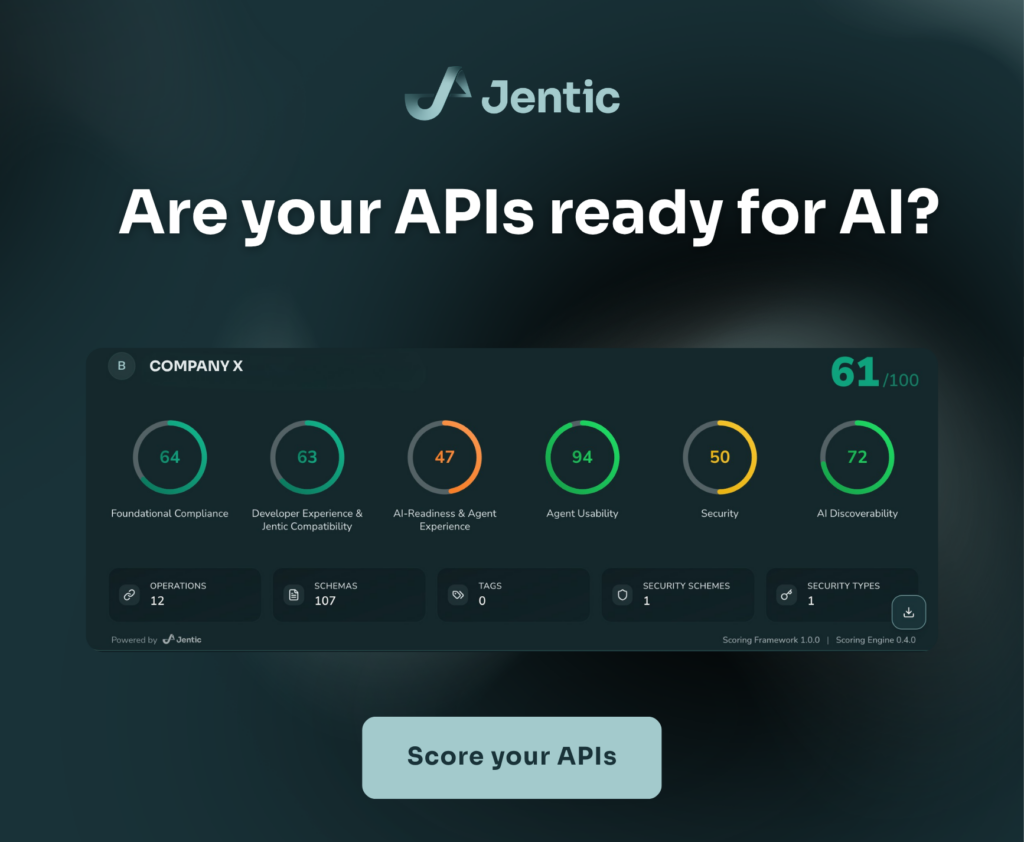
This is one of the most underappreciated gaps in enterprise AI deployment. Jentic’s API scoring tool was built specifically to address it. The company argues the industry has “conflated validity with usability for too long.” A syntactically valid API description may pass a linter but still fail an agent that needs to discover the API in context, understand what it does, and execute against it without step-by-step human guidance.
Jentic’s scoring framework evaluates APIs across six readiness dimensions, covering semantic clarity, runtime predictability, security boundaries, and machine discoverability. It is available as both a CLI and a web UI at no cost.
Q: What does “API readiness” mean in practice for ERP, CRM, and ITSM systems specifically?
For systems that form the operational backbone of an enterprise, poor API documentation, inconsistent behavior, or unclear permissions stop being a developer inconvenience and become operational risk when agents are involved. If an agent misinterprets an API and triggers an unintended action inside an ERP system, the consequences are not a failed integration test—they are a corrupted transaction or an unauthorized process change.
The Jentic framework was published under an Apache 2.0 license, with input from senior figures in the API standards community. Organizations should treat API governance, including which APIs agents can discover, what actions they can trigger, and how execution is controlled, as part of the same conversation as permissions, auditability, and workflow control.
Q: Is compute availability actually a bottleneck for enterprise AI, or is that overstated?
It is not overstated. US spending on data center infrastructure jumped nearly 70% between May 2023 and May 2024, and Lawrence Berkeley National Laboratory has projected that data center energy consumption could double or triple by 2028, accounting for up to 12% of US electricity use.
The data center compute crunch coverage catalogues the downstream effects: land scarcity in major markets, power grid pressure, water consumption restrictions, and community pushback against hyperscale campuses. Companies including SpaceX, Google, and Starcloud are exploring orbital data centers as a response to terrestrial constraints. For most enterprises, the practical implication is not orbital compute but a more disciplined view of workload placement, regional infrastructure strategy, and the real costs of inference at scale.
Q: How does enterprise AI infrastructure connect to security, and what has changed recently?
The attack surface for AI-connected enterprise systems is now categorically different from five years ago. Anthropic’s Project Glasswing was originally scoped to major tech companies and hyperscalers. Anthropic has now expanded it to approximately 150 additional organizations across more than 15 countries, explicitly adding power, water, healthcare, communications, and hardware sectors.
The threshold for inclusion is the potential to impact more than 100 million people in a successful attack. Glasswing partners receive gated access to Claude Mythos Preview, which remains in controlled preview specifically because of its offensive cyber capabilities. Anthropic is betting that getting its most powerful defensive model into critical infrastructure is worth the controlled distribution risk.
Q: What should an ERP team do first if it wants to assess whether its environment is agent-ready?
Start with the API estate. Jentic’s tool allows teams to run an initial scan to establish a baseline and configure automatic rescoring each time code changes. In parallel, assess the data layer: whether structured and unstructured data sit on a governed, queryable foundation that can provide agents with current operational context.
On the infrastructure side, workload placement and compute sourcing decisions need to account for the near-70% increase in data center demand nationally. And on security, any organization connecting agents to operational systems—especially in regulated sectors—should review the Project Glasswing expansion against their own threat model and consider whether AI-native security tooling belongs in their 2026 roadmap.
Q: Is the enterprise AI infrastructure gap a 2026 problem, or is there time to address it methodically?
The window for a relaxed, methodical approach has closed. Anthropic has said that if Mythos-class models are six to 12 months from general availability across multiple vendors, organizations’ current security posture is already obsolete against the threat they will face by end of 2026.
Databricks’ 65%-plus growth rate suggests enterprise data platform decisions made now will shape agent capability for years. And the orbital compute discussion signals that infrastructure strategy is becoming geopolitical. The physical location of compute and storage is entering enterprise risk management. The infrastructure gap is real, measurable, and widening faster than most IT roadmaps currently reflect.
What This Means for ERP Insiders
- Data platform selection is an agent infrastructure decision. The Databricks-Snowflake competition is a proxy for a broader question: which platform will govern the data agents act on. ERP leaders evaluating or renewing data platform contracts should explicitly assess agent support capabilities, not just analytics performance.
- Your existing API estate almost certainly has agent readiness gaps. Jentic’s scoring framework identifies six readiness dimensions that go beyond technical validity to cover semantic clarity, runtime predictability, and machine discoverability. Running a baseline assessment before piloting agents in ERP workflows will surface problems that would otherwise appear as failed agent actions in production.
- Infrastructure cost and availability will affect AI deployment timelines. The near-70% increase in US data center spend is translating into longer lead times, higher compute costs, and more constrained infrastructure procurement. Enterprise IT and finance teams should factor this into 2026 and 2027 AI budget models now.
- AI-connected operational systems require AI-native security posture. Project Glasswing’s expansion into power, water, healthcare, and communications signals that AI-assisted attacks are a live threat to operationally critical enterprise systems. If your ERP connects to plant management, supply chain execution, or financial settlement, the threat model has changed, and the security tooling needs to change with it.
- Agent readiness is not a single decision; it is a governance program. API readiness, data governance, compute strategy, and security posture each require ongoing management. The organizations that will run agents reliably in 2027 are those building the scoring, monitoring, remediation, and access control infrastructure now, before agent deployment creates pressure to shortcut it.