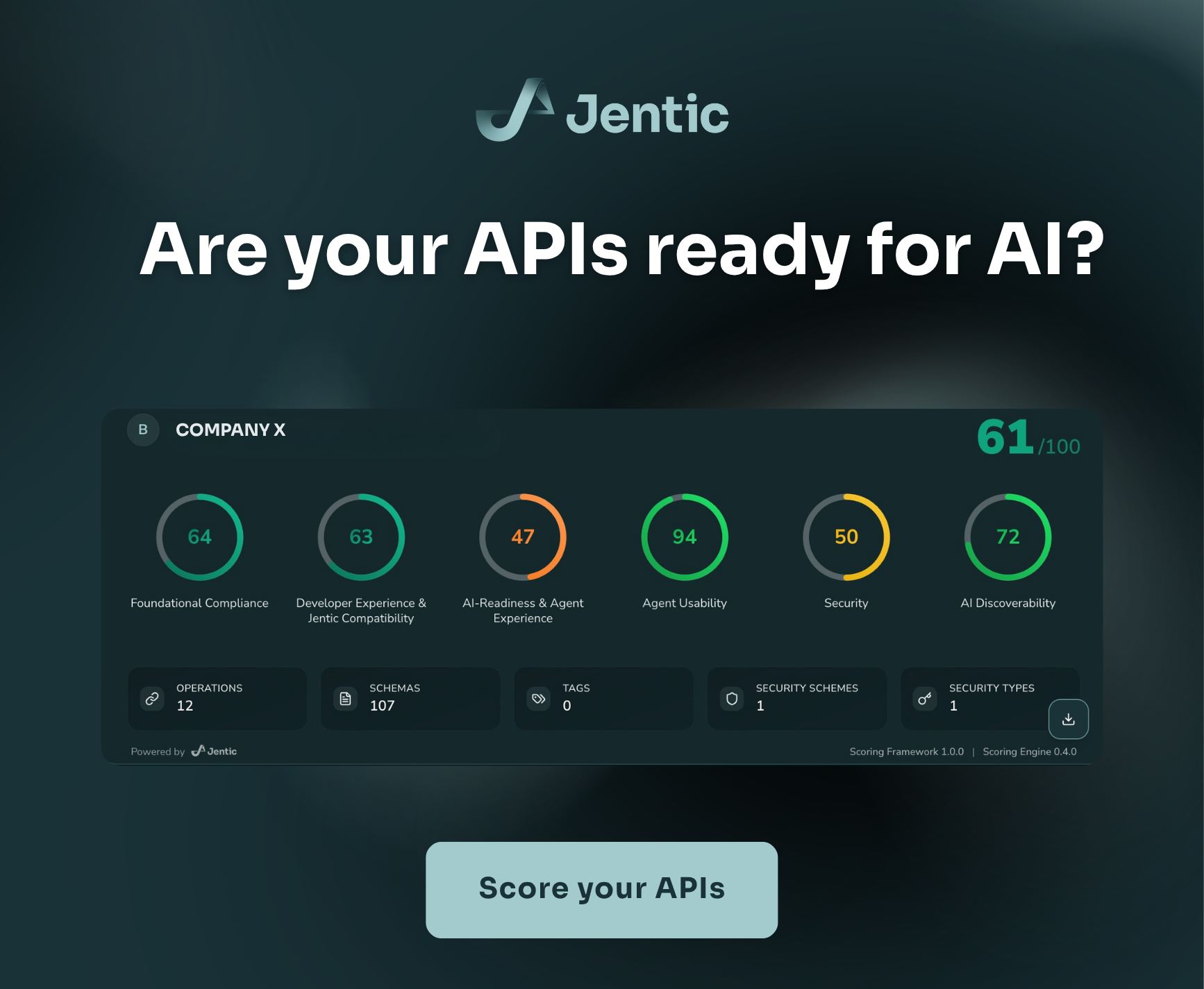
Jentic has launched a free API Scoring tool designed to measure whether enterprise APIs are ready for AI agents.
The tool, first released in December 2025 and available as both a command-line interface and a web UI, evaluates APIs across six readiness dimensions and is available at no cost. The underlying scoring framework has been published under the Apache 2.0 license, allowing developers, researchers, and organizations to inspect, contribute to, and extend the methodology.
Jentic, based in Dublin, describes itself as an AI infrastructure company focused on connecting AI agents to enterprise API landscapes. Per Compare the Cloud June 3, the scoring tool targets a gap that is likely to become more urgent as companies move from AI pilots into agentic workflows that need to discover, understand, and act through business systems.
Valid Does Not Mean Usable
Most APIs were built for human developers; a developer can interpret incomplete documentation, ask for clarification, or make an informed judgment when an API description is ambiguous. An AI agent has less room for interpretation. It needs precise, machine-readable descriptions, predictable behavior, and clear security guardrails before it can reliably execute against an API.
Jentic’s core argument is that API validity is not the same as agent readiness.
A syntactically correct API description may pass a linter, but that does not prove an AI agent can understand what the API does, discover it in context, or execute against it safely. Jentic’s scoring framework reportedly assesses whether API descriptions are technically correct, clear enough for agent interpretation, behaviorally consistent, protected by appropriate security controls, and discoverable and executable without human intervention.
Frank Kilcommins, Jentic’s head of enterprise architecture and a member of the OpenAPI Initiative’s Business Governance Board, said the industry has “conflated validity with usability for too long.”
That distinction is important for ERP and enterprise application teams. As agents begin working across ERP, CRM, ITSM, finance, procurement, and service systems, the API layer becomes part of the execution environment. Poor documentation, inconsistent behavior, or unclear permissions can become operational risk rather than a developer inconvenience.
Analysis
What this means: AI agents will expose weak API foundations. Enterprise agents cannot safely execute across ERP, CRM, ITSM, finance, and procurement systems if APIs are ambiguous, poorly documented, or inconsistent. API quality is becoming an operational readiness issue, not only a developer experience concern.
Scoring Moves into the Developer Workflow
The API Scoring CLI is designed to fit into engineering workflows. Teams can run an initial scan to establish a baseline, then configure the tool to rescore APIs automatically each time code changes. The web UI gives teams another access point for evaluating APIs without requiring the CLI.
That gives engineering leaders a trackable record of how their API estate’s AI readiness changes over time. It also turns agent readiness into something that can be monitored as part of development, not assessed only when a business team wants to connect an AI agent to a system.
The scoring framework was developed with input from senior figures in the API standards community, including Kilcommins and Erik Wilde, Jentic’s head of enterprise strategy and an OpenAPI Initiative Ambassador. Both have joined the company.
Wilde framed scoring as an entry point rather than the full answer. “Scoring is the perfect starting point,” he said, adding that Jentic is working on additional tooling to help organizations move toward an AI-ready API landscape.
Analysis
What this means: Agent readiness needs measurable standards. Jentic’s scoring tool gives engineering teams a way to baseline and track whether APIs are understandable, predictable, secure, and executable by AI agents. Enterprise architects should expect API governance to expand beyond technical validity into machine usability and agent-safe execution.
Sponsor Industry‑Grade Research
APIs Become Agent Infrastructure
The launch reflects a broader change in enterprise architecture. APIs have long been judged on whether developers can integrate with them. Agentic AI raises the standard because agents may need to choose the right API, interpret its function, execute an action, and stay within approved controls without step-by-step human guidance.
“In the AI era, the API is king, and APIs must be built for agents, not just for developers,” said Sean Blanchfield, CEO of Jentic.
This reframes API modernization. API programs have traditionally focused on integration reuse, developer experience, and application connectivity. Those priorities remain, but agent readiness adds new requirements around semantic clarity, runtime predictability, security boundaries, and machine discoverability.
Organizations that want agents to work across core systems will need to understand which APIs are ready, which need remediation, and which should not be exposed to agents at all. Jentic’s tool gives teams one way to begin measuring that gap before agents move deeper into enterprise workflows.
Analysis
What this means: Integration strategy is part of AI governance. As agents begin acting across business systems, organizations will need clearer rules on which APIs agents can discover, what actions they can trigger, and how execution is controlled. ERP teams should treat API readiness as part of the same governance conversation as permissions, auditability, and workflow control.