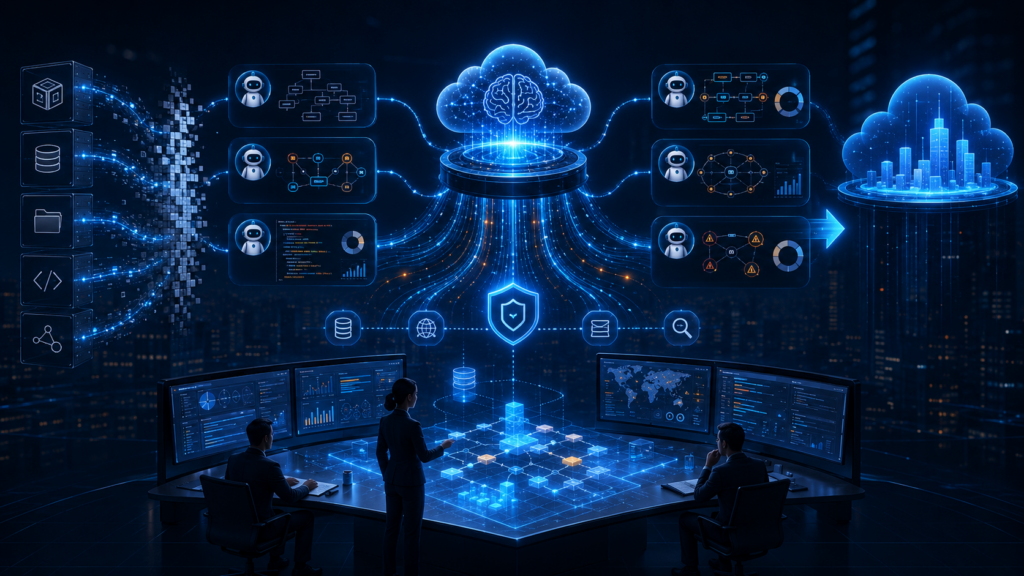
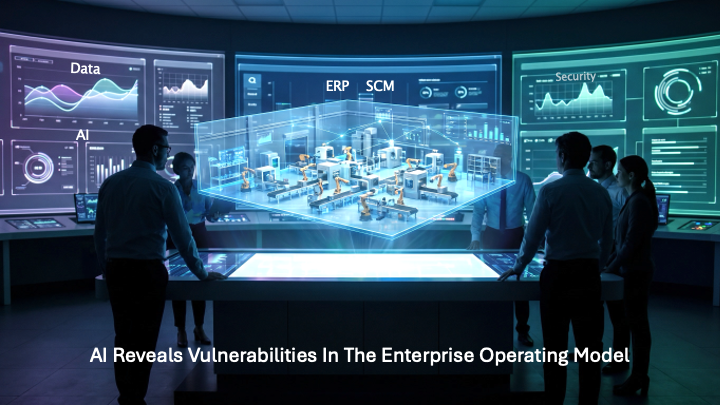
Enterprise AI is not held back only by technology. A company can modernize ERP, move data to the cloud, and deploy AI, yet important decisions can still stall between systems and functions.
The next enterprise transformation is not another technology implementation. It is a redesign of how the enterprise operates. Enterprise Resource Planning (ERP), supply chain, data, AI and security create value when they work together to move a business decision from context to action, with clear ownership at every step.
For years, transformation was judged by technical milestones: implementing ERP, migrating to the cloud or establishing a data platform. Those milestones still matter, but they are incomplete. A system can go live on time and within budget while decisions remain slow and data remain disputed. The technology changed; the operating model did not.
In an earlier article, “People, Process, Technology, and the Shift Nobody Saw Coming,” I pointed out that technology may drive transformation, but people drive technology. AI now raises the next question: what must the enterprise become as technology starts participating in decisions and execution? The answer is a connected operating model linking systems, decision rights, controls and human judgment.
AI Exposes Where Work Already Breaks Down
Enterprise systems are moving from recording work to recommending and increasingly executing it. They can flag exceptions, trigger workflows and coordinate tasks across applications. Yet many processes still depend on spreadsheets, email and people carrying context between systems. AI does not remove those weaknesses. It can make them move faster.
The opportunity is to redesign how a decision moves through the business. That means connecting the required data, the systems that recommend or execute, the people who approve or challenge and the controls that define what happens when the normal process breaks. Technology supports the operating model, but the enterprise still has to design it.
McKinsey’s November 2025 State of AI report found that nearly nine in ten organizations use AI in at least one function, yet most report no significant effect on enterprise-wide EBIT. Its top performers redesign workflows from start to finish and assign senior leaders’ responsibility for AI governance. Adding more AI does not automatically change how a business operates.
ERP Becomes Control Point for Execution
For many years, ERP systems have managed transactions across finance, procurement, manufacturing and human resources. An invoice exception can still sit unresolved because the right person was never notified, while finance can lose days reconciling data before close.
Modern ERP platforms can reduce those delays by flagging exceptions, recommending next steps and starting controlled workflows. In collections, an AI-supported process can rank overdue accounts by payment history, customer value and risk, recommend an action and route higher-risk cases to a manager instead of treating every account the same.
ERP’s role is transactional control. It should move routine work through governed workflows while reserving material exceptions for human judgment. The business sets approval thresholds and is responsible for the results, while ERP consistently enforces these rules. As I wrote in “AI Is Changing ERP, Not Replacing It,” AI can accelerate ERP, but it does not replace the controls and data discipline that make transactions reliable.
Supply Chain Connects Visibility to Decisions
Most organizations can see inventory, supplier performance, delays and demand more clearly than before. But visibility without decision logic only shows the problem in higher resolution.
The supply chain’s specific role is connecting planning with physical execution. When a shortage hits, a connected operating model can identify affected orders, check inventory across locations, estimate the cost of alternatives and recommend a response based on customer priority and operational impact.
Planners and procurement teams still resolve the exceptions that require experience and judgment, but they should not have to assemble the context manually. Better coordination can reduce stockouts, premium freight and recovery time when planning and execution run as one process.
I made a similar case in “Why Sports Has Become a Blueprint for Real-Time Enterprise Execution.” NFL Next Gen Stats and MLB Statcast show why real-time visibility matters only when the organization knows who should act, what to decide and how quickly execution can follow.
Trusted Data Becomes an Operational Requirement
Every business decision depends on clear definitions, but many organizations still face challenges due to duplicate records and unclear ownership. ERP defines a customer one way, the customer platform another and the supply chain system a third. The problem is not technical alone; the business has not agreed on who owns the definition or resolves conflicts.
The risk increases when AI relies on those records to make recommendations or take action. While AI can process data quickly, it doesn’t resolve disagreements over definitions, which can cause confusion or errors. It might make a recommendation seem very reliable, even though the background context is still uncertain.
Data provides important context. Clear definitions, ownership, quality standards and source corrections ensure ERP, supply chain and AI collaborate effectively, offering a reliable foundation for action. Gartner reported in 2026 that organizations with successful AI initiatives invest up to four times more in data quality, governance, AI-ready people and change management than organizations reporting poor outcomes.
The foundation is not separate from AI value; it is what makes that value repeatable.
Get Our Free Weekly Newsletter
AI Requires Decision Rights, Not Just Experiments
Early enterprise AI efforts focused on generating content, summarizing documents and helping people find information. Those uses can improve productivity, but the more consequential stage begins when AI evaluates information across systems, coordinates workflow steps and acts within ERP, supply chain and customer processes.
AI’s primary function is to interpret information and coordinate actions. The critical question is not only what an agent can do, but who authorizes it, on whose behalf and within what limits. Organizations need to define which data an agent may access, what it may recommend, what it may execute, when approval is required and how an action can be reviewed or reversed.
NIST’s AI Risk Management Framework and Generative AI Profile treat governance, defined roles, and human oversight as operating requirements. AI can perform work, but it cannot own the consequences.
Security Follows Every Automated Action
Enterprise security has traditionally focused on applications, networks and user accounts. Those controls remain essential, but AI agents, service accounts and automated workflows create a chain of activity that can cross several platforms in seconds.
A compromised identity, excessive permission or poorly designed workflow can change records, initiate transactions or expose information across functions. Security therefore has to trace which identity accessed the data, which permissions were used, what action followed and whether the required approval occurred.
Security’s key role is to enforce least privilege, approval and traceability throughout that chain. Sensitive actions should be limited to the task, recorded for review and designed so teams can stop or reverse them. That control gives the business confidence to use AI in financial, operational and customer-facing processes without creating unacceptable exposure.
Sponsor Industry‑Grade Research
People Design and Own Operating Model
Consider a manufacturer facing a supplier delay. AI can identify affected orders and recommend moving inventory. ERP can enforce purchasing controls, supply chain systems can assess production impact, and security can determine what the agent may execute. People still decide which customer takes priority, who approves the purchase and when an override is justified. That is where the operating model is tested.
People’s unique role involves judgment, challenging others and ensuring accountability. Mindset matters here, though not as a substitute for technology, governance or process design. Ricky Kalmon describes mindset as the software between your ears. Employees need to be ready to evaluate a recommendation, manage an exception and question the system when the context does not fit.
As I wrote in “ERP Shifts to Industry 5.0 to Enable Smarter Human-Centric Operations,” the point is collaboration: technology handles more routine tasks as people shift toward strategic roles, focusing on judgment and exception handling. People remain the design center, not the part left over after implementation.
What Enterprise Leaders Should Do Now
The most useful design unit is not the application. It is the decision. Start with one process where delay or exception cost is visible, such as an invoice exception, a supply disruption or a customer credit change. Map the required data, system actions, owner, approval thresholds, exception path and audit evidence from beginning to end.
Test the tough scenarios, not just when everything goes right. What happens when data conflicts, an approval is delayed or someone overrides the system? Focus on outcomes like faster cycles, fewer exceptions and lower costs, not the number of agents deployed.
Start with one decision, prove it works and build from there. The goal is steady progress, not full autonomy overnight.
The greater risk is layering AI onto fragmented processes and aging systems that cannot provide real-time context, integration or controlled execution.
Gartner projects that through 2026 organizations will abandon 60 percent of AI projects that lack AI-ready data, and RAND research puts the enterprise AI failure rate above 80 percent, roughly twice that of conventional software, with weak process and decision structures cited more often than the models themselves. That forecast is already visible in the field.
S&P Global Market Intelligence found that the share of companies abandoning most of their AI initiatives before production rose to 42 percent, up from 17 percent a year earlier.
The Operating Model Is the Transformation
ERP, supply chain, data, AI and security are parts of one operating environment, not separate transformation destinations. Their value comes from how well they work together to move a decision from context to controlled action.
Vendors can make integration, identity management, auditability and decision controls easier to implement. Customers still have to define the work, the decision rights and the level of autonomy the business will accept. No platform compensates for an organization unwilling to change how work gets done.
The next chapter will be defined by whether the enterprise can turn trusted context into controlled action. AI reveals those vulnerabilities, but it also gives leaders a clearer view of what needs to change. Technology may drive transformation. People still determine the outcome.
Editor’s Note: What This Means for ERP Insiders
AI value depends on how decisions move through the enterprise. ERP leaders should stop measuring transformation only by whether systems go live, data platforms launch, or AI tools are deployed. The more useful test is whether a business decision can move from trusted context to controlled action with clear ownership, approval rules, exception handling, and audit evidence.
ERP is becoming the control point for AI-enabled execution. As AI starts recommending actions and triggering workflows, ERP must enforce the rules that make those actions reliable. Finance, procurement, HR, manufacturing, and supply chain teams need to define which work can move automatically, which actions require review, and which exceptions must stay with people.
Data governance is an operating requirement. AI cannot resolve conflicting definitions of customer, inventory, margin, supplier risk, or payment priority on its own. ERP teams need clear data ownership, quality standards, semantic consistency, and correction paths before AI recommendations can be trusted in live processes.
Security has to follow the workflow, not just the user. Automated actions, agents, service accounts, and cross-system workflows can move faster than traditional controls were designed to track. ERP and security teams should define least privilege, approval thresholds, identity traceability, and reversal paths for every sensitive AI-enabled action.