


Manufacturing organizations often struggle with manual handling of material certification documents and batch genealogy records across multiple plants. These processes often require engineers and supply chain teams to manually retrieve certification documents from disparate systems when responding to customer compliance requests, leading to delays, errors and significant operational overhead.
For example, a global manufacturing environment automated its material certification and batch genealogy processes by integrating SAP Document Management System, Microsoft SharePoint and the Seeburger BIS Integration Suite. The solution centralized document storage, automated document indexing and enabled rapid retrieval of certification records tied to material batches in SAP ERP.
The resulting architecture eliminated thousands of hours of manual effort annually while significantly improving the organization’s ability to respond to customer compliance requests. The journey required the manufacturer to take a hard look at the system architecture, integration design and implementation approach while deploying the solution across multiple global manufacturing facilities.
Analysis
Editor’s Note: What This Means for ERP Insiders
Compliance automation elevates ERP’s strategic value. Manufacturing-focused ERP vendors must prioritize native document management integration as differentiation against cloud-native platforms, especially for batch-driven industries where regulatory traceability directly impacts customer contract retention and audit readiness.
The Challenge of Material Certification and Batch Traceability
Manufacturing companies often face increasing pressure to provide detailed certification documentation and batch traceability for the products they supply. Customers, regulators and quality auditors request supporting documents such as:
- Material test certificates
- Supplier compliance documentation
- Quality inspection reports
- Batch genealogy records.
In many organizations, these documents are stored across multiple systems or even maintained manually. As a result, responding to customer certification requests can become a time-consuming process requiring coordination among supply chain, quality assurance and engineering teams.
Before implementing automation, the organization relied on a manual process for retrieving certification documents. When a customer requested documentation for a particular shipment or batch, employees needed to:
- Identify the relevant production batch in SAP
- Locate the associated certification documents stored in local repositories
- Verify document validity and revision levels
- Compile and deliver the documentation package along with the shipment.
Across multiple manufacturing plants, this process consumed thousands of labor hours annually and introduced risks of delays or incomplete responses during customer audits.
To address these challenges, the organization designed an automated certification management architecture integrating SAP with enterprise document management using EDI technologies.
Solution Architecture Overview
The automated solution was designed to create a centralized and fully traceable certification management system that links material batches in SAP to their associated certification documents.
The architecture integrates three core enterprise platforms:
| System | Role |
| SAP ERP | Source of production batch and material traceability data |
| SharePoint | Centralized storage repository for certification documents |
| Seeburger Integration Suite | Middleware for document processing and integration |
SAP Operating as the System of Record
SAP maintains the authoritative record for:
- Material master data
- Batch numbers
- Production orders
- Delivery and shipment information.
Certification documents must be traceable to these batch records to support regulatory compliance and customer audits.
Document Storage and Governance
SharePoint provides a centralized repository for storing certification documents, enabling:
- Structured document folder based on plant location
- Secure access management
- Long-term document retention
- Mapping to material/batch by users.
Integration Layer
The Seeburger integration platform orchestrates document processing workflows, including:
- Receive metadata from SharePoint
- IDoc Mapping
- SAP document linking.
This architecture ensures certification documents are automatically associated with their corresponding material batches and can be retrieved instantly when needed.
Automating Certification Document Management
The automated certification management process begins when certification documents are received from suppliers or generated internally during production.
These documents typically include:
- Supplier certificates of analysis
- Quality inspection reports
- Material compliance statements.
Instead of locally storing these documents, the automated system performs several key functions.
- Document Ingestion. Certification documents are uploaded into SharePoint when they are received from vendors via email to a plant specific email address. Users review these documents meta and enrich it with material/batch information. This triggers the workflow to send the meta data to EDI via .csv file.
- Metadata Extraction. Key data elements are extracted from each document, including the material, batch and document number as well as the certification type and any document revisions. This metadata allows the system to associate each certification document with the correct material/batch.
- SAP Document Linking. Using the SAP document management framework, the system automatically creates links between the certification documents and relevant SAP objects such as material batches, inspection lots and production orders. This ensures users can retrieve certification documents directly from SAP transactions without searching external systems.
Enabling Batch Genealogy and Traceability
One of the most critical aspects of manufacturing compliance is the ability to trace materials across the production lifecycle. Batch genealogy enables organizations to identify:
- Raw materials used in production
- Intermediate components
- Finished goods shipped to customers.
By integrating certification documents with batch genealogy data in SAP, the solution provides full traceability across the manufacturing supply chain.
A custom transaction was developed to list all the batches used in a finished goods batch along with a link to the material certification document. This capability allows quality teams and customer service representatives to respond quickly to documentation requests.
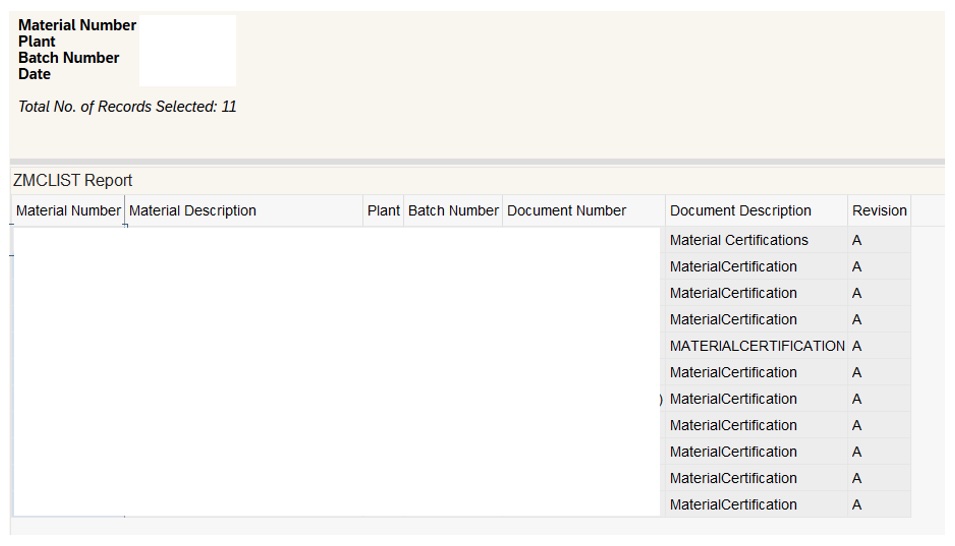
For example, when a customer requests certification documentation for a shipment, the system can automatically identify:
- The finished goods batch shipped to the customer
- The raw material batches used in production
- The certification documents associated with those batches.
The result is a complete documentation package that can be generated within seconds rather than hours.
Implementation Approach, Results
Deploying the automated certification solution required careful coordination across multiple technical and operational teams.
The implementation followed several phases:
- Architecture design. The first step involved defining the integration architecture and data flow between SAP, SharePoint, and the integration platform.
- Data mapping. Key metadata fields were mapped between systems to ensure certification documents could be linked accurately to SAP material batches.
- Integration development. Custom interfaces were developed to enable document ingestion, metadata extraction, SAP document linking and automated document retrieval.
- Identifying issues. During testing, issues included document number length in SAP restricted to 25 and re-triggering the meta data csv file in case incomplete material/batch information.
Analysis
Editor’s Note: What This Means for ERP Insiders
Middleware remains central to brownfield modernization strategies. The reliance on Seeburger and SharePoint reveals that hybrid integration architectures still dominate multi-plant global manufacturers unwilling to replace legacy SAP ERP instances.
Business Impact and Operational Benefits
The automated certification management system delivered several measurable benefits across the organization.
The most significant impact was the reduction in manual effort associated with certification document management. Prior to automation, employees spent substantial time locating, verifying, and compiling certification documents for customer requests.
By automating document linking and retrieval, the system eliminated much of this manual work, resulting in an estimated 4,000 hours of labor savings annually.
Additional benefits included:
- Faster response to customer compliance requests
- Improved audit readiness
- Reduced risk of documentation errors
- Centralized control of certification records
- Enhanced visibility into batch genealogy.
These improvements strengthened the organization’s ability to meet stringent customer and regulatory requirements while reducing operational overhead.
Key Lessons Learned
Organizations considering similar automation initiatives should keep several lessons in mind.
First, establishing a single authoritative source for certification documents is critical. Centralized document storage ensures consistency and prevents version conflicts.
Second, accurate metadata is essential for successful integration. Careful attention must be paid to mapping material numbers, batch identifiers, and document types across systems.
Third, user adoption plays a key role in realizing the benefits of automation. Training programs and clear documentation helped ensure employees understood how to access certification documents through SAP.
Automating material certification and batch genealogy processes can significantly improve operational efficiency and compliance in manufacturing environments. By integrating SAP with enterprise document management and EDI platforms, organizations can eliminate manual document handling and enable rapid retrieval of certification records.
The architecture described in this article demonstrates how centralized document management and automated integration can transform certification workflows across global manufacturing operations. With thousands of hours saved annually and improved responsiveness to customer requests, the solution highlights the value of combining SAP’s traceability capabilities with modern document automation technologies.
As regulatory and customer requirements continue to evolve, automated certification management systems will play an important role in ensuring compliance and operational agility.
Analysis
Editor’s Note: What This Means for ERP Insiders
Operational ROI justifies targeted automation over platform replacement. Achieving 4,000 hours annual labor savings through targeted integration demonstrates that incremental process automation delivers measurable value without full-scale transformation.