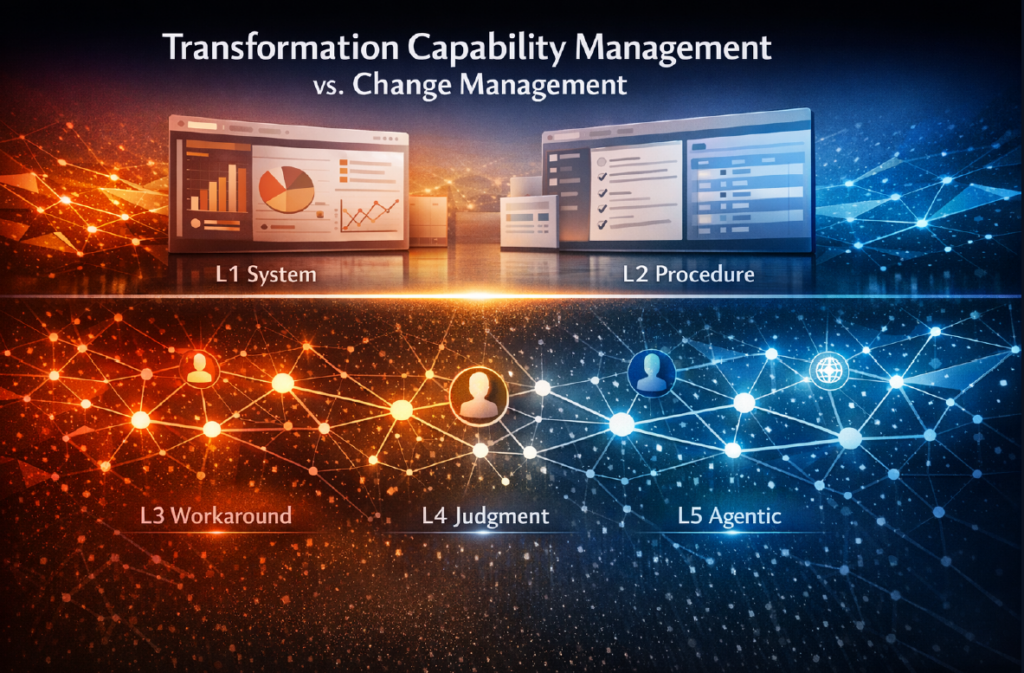

Across the public sector, significant investment is going into ERP and wider transformation programs with platforms replaced and processes redesigned. Despite the changes happening, many programs are still falling short of the outcomes they set out to achieve.
The data reflects this challenge. Gartner research indicates that by 2027, more than 70% of recently implemented ERP initiatives will fall short of fully achieving their original business goals. Its separate 2024 survey data also found that, across digital initiatives more broadly, only 48% meet or exceed their business outcome targets.
These figures point to a familiar issue: Delivery milestones and organizational outcomes are not the same thing. Programs can move forward, systems can go live, and yet, the underlying way the organization operates remains unchanged. It is at this point a more difficult question comes into focus: Is the organization ready to work differently?
In many programs, that question is answered too late. By the time adoption comes into focus and implementation is under way, the program is shaped around technology and delivery timelines while the harder work of changing behaviors, accountabilities and ways of working remains unsolved.
Analysis
What This Means for ERP Insiders
Readiness must move upstream in ERP programs. Transformation leaders should treat operating-model alignment, behavior change and process standardization as delivery work, not preparatory work, to reduce post-implementation underperformance.
ERP Implementations Expose Existing Problems
ERP programs rarely fall short because software alone has let the program down. More often, they expose what already exists within the organization. Longstanding workarounds, blurred ownership, inconsistent processes and local variations that once seemed manageable become more exposed when a new platform requires greater discipline. The system does not create those weaknesses, but it does make them harder to hide.
This is where readiness is often misunderstood. It is sometimes treated as a softer stage before delivery begins, or as something that can be addressed later through communications and training. Readiness is a test of whether the organization has thought clearly enough about how it wants to operate, what it is prepared to standardise and where it will need people to behave differently.
That question matters even more in the public sector, where major ERP programs are rarely launched in calm conditions. More often, they begin against a backdrop of financial pressure, aging systems, stretched teams and rising expectations about productivity and service quality.
Under those circumstances, pace can feel reassuring because movement is easier to demonstrate than preparedness. Yet a program can move quickly through procurement and design while still leaving the hardest organizational questions unresolved, only for the strain to appear later when the future model begins to affect real roles and decisions.
Go-live Can Be Misleading Measure of Success
This is where many programs begin to wobble. Go-live matters, and no serious program should diminish the effort required to reach it, but it is also the point at which many organizations begin telling themselves a story that is too simple. The system launches, disruption is limited and the risks appear to have been contained, yet the deeper question is whether anything has truly changed in practice.
Too often, the new platform sits alongside familiar habits rather than replacing them. That distinction matters because many of the benefits attached to ERP do not come from deployment alone. They come from consistency after deployment, from managers making the new process hold, from teams trusting the system enough to stop maintaining shadow arrangements and from leaders continuing to pay attention once the headline milestone has passed. Where that does not happen, the shortfall is often subtle rather than dramatic.
Reporting may improve but decision-making does not improve to the same extent. Processes may become more digital but not necessarily more disciplined. The new platform is live, yet the deeper operating change remains incomplete.
This problem becomes sharper in cloud ERP, where implementation is only one stage in a continuing cycle of change. Product updates continue, new functionality appears and opportunities for improvement keep emerging. Organizations that treat change as something to complete by go-live usually find themselves struggling soon afterwards because the real challenge is no longer whether the system works on day one, but whether the organization has the confidence and discipline to keep adapting with it over time.
Analysis
What This Means for ERP Insiders
Go-live no longer defines ERP success. For vendors, architects and integrators, the piece underscores that measurable value depends on sustained process discipline, leadership attention and adoption after deployment, especially in cloud environments.
What Leaders Need to Change
The first task for leaders is to bring readiness into the centre of the program much earlier and to treat it as part of delivery rather than as preparation for delivery. That means being clearer about the future operating model and more honest about where current behaviors are likely to conflict. Too many programs move forward based on broad support for change, only to discover later there is far less agreement about what the change requires.
Leadership also needs to treat adoption as a core part of implementation rather than as an activity running alongside it. Where adoption is seen as secondary, communications become narrower, learning is left too late and post-go-live support is approached too lightly. Where it is built into the program from the start, leaders are more likely to test whether the organization is ready to let go of familiar habits instead of assuming system training will be enough.
Success measures need the same discipline. Timeline, spend and defect counts all matter, but they only describe part of the picture. Senior leaders also need to ask whether processes are being followed consistently, whether responsibilities are clearer and whether the organization is becoming more capable of improving once the program team has stepped back. Those are harder questions because they test the substance of change rather than the completion of a plan.
Public sector ERP programs rarely fall short because the case for change is absent. They fall short because the organization leaves the most difficult part too late and then tries to catch up once implementation is already under way.
ERP can support operational improvement, but it cannot carry change by itself. When readiness, adoption and leadership attention are built in from the start, the program has a far better chance of delivering lasting improvement rather than a successful launch followed by slower disappointment.
Analysis
What This Means for ERP Insiders
Cloud ERP increases the premium on continuous change. Because updates, new functionality and optimization opportunities persist after implementation, partners must design support models that build organizational adaptability rather than one-time deployment capacity.