
According to Gartner more than 70% of ERP initiatives by 2027 will fail to fully meet their original business goals. This high failure rate is happening despite widespread investment in cloud platforms, analytics and AI from many industries. ERP leaders still hear a familiar frustration from business stakeholders: “We have the data—why aren’t we acting faster?”
In many organizations, ERP systems are functioning exactly as designed. Financial transactions are accurate. Workforce and operational data are current. Dashboards refresh frequently. Predictive models flag emerging risks earlier than ever.
However, when disruptions such as staffing shortages, compliance exposure, supply chain volatility or service breakdowns occur, the response is still slow, fragmented and reactive.
The issue is rarely data quality or tooling. It is a structural problem. Insight surfaces in one part of the ERP landscape while decisions and actions are owned elsewhere. Organizations generate intelligence everywhere, yet struggle to move it across decision boundaries.
This intelligence-to-action gap has become a major limitation for modern ERP systems.
ERP Modernization’s Operational Limitations
ERP platforms are the operational backbone of most enterprises. They record transactions, provide controls and regulate a shared system of record across many divisions. Over the last decade, ERP has been “modernized” through cloud migrations, better user experience, embedded analytics, and AI-enabled capabilities.
However, many organizations find it difficult to turn ERP investments into better, faster decisions. The problem is ERP platforms were designed to ensure accuracy and control. They weren’t built to orchestrate forward-looking decisions across the enterprise.
Today’s ERP leaders are expected to anticipate risk, optimize resources and intervene before issues escalate across interconnected systems and volatile environments. This requires ERP to function in ways that support enterprise intelligence.
Why Adding AI to ERP Isn’t a Solution
As ERP vendors embed more AI into their platforms, it is tempting to assume intelligence alone will close the gap. In practice, it often exposes how wide the gap really is.
For example, predictive alerts surface risks earlier, but the notices remain trapped in dashboards. Automation improves efficiency inside individual modules, but they don’t coordinate enterprise response. Chatbots answer questions without understanding downstream implications across finance, HR, compliance or provisioning systems.
The organization has richer insights, but this doesn’t make them more decisive or effective.
This mirrors wider enterprise research findings. For example, a McKinsey study found that while AI adoption continues to accelerate, many organizations are struggling to translate analytics into operational decisions at scale.
IDC’s study reported “over 65% of organizations believe AI is critical to their ERP system,” reinforcing the belief AI-driven innovation is a foundational requirement for modern ERP platforms.
The underlying issue is not the absence of AI, but rather the absence of a unifying enterprise model that defines where intelligence should live, how it should flow and how insight should trigger coordinated action across ERP systems.
The Structural Problem For ERP Leaders
Across large, multi-system ERP environments, similar patterns recur:
- Predictive insights surface, but they stall in progression
- Automation improves local efficiency but fragments enterprise response
- Governance lags behind intelligent decision-making.
At the core, enterprise intelligence does not fail because organizations lack insight, but because they lack a structure that connects insight to coordinated action.
Without that structure, teams face issues such as:
- Analytics inform, but do not decide
- Automation optimizes locally, but destabilizes globally
- Governance reacts after the fact instead of shaping design.
For example, a predictive staffing alert may surface in HR, while budget authority sits in finance and compliance approval resides elsewhere, leaving no single path for timely action.
Using CAIP-HE as a Structural Model for Intelligent ERP
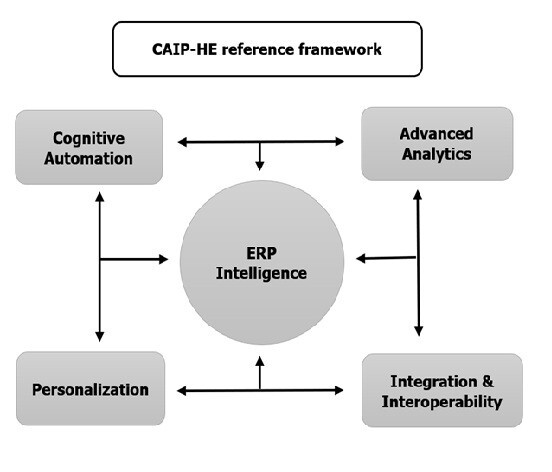
To address this structural gap, the CAIP-HE framework, developed by Tirumala Rao Chimpiri, is introduced as a reference model for how intelligence should flow across ERP environments.
The CAIP-HE framework does not introduce new technologies. Instead, it organizes capabilities most ERP environments already possess, but rarely integrate well. The framework builds on recurring patterns observed across complex ERP environments and is applicable across broader enterprise contexts.
CAIP-HE is not a product, platform, or implementation methodology. Organizations do not implement CAIP-HE like software or deploy it as a solution. Instead, it functions as a reference framework – a structural lens that evaluates how analytics, automation, integration and personalization interact within an ERP environment.
The framework consists of four interdependent elements:
- Cognitive automation
- Advanced analytics
- Integration and interoperability
- Personalization.
CAIP-HE, developed by Tirumala Rao Chimpiri, is not presented as a validated causal model; it is grounded in repeated enterprise patterns and is intended to help leaders reason about how intelligence should flow from insight to decision to execution.
When these elements operate together, ERP systems remain systems of record while also functioning as systems of intelligence that support anticipation, coordination and execution (Figure 1).
Observing Structural Patterns Across Industries
When viewed through the CAIP-HE reference framework, consistent structural patterns appear across industries. Examples in different industries show predictive insight changes outcomes when it is structurally connected to downstream workflows and decision authority. Three common patterns illustrate this challenge.
- In financial services, early risk signals improve outcomes when they trigger coordinated compliance and finance workflows.
- In manufacturing, predictive insight changes results when it flows into procurement and scheduling decisions.
- In logistics, real-time risk monitoring improves reliability when intelligence drives automated routing and proactive communication.
These examples illustrate how CAIP-HE can be used as an evaluative lens to diagnose where intelligence breaks down between insight and action.
Why Governance Must Be a Priority
Governance becomes more important as ERP systems are evolving to be smarter. Automated decisions should be explainable, auditable, and accountable. Where there are potential legal, financial, or ethical consequences, human judgment should still be included in the decision-making process.
Industry groups, including those convened by the World Economic Forum, emphasize that responsible AI systems must be explainable, auditable and accountable by design. These requirements must be designed into enterprise systems upfront and not retrofitted.
Governance needs to keep up with intelligent systems, not lag behind them. It needs to be part of how ERP systems are architected and how decisions run across them.
Four Ways ERP Leaders Can Use CAIP-HE as a Reference Framework
Using CAIP-HE as a reference framework, ERP leaders can ask more precise questions about how intelligence flows across their environments.
- Stop evaluating AI features in isolation. Assess how insights move or fail to move across ERP systems.
- Map decision ownership. Identify where insight stalls between detection and action.
- Design intelligence flows deliberately. Ensure analytics, automation, integration, and personalization operate as a system, not as separate initiatives.
- Embed governance early. Treat explainability and accountability as design requirements, not compliance add-ons.
Rethinking ERP’s role
ERP systems will always record transactions and enforce process consistency. That role is foundational, but insufficient in environments where decisions must be coordinated across analytics, automation and multiple interconnected systems.
As organizations embed more intelligence into ERP environments, the challenge is no longer whether insights exist; it’s whether those insights are structurally capable of triggering decisions and coordinated action across the enterprise. Without a unified structural model, intelligence becomes fragmented, governance becomes reactive, and automation amplifies inconsistency rather than resolving it.
CAIP-HE is not a replacement for ERP platforms or operating models. It is a structural lens for evaluating whether enterprise intelligence can flow from insight to decision to execution. In an environment where AI and analytics are everywhere but coordinated action remains rare, that structural lens is becoming essential.
Editor’s Note: What This Means for ERP Insiders
Intelligence-to-action gaps are a common cause of ERP failure rates. Organizations generate insights everywhere yet struggle moving intelligence across decision boundaries because ERP platforms were designed for accuracy and control rather than orchestrating forward-looking decisions across interconnected systems and volatile environments, as predictive alerts remain trapped in dashboards while automation improves local efficiency without coordinating enterprise response.
CAIP-HE reference framework addresses structural fragmentation. The framework functions as an evaluative lens for diagnosing where intelligence breaks down between insight and action, rather than introducing new technologies, enabling leaders to assess how analytics, automation, integration, and personalization interact within ERP environments as systems rather than separate initiatives. Transformation leaders must stop evaluating AI features in isolation and instead map decision ownership identifying where insight stalls between detection and action, designing intelligence flows that operate systemically.
Explainability and accountability must be architected. Automated decisions require human judgment inclusion where legal, financial, or ethical consequences exist, with workflow redesign determining whether intelligence can be consistently applied through traceable, auditable processes ready for human handover when needed. This signals product strategy evolution where ERP vendors must embed governance frameworks supporting responsible AI by design rather than retrofitting compliance.