For ERP leaders, shifting enterprise data to the cloud is no longer just a technical upgrade. It is a structural change in how they run core systems, govern data, and balance innovation against risk and cost every working day.
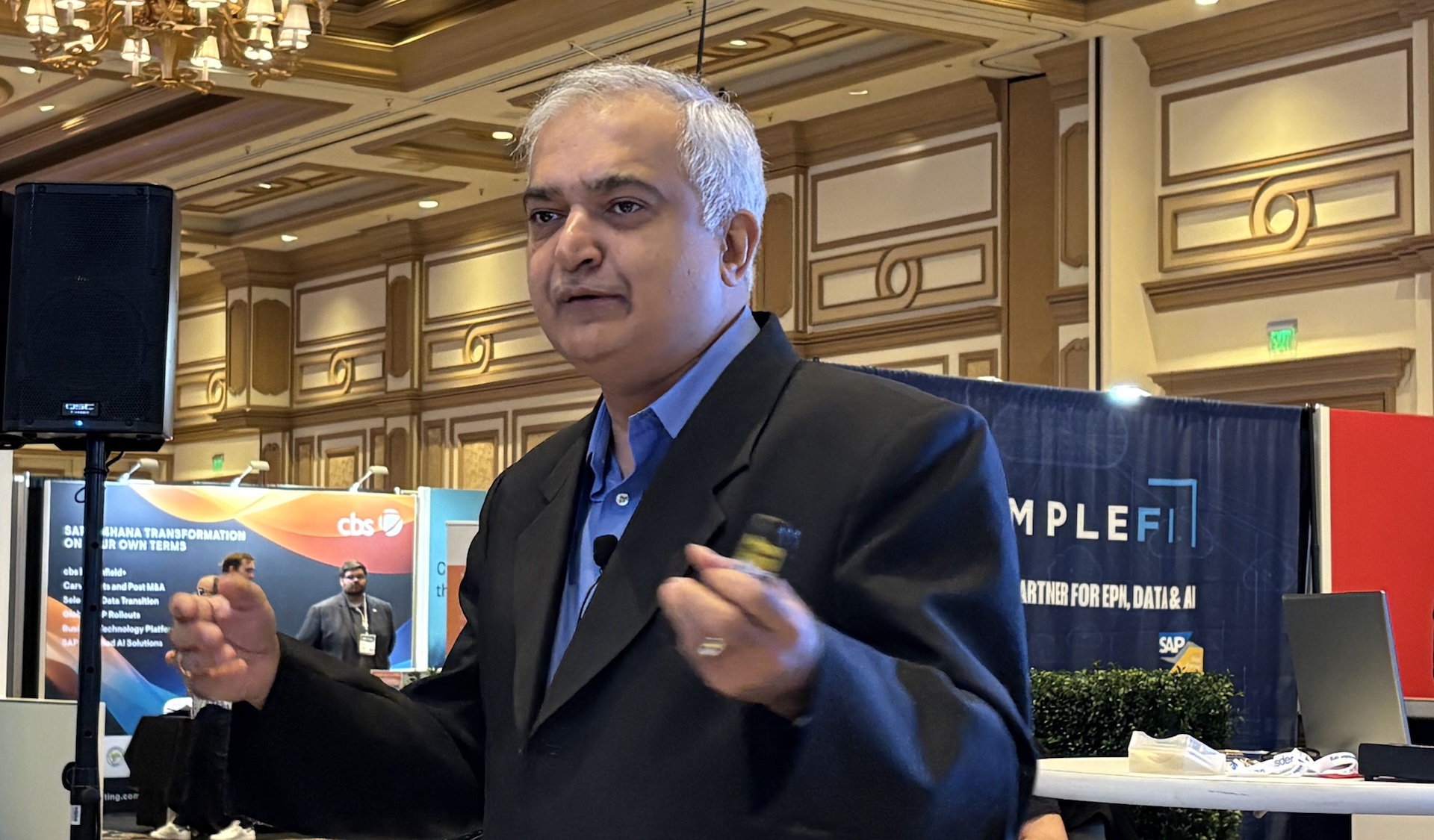
The SAPinsider Las Vegas 2026 session “Top 5 Challenges and Opportunities of Managing Data in the Cloud,” led by Mitresh Kundalia, principal, SAP Quality Systems & Software, framed cloud data strategy as a continuous operating discipline rather than a one-off migration. The themes resonate well beyond SAP and apply to any organization trying to modernize ERP around cloud platforms, analytics and AI.
Analysis
What This Means for ERP Insiders
Cloud operating discipline will shape ERP competitiveness. Executives must embed elasticity, security, and cost optimization into daily practice to unlock cloud-era ERP innovation without exposing the business to unmanaged financial or cyber risk.
Elastic Infrastructure Changes Planning, Designing and Reporting
The starting point is the cloud paradigm shift. Kundalia said, “Moving enterprise data to the cloud is more than a location change. It represents a fundamental transformation how data is managed, accessed and leveraged.”
Traditional data centers force CIOs to size hardware for peak load, meaning they pay for idle capacity 90% of the time yet still risk performance issues during seasonal spikes or promotions.
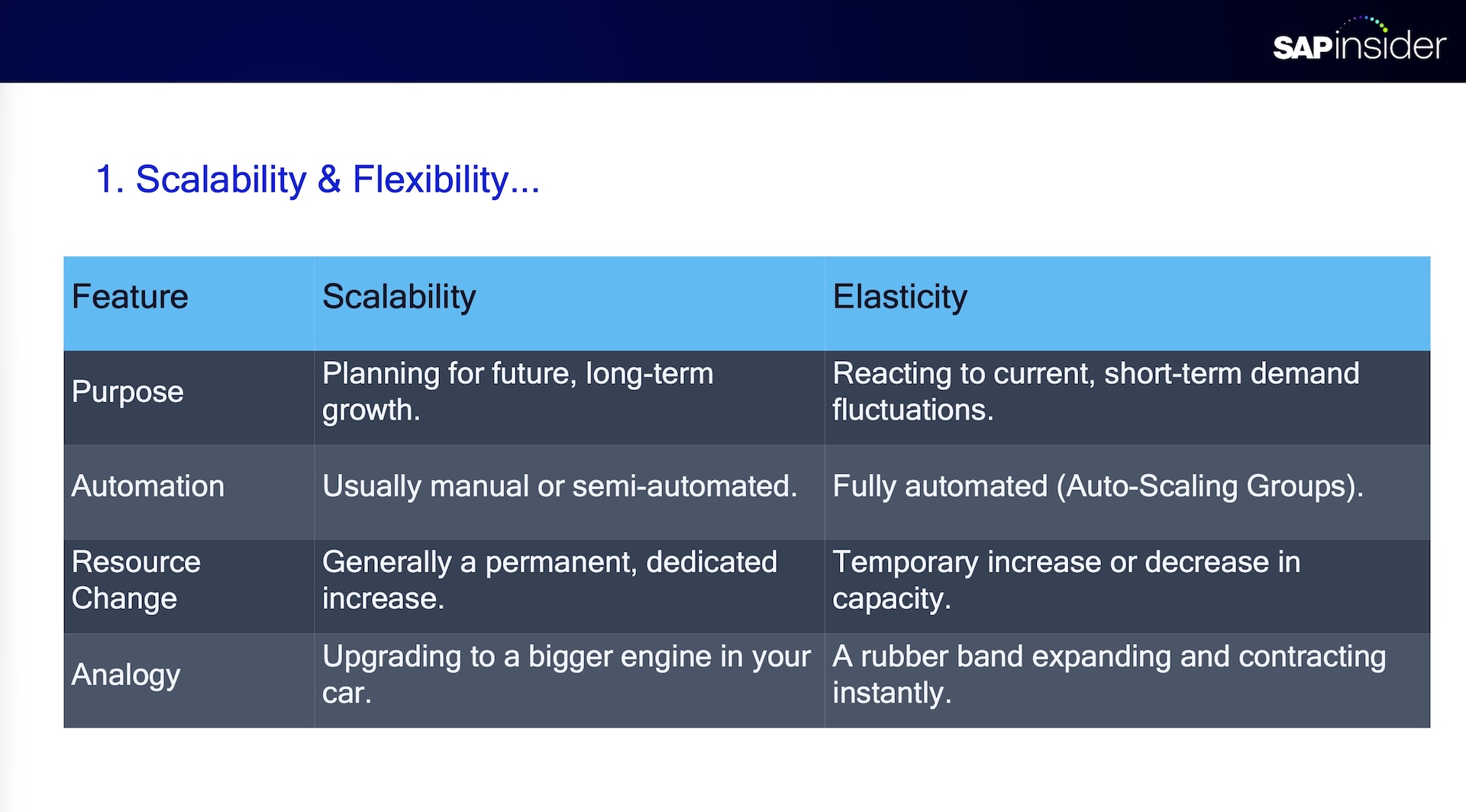
Cloud platforms replace that model with scalability and elasticity. Systems can scale vertically and horizontally by adding CPU, memory, or nodes, and auto-scaling rules can expand or contract resources in minutes based on actual demand. In Kundalia’s Black Friday retail example, on-premises servers crash under a 100x traffic surge, while a cloud-native setup provisions dozens of extra application servers automatically and then winds them down afterward. For ERP and platform teams, that means capacity planning becomes a matter of designing policies and monitoring metrics, not waiting months for hardware.
Elasticity introduces new responsibilities. Because it is easy to spin up resources, organizations often face “resource sprawl” and “zombie” instances that continue to run and generate cost long after projects finish. Kundalia recommended mandatory tagging for ownership and environment, lifecycle rules that shut down nonproduction systems during off-hours and infrastructure-as-code templates so every environment is defined, traceable and reproducible. In practical terms, ERP leaders must treat infrastructure as part of governance and cost control, not just something operations teams worry about.
Cloud-native analytics then change how the business consumes ERP data. Real-time pipelines and self-service BI allow organizations to move from monthly retrospective reports to near real-time dashboards and predictive alerts.
Pre-trained AI models, exposed via APIs, can plug into these pipelines to predict churn, detect fraud, or flag anomalies without requiring in-house data science teams. This shifts the day-to-day focus of finance and operations leaders from assembling spreadsheets to interpreting continuous signals and acting on them quickly.
However, real-time analytics only work if the underlying data is consistent and integrated. Kundalia highlighted long-running issues with data quality. “Without a unified semantic layer, revenue might mean something different to sales vs. finance,” he said.
Kundalia argued for architectures that favor ELT over ETL, bring raw data into cloud warehouses or lakehouses, and then use standardized transformations and a shared semantic layer.
Reverse ETL pushes curated metrics back into operational tools, ensuring that frontline systems and dashboards align. For ERP decision-makers, this means data architecture decisions must be made alongside application choices; without the former, the latter underdelivers.
Analysis
What This Means for ERP Insiders
Data architecture becomes the new integration frontier. Vendors and integrators that deliver unified semantic layers, ELT pipelines, and governed lakehouse patterns will best support real-time, AI-infused decision-making on top of SAP and non-SAP data.
Security, Cost, Governance and S/4HANA: Where Risk, Value Collide
Security and compliance remain primary board-level concerns as ERP workloads move to the cloud. Kundalia stressed large cloud providers often exceed the security posture of many on-premises data centers, but only if customers implement strong identity controls and configuration hygiene. The cloud has no meaningful “inside” perimeter; once a user’s credentials are compromised or a storage bucket is misconfigured, attackers have broad reach.
“If a user’s credentials are stolen, the attacker has the keys to the kingdom,” Kundalia said, adding the biggest cause of these intrusions is user error rather than hacking. “Real people suffer from these mistakes as productivity stalls out.”
Kundalia recommended companies adopt a zero-trust approach with multifactor authentication, encryption at rest and in transit, and policy-as-code guardrails that block insecure deployments by default. Continuous compliance scanning and automated evidence collection are essential for regulations ranging from GDPR to industry-specific mandates. For ERP and security leaders, this turns routine work into constant monitoring of identity, configuration and audit trails instead of periodic firewall reviews.
Cost management is another area where daily behavior must adapt. The move from capital expenditure to operational expenditure frees cash and brings granular visibility through per-second billing and detailed usage APIs. Yet the same flexibility can cause budgets to spike due to data egress fees, idle resources, or over-provisioned instances.
Kundalia recommended building a FinOps culture that uses dashboards, budgets, alerts, rightsizing, and spot instances for stateless workloads. For ERP portfolio owners, cloud cost becomes a shared responsibility across architecture, finance, and product teams rather than a line item revisited once a year.
Governance connects all these threads. Without strong policies and automation, data lakes quickly degrade into data swamps filled with duplicative, inconsistent information. Business units frustrated with central IT may launch their own cloud databases, creating shadow IT and inconsistent metrics. Kundalia pointed to modern data catalogs that scan estates, classify sensitive data, and enable safe self-service discovery. The goal is not to lock data away but to make it reliably usable with clear lineage, access rules, and retention policies.
For organizations planning or executing SAP S/4HANA moves, these considerations become even more critical. Kundalia positioned S/4HANA in the cloud as a fundamental transformation that simplifies the data model, accelerates innovation cycles, and integrates cleanly with adjacent SaaS platforms. His guidance centered on five phases: discover and classify data, cleanse and deduplicate, choose migration patterns, move in waves rather than big bang, and validate processes and controls after each wave. Day-to-day, that means ERP leaders must prioritize data cleaning and process standardization early, adopt a “clean core” mindset, and link each migration wave to measurable business outcomes.
Cloud adoption is no longer optional, but unmanaged cloud is risky. Scalability, elasticity, real-time analytics and AI will deliver competitive advantage, but only if security, cost, and governance are designed into how teams work every day.
Analysis
What This Means for ERP Insiders
S/4HANA cloud migration demands phased, outcome-led execution. ERP strategists should pair clean-core initiatives with staged cloud moves, explicit risk ownership and FinOps practices to ensure modernization delivers sustainable value rather than one-off project wins.