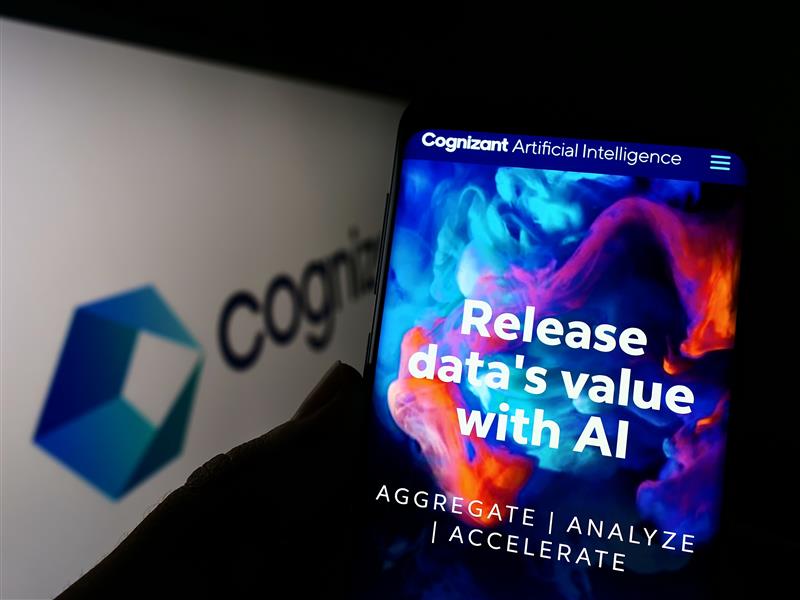
Cognizant and Microsoft have formalized a multi-year expansion of their existing AI partnership. Announced on December 18, the agreement expands the partnership to co-building industry-specific AI solutions, joint global go-to-market activity, and deeper integration of Microsoft’s AI stack into Cognizant’s services model.
Financial services, healthcare and life sciences, retail, and manufacturing will benefit first from the effort. These sectors combine high regulatory pressure, complex workflows, and large enterprise systems, where scaled AI deployments carry high risk and reward.
“By combining Microsoft’s trusted cloud and AI with Cognizant’s industry platforms, we are strongly positioned to help clients solve the last-mile challenge of scaling AI across the enterprise,” said Ravi Kumar S., CEO of Cognizant.
More broadly, the expansion shows how hyperscalers and professional services are reshaping enterprise AI delivery. Hyperscalers continue to narrow partner ecosystems, while large services firms move upstream from implementation toward AI orchestration.
The result is deeper alliances for hyperscalers and services firms operating higher in the AI value chain. Enterprise buyers give up some interoperability options in exchange for more integrated stacks, clearer ownership models, and faster paths to production.
Moving AI From Pilots to Production
AI adoption often stalls before it produces durable operational impact. While organizations have invested heavily in models and pilots, many struggle to translate those efforts into repeatable improvements embedded in day-to-day operations.
The technical focus of the partnership is workflow-level AI integration. Cognizant and Microsoft are embedding agentic AI directly into core business processes, where decisions are made, transactions occur, and systems of record interact.
At the platform level, Microsoft’s Copilot stack—spanning Microsoft 365, GitHub, and Azure—provides the interface and orchestration layer. The Work IQ, Foundry IQ, and Fabric IQ capabilities support workflow intelligence, data integration, and operational analytics.
Cognizant’s role is to connect these tools to enterprise systems, industry platforms, and process logic, allowing AI agents to act within established workflows.
While Microsoft’s AI and data services form the underlying intelligence layer, Cognizant packages that capability into repeatable, industry-specific assets.
Azure, Azure AI Foundry, and Microsoft Fabric supply model access, data pipelines, and governance controls. Cognizant builds on that foundation through its Neuro AI Suite, embedding domain logic, compliance rules, and process context specific to each sector—TriZetto, Skygrade, and FlowSource anchoring AI to established industry systems.
The approach emphasizes configurable solution patterns where prebuilt agents, workflow templates, and data models can be reused across clients, allowing standardized AI delivery.
Why Depth Matters in Production-Ready AI
The partnership sits alongside Microsoft’s broader December partner rollout with services firms, including Infosys, TCS, and Wipro. While that effort also emphasized workforce scale, the Cognizant agreement adds more sector and go-to-market focus, aligning deployment with co-built industry solutions.
Microsoft’s partnerships show how the economics of delivery are changing for hyperscalers, which are concentrating investment and co-development with fewer firms.
Depth, rather than breadth, has become the differentiator for production-ready AI, favoring services providers that can operate inside regulated, mission-critical environments.
At the same time, services firms are moving upstream into AI orchestration. Their role expands from deploying tools to owning integration logic, operational controls, and ongoing optimization—responsibilities closer to business outcomes and accountability.
Cognizant’s recent acquisition of 3Cloud reinforces this delivery model. As an Azure-focused services specialist, 3Cloud adds depth in cloud-native architecture, data platforms, and AI operations on Microsoft’s stack.
The convergence of hyperscalers and services firms presents a trade-off for enterprise buyers. Tighter alliances can reduce some interoperability choices, such as the ability to mix and match AI platforms, models, or integration partners across the stack.
In return, enterprise buyers are more likely to see ROI through faster deployment cycles, lower integration overhead, and AI capabilities that are embedded directly into workflows. The payoff is less optionality at the component level, but more predictable outcomes at the operational level.
What This Means for ERP Insiders
Market consolidation is accelerating. Hyperscalers are prioritizing fewer, deeper partnerships as AI moves into production, favoring service providers that can operate inside regulated environments and mission-critical systems. Expect a shift from open ecosystems to curated alliances with clearer lines of accountability.
Consultants are moving up the AI value chain. Large services firms are expanding beyond implementation into AI orchestration, taking ownership of integration logic, governance, and operational performance tied directly to business outcomes. Professional services are becoming long-term AI operators, not short-term deployment partners.
ERP procurement is becoming more strategic. AI integration increasingly arrives bundled with cloud platforms and services partners, reducing mix-and-match flexibility while simplifying deployment, governance, and lifecycle management. ERP buyers will optimize for production readiness and accountability, not just feature breadth or vendor optionality.