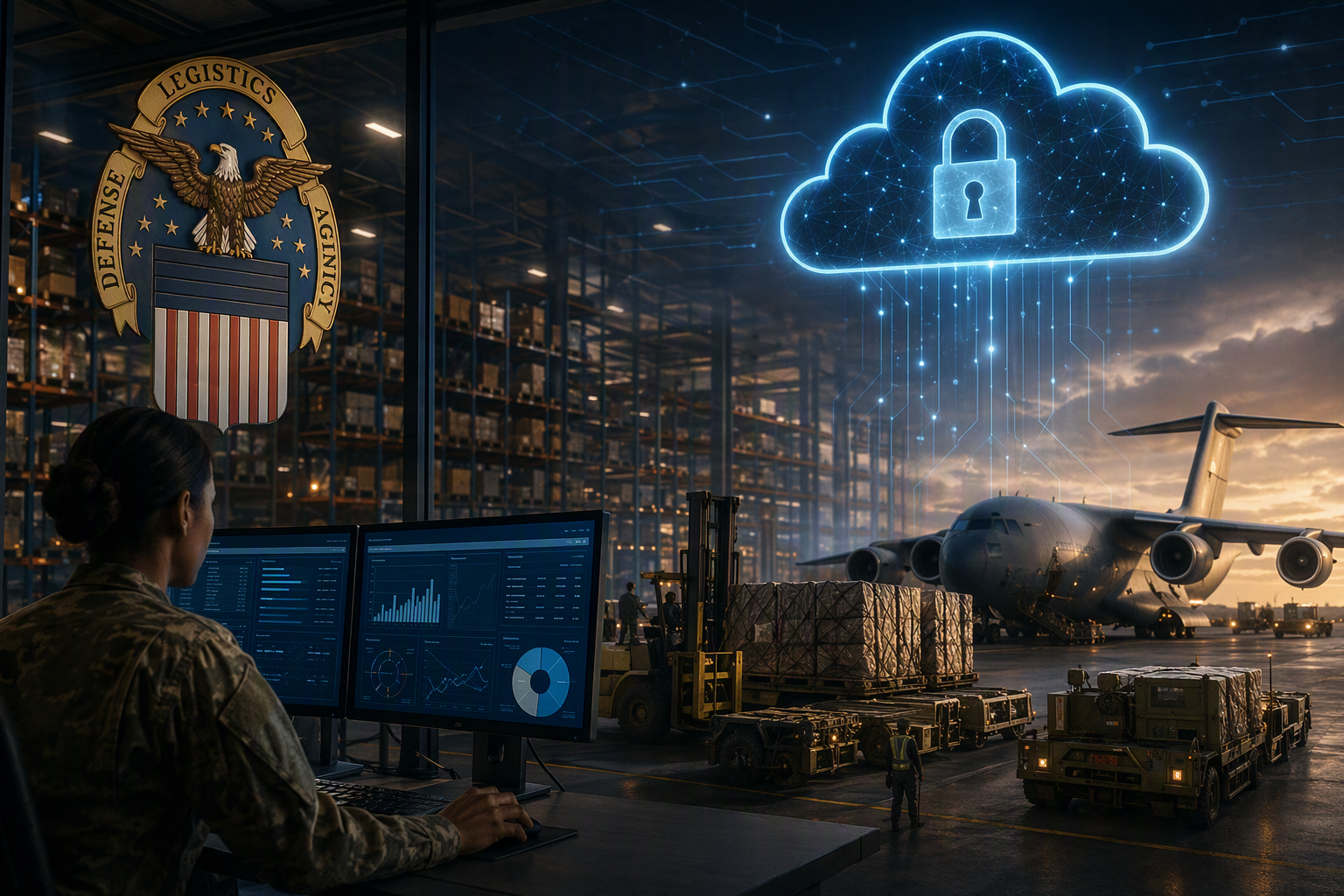
The Defense Logistics Agency (DLA) is turning ERP modernization into an audit-readiness race. DLA is years ahead of schedule on an ERP modernization program aimed at reducing technical debt, improving financial accountability, and moving the agency away from heavily customized legacy systems.
At the same time, a related federal opportunity shows DLA seeking SAP ERP cloud hosting, subscription licenses, and managed services, including SAP NS2 PCE RISE Cloud Services.
The two developments show how federal ERP modernization is changing. Agencies are not only replacing aging systems. They are trying to establish secure cloud baselines, reduce custom code, standardize processes, strengthen audit evidence, and shift more sustainment responsibility to commercial platforms and managed-services providers.
The procurement angle also raises the stakes for SAP partners, federal systems integrators, secure cloud providers, and public-sector ERP specialists. DLA’s modernization path sits at the intersection of SAP, cloud hosting, auditability, procurement transformation, and defense-scale sustainment.
Analysis
What this means: Federal ERP modernization is a proof problem. Agencies need platforms that can generate clean records, normalize processes, preserve controls, and support audit evidence at scale. The modernization winner will not simply be the system that runs the process; it will be the system that proves the process happened correctly.
Audit Pressure Moves the Timeline
DLA’s modernization effort began as a technical-debt problem.
Federal News Network reported the agency funded its ERP transformation in 2020 and began implementation in 2021, initially targeting completion by 2030. DLA CIO Adarryl Roberts said the agency found its ERP had been customized so heavily that transitioning to the new baseline would be nearly impossible without buying down technical debt and reengineering business processes.
The audit deadline changed the pace. Roberts said the need to be auditable by 2027 was a major driver, forcing DLA to accelerate so it could establish a firm technical baseline, normalize processes, train the workforce, and create the evidentiary material required for audits.
As of February 2026, DLA’s finance, warehousing, distribution, and disposition services were on the new ERP technical baseline. Procurement is the final major component and is scheduled to move at the beginning of fiscal 2028.
That makes procurement the next pressure point. It is also one of the hardest areas to modernize in a defense logistics environment because procurement connects mission demand, vendors, contract rules, funding, inventory, distribution, and compliance records.
Getting to Commercial Public-Sector ERP
DLA is also moving away from a government-built procurement application.
Roberts told Federal News Network the DLA had maintained a government-built procurement system for the past 10 to 15 years and is now on track to use out-of-the-box public-sector capabilities built into its ERP platform.
That shows how custom government systems can create long-term sustainment risk. Agencies become dependent on specialized developers, undocumented workarounds, aging code, and institutional knowledge that leaves when employees retire or contractors rotate off.
Commercial off-the-shelf ERP does not remove every public-sector requirement. DLA still has laws, regulations, mission needs, and defense-specific responsibilities that may require configuration or extension. But the agency is seemingly trying to return more of the operating model to standard, especially where commercial public-sector capabilities can support auditability and lower sustainment burden.
The related DLA ERP Procurement for Public Sector, or PPS, DIBBS modernization notice reinforces that direction. HigherGov’s summary says the goal is to upgrade the current ERP environment to SAP S/4HANA Cloud, with a focus on implementing SAP Procurement for Public Sector and Bulk Fuels Management 4.0 by October 2027.
Analysis
What this means: Customization can be an audit liability. Federal agencies can justify some tailoring when law, mission, or security requires it, but years of custom code can make upgrades harder and evidence weaker. DLA’s move toward commercial public-sector ERP capabilities shows how audit readiness can push agencies back toward standard processes.
The Cloud Services Contest
The modernization work is also creating a secure cloud and managed-services contest around DLA’s SAP environment.
A SAM.gov solicitation summary published by Drexault describes a DLA requirement for SAP ERP cloud hosting, subscription licenses, and managed services through an indefinite delivery, indefinite quantity contract. The opportunity covers SAP NS2 PCE RISE Cloud Services, SAP NS2 multi-tenant cloud services, professional services, premium engagement services, and other commercial off-the-shelf software identified in the contract line items.
The solicitation summary says the services would support DLA’s mission-critical SAP platform workloads and multiple ERP applications integrated with the agency’s existing SAP infrastructure. G2X separately listed the item as a DLA RFP for a $903 million ERP cloud hosting and SAP RISE support IDIQ.
That makes the opportunity broader than hosting. DLA is looking for vendors that can support enterprise-scale SAP operations in a DoD environment, including cloud infrastructure management, security, compliance, service levels, SAP credentials, and managed support.
For SAP NS2, systems integrators, and secure cloud partners, DLA represents the kind of customer where ERP modernization cannot be separated from operational risk. The agency supports military logistics, distribution, procurement, finance, and supply chain operations that cannot afford weak controls or unstable migration paths.
Cloud Is Part of the Audit Model
Federal News Network also reported DLA’s ERP modernization occurred alongside a major application rationalization effort.
When DLA began its digital transformation in 2021, the agency managed roughly 1,300 applications. After review, it narrowed that portfolio to about 100 applications. Roberts said DLA took a cloud-first approach, driven by data center closure mandates, scalability needs, and the eventual use of automation and AI-type tools.
DLA is now nearly entirely cloud-based and operates a multi-cloud environment across Oracle Cloud Infrastructure, Microsoft Azure, Amazon Web Services, and Google Cloud. Roberts said the agency chose a multi-cloud strategy for resilience and to use the major cloud providers where each made sense.
That cloud context is important because audit readiness depends on more than ERP functionality. Agencies also need stable hosting, secure identity and access controls, reliable integrations, documented change management, system availability, backup and recovery, and operational evidence across the full technical environment.
A clean audit trail can fail if the infrastructure around the ERP system is fragmented, poorly governed, or unable to preserve evidence consistently.
Analysis
What this means: Cloud hosting is becoming part of federal ERP assurance. Agencies need providers that can run mission-critical workloads securely, document operational controls, support resilience, and preserve evidence for auditors. ERP modernization will increasingly reward vendors that can connect application delivery with cloud operations and compliance discipline.
Sponsor Industry-Grade Research
Managed Services Up the Value Chain
DLA’s requirements also show how managed services are moving deeper into federal ERP transformation.
Traditional ERP support has centered on keeping the application running, applying fixes, managing enhancements, and supporting users. DLA’s environment requires more. Providers may need to support hosting, subscriptions, SAP RISE services, premium engagement services, migration, compliance, cybersecurity, service-level management, and sustainment across a complex SAP landscape.
That creates a higher bar for partner readiness. Federal ERP teams need vendors that understand SAP architecture, Defense Department controls, acquisition requirements, secure cloud operations, audit evidence, and business process modernization. They also need partners that can help agencies move away from fragile custom code without disrupting mission operations.
The opportunity also reflects a broader procurement trend. Agencies are buying outcomes around modernization, security, audit readiness, and lifecycle sustainment, not just software licenses or implementation labor.
That shift gives established federal integrators an advantage, but it also opens space for specialized SAP, cloud, and security partners that can bring targeted capability into larger bid teams.
What is the ERP Baseline?
DLA’s story connects three modernization forces that are often discussed separately.
- The agency needs to reduce technical debt by de-customizing where possible and shifting toward commercial public-sector ERP capabilities.
- It needs a secure cloud and managed-services model that can support SAP operations at defense scale.
- And it needs an ERP baseline strong enough to support the Defense Department’s audit push.
Those goals reinforce each other. A standardized ERP process is easier to train, sustain, and audit. A secure cloud platform can improve scalability, resiliency, and operational visibility. Managed services can help agencies maintain specialized systems without carrying all of the capability internally. Audit pressure gives the modernization program urgency and a concrete test of whether the changes worked.
For public-sector ERP leaders, DLA’s modernization path offers a clear lesson. The audit is not a reporting event at the end of the year. It is a design requirement for the ERP program from the start.
Analysis
What this means: Audit readiness should shape ERP design before implementation begins. Public-sector CIOs and controllers need to align process standardization, data quality, access controls, cloud hosting, change management, and evidence capture around the audit outcome they must eventually defend. DLA’s path shows why modernization programs need finance, procurement, IT, and compliance leaders at the table together.