Nokia has signed a multi-year agreement with SAP to accelerate its enterprise transformation through RISE with SAP Methodology, with its SAP S/4HANA environment hosted on Microsoft Azure. SAP announced the agreement on June 30 and said it was concluded at the end of 2025.
The deal marks a significant step in Nokia’s move toward RISE with SAP and builds on the company’s ongoing consolidation of multiple ERP systems into a unified SAP S/4HANA landscape.
The transformation covers Nokia’s business-critical ERP environment, including finance and key logistics capabilities. Nokia’s SAP landscape includes SAP S/4HANA for central finance, SAP Master Data Governance, SAP Extended Warehouse Management, SAP Global Trade Services, and SAP S/4HANA Cloud for advanced available-to-promise.
The agreement puts Microsoft Azure underneath that transformation, giving Nokia a hyperscale cloud platform for SAP workloads while SAP operates and manages the S/4HANA environment in the cloud.
Hyperscalers’ Role in ERP Transformation
Large SAP customers are no longer treating hyperscaler choice as a background infrastructure decision. The cloud platform increasingly shapes migration risk, performance, security, operational resilience, data strategy, and the pace at which companies can adopt AI-enabled capabilities.
SAP said Azure will provide the global scale, security, and performance needed to support Nokia’s most business-critical enterprise workloads. Nokia already operates parts of its SAP landscape on Azure, and consolidating more workloads on one hyperscale platform is expected to support performance, security, latency, and resilience.
For ERP leaders, that makes the Nokia agreement more than a RISE with SAP customer win. It shows how the ERP core, cloud platform, and AI roadmap are becoming harder to separate.
Analysis
What this means: Hyperscaler choice can shape ERP strategy. Nokia’s RISE with SAP agreement shows how cloud platform decisions influence performance, resilience, AI readiness, and long-term ERP operating models. ERP leaders should treat hyperscaler selection as a strategic architecture decision, not a hosting detail.
RISE Is the Transformation Wrapper
SAP is positioning RISE with SAP as a structured business transformation framework rather than a one-time technical migration.
For Nokia, that means using RISE with SAP Methodology to manage processes, data, applications, and operating models as the company modernizes its ERP environment. SAP said the approach provides a road map, integrated toolchain, and continuous access to innovation while helping Nokia keep a clean core.
Global ERP consolidation can create value by standardizing processes and reducing complexity, but only if companies avoid recreating the customization sprawl that made earlier landscapes hard to maintain.
Nokia’s move shows the operating model behind modern SAP transformation—simplify the ERP landscape, shift infrastructure management to SAP’s cloud operating model, and use the resulting foundation to adopt embedded AI and cloud innovations over time.
Analysis
What this means: Clean-core discipline will decide how much value cloud ERP delivers. Nokia is consolidating its SAP landscape while using RISE with SAP Methodology to manage processes, data, applications, and operating models. Cloud migration can reduce complexity, helping transformation teams not to carry old customization and fragmented process design into a new environment.
Get Our Free Weekly Newsletter
AI Value Starts with ERP Core
SAP said Nokia will gain access to embedded AI capabilities through SAP’s cloud ERP portfolio, with AI-enabled functionality adopted progressively as part of the journey. Nokia also described the agreement as a future-ready path for business growth that simplifies the ERP landscape, enables continuous innovation, and strengthens the company’s commitment to AI-driven processes.
That is the practical AI story for ERP teams. AI cannot deliver much value inside fragmented ERP environments if master data, logistics processes, finance structures, and operating models remain inconsistent. Nokia’s program ties AI readiness to the core modernization work underneath it.
Microsoft’s role also reinforces the hyperscaler dimension. SAP and Microsoft have been expanding their RISE with SAP on Microsoft Azure initiative, offering customers technical expertise, support, and migration guidance designed to reduce risk and accelerate cloud innovation.
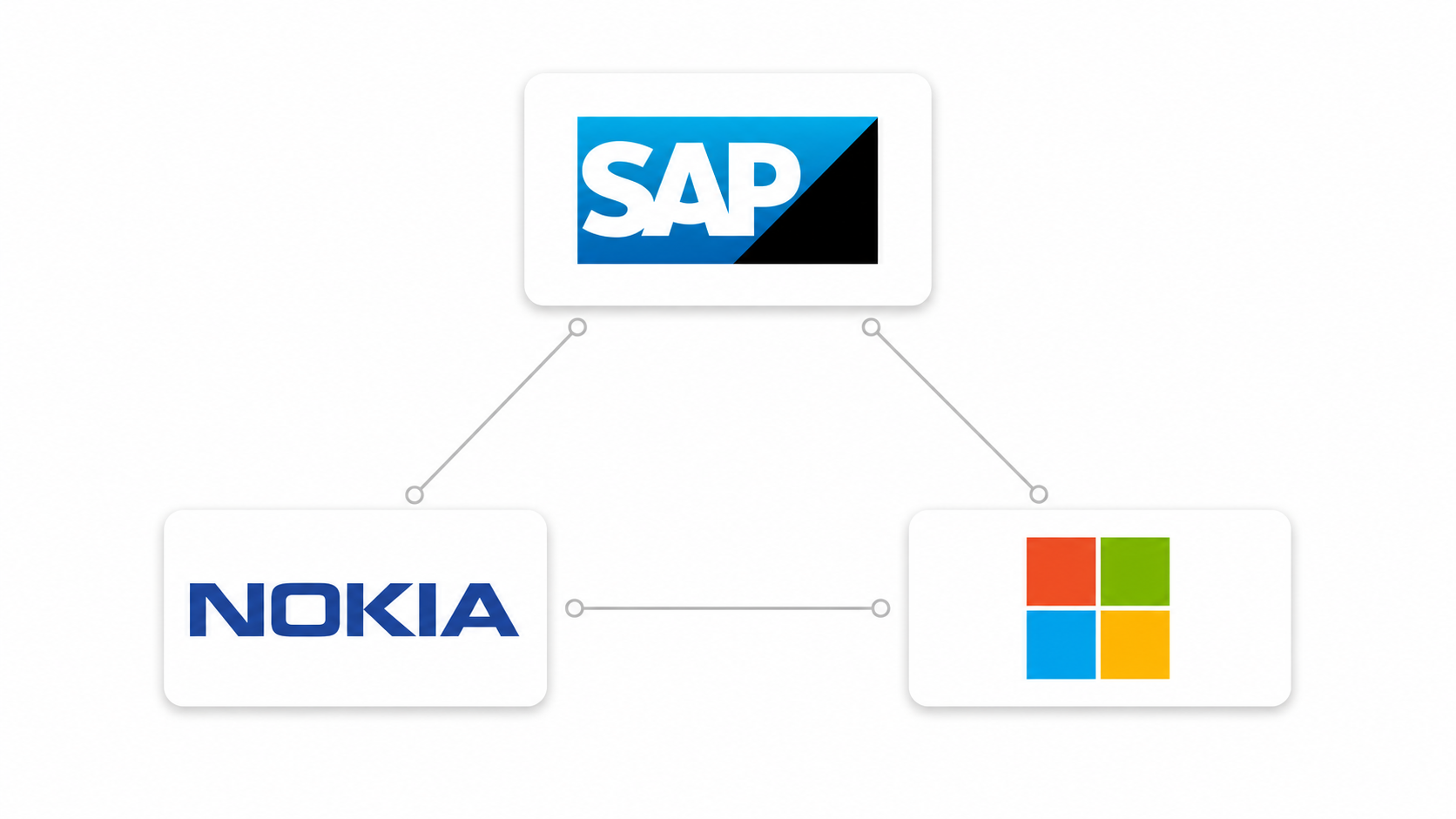
For Nokia, the result is a three-party transformation model: SAP provides the ERP and managed cloud operating framework, Microsoft provides the hyperscale infrastructure, and Nokia uses the combination to simplify its global ERP backbone while preparing for AI-enabled processes.
Analysis
What this means: AI readiness starts in the business core. Nokia’s agreement links embedded AI adoption to S/4HANA modernization, master data governance, logistics, trade, warehouse, and finance capabilities. ERP teams should expect AI value to depend on whether the core system has clean data, standardized workflows, and a cloud foundation that can absorb continuous innovation.