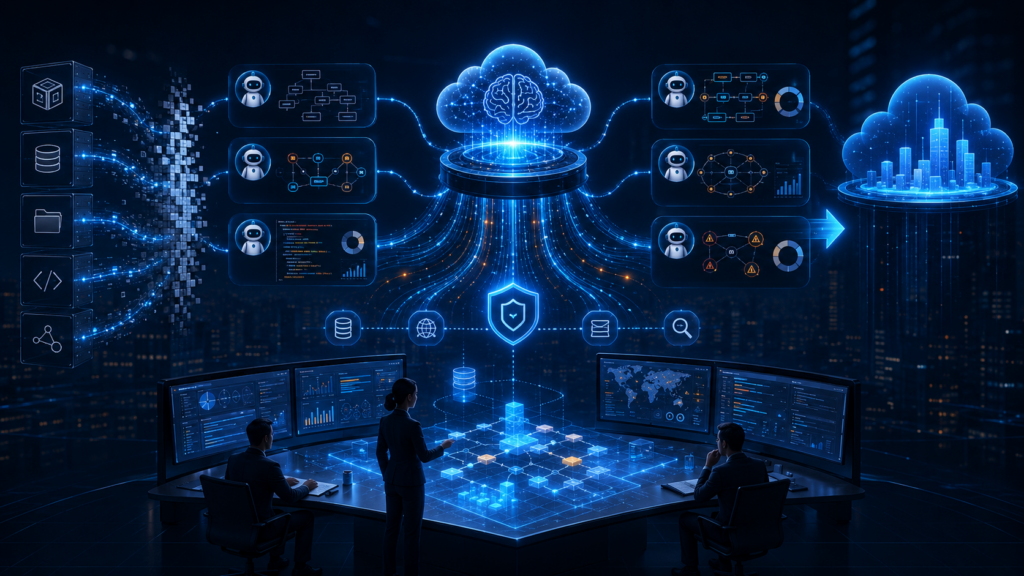
Microsoft is pushing Dynamics 365 Supply Chain Management deeper into agentic execution, positioning its ERP Model Context Protocol (MCP) Server as the governed connection point that lets AI agents act across supply chain processes, not just surface recommendations for human follow-up.
In a May 4 Dynamics 365 blog post, Sameer Verma, vice president and chief product officer of Microsoft Dynamics 365 AI ERP, framed the change around a familiar supply chain problem—disruption signals are everywhere, but they remain fragmented across suppliers, logistics, operations, and compliance systems. The challenge is no longer simply seeing disruption. It is synthesizing enough context to act before delays ripple into orders, production, inventory, and customer commitments.
The Dynamics 365 ERP MCP Server reportedly is Microsoft’s answer to that execution gap. The server gives agents secure, governed access to business processes and data inside Dynamics 365, allowing them to take actions such as updating orders, adjusting supply plans, or initiating transfers based on current conditions.
From Supply Chain Visibility to Execution
Per Microsoft, supply chain AI has to move beyond isolated use cases. In the blog, Verma described leading companies as moving toward decisions and actions that connect across end-to-end processes. That includes more proactive risk management, faster execution, and closer coordination between people and agents.
The ERP MCP Server connects agents to both data and execution systems. Agents can respond to live operational signals and take action inside Dynamics 365 Supply Chain Management, while remaining tied to business policies and constraints such as service levels, customer priorities, and cost thresholds.
A planning agent that identifies a material shortage but cannot trigger a transfer or adjust a supply plan still leaves the execution burden on planners. Microsoft is positioning Dynamics 365 so agents can help close that loop inside the system of record, with people focused on oversight, exceptions, and strategic decisions.
Governance Moves with the Agent
Microsoft does not present autonomy as unrestricted system access. It anchors the agentic supply chain model in governance, business context, and human control.
Work IQ gives agents real-time understanding of how work happens across the organization by connecting productivity tools such as Outlook, Teams, and Word with live operational data in Dynamics 365. In a disruption scenario, that means the agent can see the impact on orders, inventory, and customer commitments before acting in the system of record.
Microsoft also points to Microsoft Agent 365 as the place for IT teams to observe, govern, and secure agents across the organization. That governance layer becomes critical as agents begin touching real supply chain processes. Once agents can update orders or supply plans, the key design question changes from what insight they generate to which actions they can take, under which policies, and with what review or escalation requirements.
Get Our Free Weekly Newsletter
Customer and Process Examples Show the Boundaries
Microsoft cites Coca-Cola Beverages Africa as a customer using Dynamics 365 and the Dynamics 365 ERP MCP Server to autonomously run planning cycles and simplify work for end users. A second customer reference comes from Farmlands Cooperative. Andre Scheepers, chief digital officer at Farmlands, said the company is standardizing on Microsoft Dynamics 365 and applying agentic AI “with humans firmly in the loop” to create a more efficient, resilient, and scalable operating model.
In forecast-to-plan, Dynamics 365 Supply Chain Management Demand Planning capabilities and Copilot can help planners incorporate external signals, explain why forecasts are moving, and evaluate scenarios. In source-to-pay, a procurement agent can triage supplier communications, match them to affected purchase orders, summarize downstream impacts across inventory, sales orders, and production schedules, and highlight options when inventory is available elsewhere in the network.
Across production, warehouse, order fulfillment, field service, and commerce scenarios, Microsoft’s message is consistent: agents should help apply updates directly inside operational workflows, while people continue to handle oversight, exception management, and higher-value decisions.
Sponsor Industry‑Grade Research
What This Means for ERP Insiders
AI agents inside ERP systems are moving closer to governed execution. The Dynamics 365 ERP MCP Server gives agents a controlled path to update orders, adjust supply plans, and initiate transfers inside ERP workflows. For supply chain leaders, the evaluation question now extends beyond recommendation quality to action rights, policy constraints, and auditability.
Supply chain AI reliability depends on business context. Microsoft’s emphasis on Work IQ, Dynamics 365 operational data, and productivity signals shows that agents need context from both work conversations and the system of record. Enterprise architects will need to design agent workflows around orders, inventory, customer commitments, and business rules rather than treating agents as disconnected assistants.
Human oversight remains part of the operating model. The customer and process examples keep people in the loop for decisions, exceptions, and mitigation. Dynamics 365 customers exploring ERP MCP Server should ask where autonomous planning begins and ends, which actions require review, and how Agent 365 governance will document agent activity across supply chain workflows.