Google Cloud is using two major partnerships to push Gemini Enterprise further into the operating layer of enterprise AI.
Per a May 28 announcement, Workday and Google Cloud expanded their strategic partnership to bring HR and finance agents into Gemini Enterprise, with Workday’s Sana Self-Service Agent now available in early access for eligible Workday customers. And per a June 4 announcement, IBM and Google Cloud launched a new Google Cloud Practice that will bring thousands of IBM consultants and forward-deployed engineers into enterprise AI deployment, core systems modernization, and industry-specific agent delivery.
Workday and Google Cloud named Accenture, Deloitte, and KPMG as global systems integrator partners helping customers identify and deploy high-impact agentic use cases. IBM’s partnership goes further by creating a dedicated Google Cloud Practice with certified consultants and industry-specific agent assets.
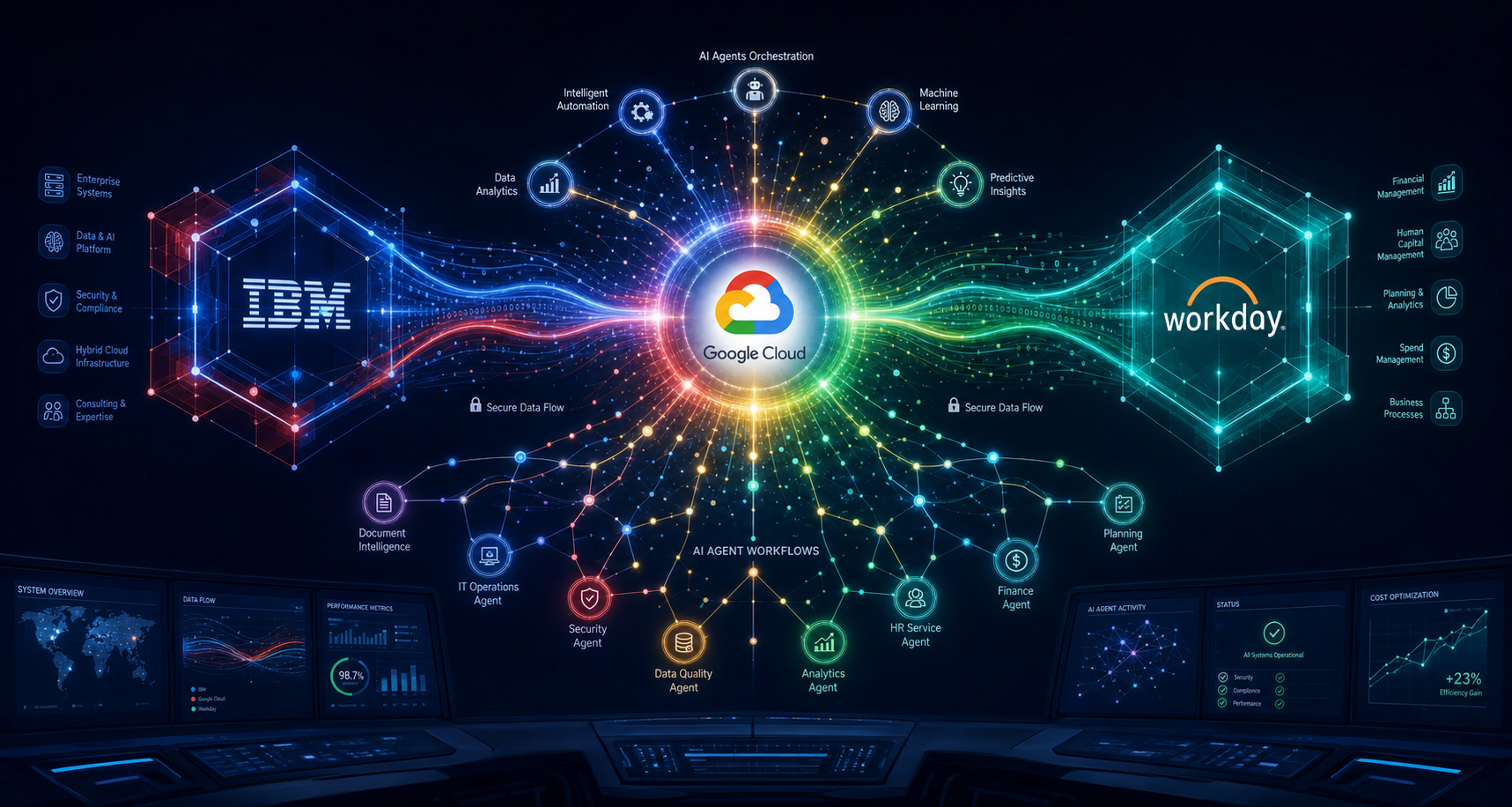
The two announcements are aimed at different parts of the enterprise market, but they point to the same strategy. Google Cloud is trying to make Gemini Enterprise become a place where agents can operate across enterprise applications, data platforms, industry workflows, and delivery teams.
Analysis
What this means: Google Cloud is building Gemini Enterprise through application and delivery partnerships. The Workday and IBM announcements show Google Cloud using partnerships to move Gemini Enterprise into real business workflows and large-scale transformation programs. ERP leaders should watch how quickly Google can turn model strength into governed execution across HR, finance, industry, and hybrid-cloud environments.
Workday: HR and Finance Agents in Gemini Enterprise
Workday and Google Cloud’s expanded partnership puts the Sana Self-Service Agent from Workday directly into Gemini Enterprise. Employees can ask questions in Gemini Enterprise and receive answers pulled from Workday, with policies and permissions applied.
Gemini is also becoming the default AI model for Sana for Workday. Workday said Sana supports CHROs, CFOs, managers, and employees in one place, allowing them to ask questions, trigger workflows, and work with Workday agents. With Gemini as the default model, Workday is positioning the integration around stronger reasoning, multilingual support, and multimodal capabilities, while keeping Workday’s security, business rules, and approval chains in place.
The initial use cases are everyday HR and finance tasks. Employees can check time-off balances, update personal information, view payslips, review tax withholding, or request leave through a conversational flow. Managers can review team goals, approve timesheets in bulk, start performance reviews, or submit payroll input. Finance users can ask about expense and travel policies, check corporate card eligibility, and receive guided help to create requests or open cases.
Multi-Agent Workflows Need Governance, Data Context
The Workday-Google Cloud announcement is also a governance story. The companies said the partnership combines the Workday Agent System of Record with Google Cloud’s agent platform and models to create a foundation where agents from Workday, Google Cloud, and third parties can work together on HR and finance workflows.
The partnership supports Agent-to-Agent, Agent-to-UI, and Model Context Protocol approaches, allowing agents to share information and hand off tasks inside a workflow. Alphabet will also use the collaboration to build and run a custom Workday agent through Gemini Enterprise Agent Platform for Workday administrators.
A deeper data connection is part of the same push. Workday and Google Cloud are connecting Workday Data Cloud and Google Cloud Lakehouse through zero-copy technology, allowing data to be shared and queried without moving or duplicating it. The companies said this allows organizations to analyze business trends and financial risks while keeping data in Workday’s secure environment.
Analysis
What this means: Agent adoption depends on trusted systems of record. Workday’s partnership with Google Cloud keeps HR and finance answers, actions, policies, and permissions tied to Workday while exposing them through Gemini Enterprise. That model shows how enterprise agents may reach users through AI interfaces while relying on ERP and HCM systems for governance and business context.
Sponsor Industry‑Grade Research
IBM: Adding the Delivery Layer
The IBM-Google Cloud announcement addresses a different constraint: the talent and delivery capacity needed to move enterprise AI into production.
IBM and Google Cloud launched a new Google Cloud Practice designed to help organizations scale AI and modernize core systems. The practice combines IBM Consulting Advantage, IBM’s AI-powered delivery platform for designing, building, and deploying AI solutions, with Google Cloud’s Gemini Enterprise Agent Platform, cybersecurity tools, and data capabilities.
IBM said the practice will include thousands of Google-Cloud-certified consultants and forward-deployed engineers. The company described the partnership as a multi-billion-dollar opportunity in Google Cloud Services.
IBM is also creating a portfolio of industry-specific AI agents built on IBM Consulting Advantage and optimized for Gemini Enterprise. The agents are intended to support use cases in banking, government, retail, telecommunications, energy, security, insurance, and life sciences.
Modernization Sits Beneath the Agent Story
IBM and Google Cloud are not presenting the partnership as a pure AI buildout. The announcement puts AI delivery, data modernization, cybersecurity, hybrid cloud, and operational resilience into the same program.
The practice will focus on production-ready AI and data, industry-specific solutions, cybersecurity operations, hybrid cloud modernization, enhanced AI-powered workflows, and operational resilience and governance. IBM said Red Hat OpenShift is now available directly in the Google Cloud Console, giving customers another path for modernizing workloads across on-premises and cloud environments.
The companies also pointed to prior work with Airbus, where IBM consultants and Google Cloud helped transition two aerospace businesses into independent operations in under 18 months by updating more than 100 critical systems across engineering, manufacturing, customer service, and other regulated functions.
Analysis
What this means: System integrators are becoming critical to production AI. IBM’s new Google Cloud Practice reflects the delivery challenge behind enterprise AI. Vendors can ship agents and platforms, but customers still need modernization work, data integration, cybersecurity, governance, and industry process design before agents can operate reliably across core systems.