Google Cloud’s Gemini Enterprise partner strategy is expanding again, this time through a deeper collaboration with NTT DATA aimed at moving enterprise AI from pilots into production.
NTT DATA announced on June 9 it is expanding its collaboration with Google Cloud to help enterprises deploy agentic AI solutions built with Gemini Enterprise. The program combines Google Cloud’s AI, data, and cloud platform capabilities with NTT DATA services across strategy, implementation, adoption, managed services, and value realization.
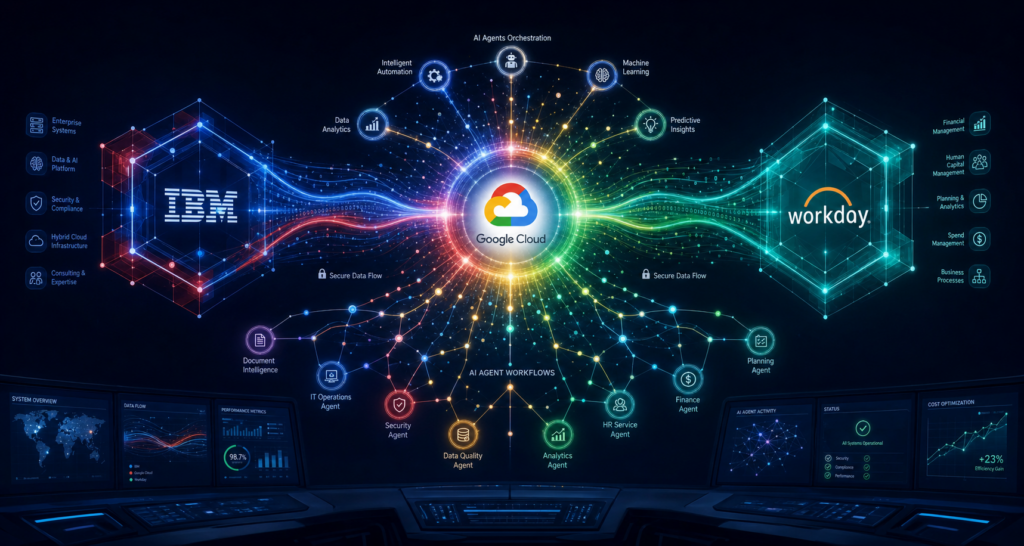
The announcement follows Google Cloud’s recent Gemini Enterprise moves with Workday and IBM. Workday is embedding HR and finance agents into Gemini Enterprise, while IBM launched a Google Cloud Practice focused on AI delivery, core systems modernization, and industry-specific agent deployment. NTT DATA’s expanded collaboration adds another delivery and co-innovation layer, with a target of 5,000 certified Gemini Enterprise experts and a joint roadmap to co-innovate and deploy up to 500 AI agents across enterprise use cases.
Analysis
What this means: Google Cloud is turning Gemini Enterprise into an ecosystem strategy. The Workday, IBM, and NTT DATA announcements show Google Cloud building around application access, delivery capacity, and repeatable agent deployment at the same time. For ERP vendors, product leaders, and partner strategists, enterprise AI platforms will compete on how well they connect models, systems of record, implementation teams, and industry workflows.
NTT DATA Builds a Gemini Enterprise Practice
NTT DATA will establish a dedicated global Gemini Enterprise practice supported by joint business planning, technical enablement, training, certifications, engineering support, and coordinated go-to-market investment.
The practice is designed to help clients accelerate deployment, deepen adoption, and create repeatable paths to business value with Gemini Enterprise. NTT DATA said the program will support agent development across banking, insurance, manufacturing, retail, IT services, marketing, procurement, finance operations, software development, and cloud migration.
“Enterprises need a practical way to scale AI adoption, strengthen governance, enable their workforce. and create measurable business value,” said Abhijit Dubey, CEO and Chief AI Officer, NTT DATA. “This expanded partnership with Google Cloud and NTT DATA is helping clients move beyond pilots and embed AI into the way their organizations operate, creating a faster and lower-risk path to enterprise-wide transformation.”
The 5,000-certification target is key because the constraint in enterprise AI is no longer only model access. Customers also need implementation capacity, domain expertise, rollout support, change management, and managed services to turn isolated pilots into production workflows.
Analysis
What this means: System integrators (SIs) are becoming the scale layer for agentic AI. NTT DATA’s 5,000-certification target and 500-agent roadmap reinforce that production AI depends on delivery capacity, governance support, and domain-specific implementation work. For SIs and transformation leaders, the emerging market opportunity is not just building agents, but industrializing how agents move from use-case selection to governed deployment.
Agent Factories Become the Delivery Model
NTT DATA and Google Cloud are positioning the collaboration around industrialized agent development. The companies plan to co-innovate and deploy up to 500 AI agents across horizontal and industry-specific use cases, creating reusable assets that can be adapted across clients.
The program includes a global factory model that combines reusable agent assets, engineering talent, and co-innovation pipelines. It also includes dedicated joint engineering and innovation teams that bring together NTT DATA experts and Google Cloud engineers to prototype, produce, and scale high-value use cases.
The companies will also use forward-deployed engineers embedded directly with clients, alongside industry domain experts. That delivery model is intended to reduce time-to-value by putting engineering support closer to production environments and business process owners.
“We are seeing massive demand for AI agents that can fundamentally transform core business workflows,” said Matt Renner, President and CRO, Google Cloud. “This expanded partnership combines Google Cloud’s leading AI platform with NTT DATA’s delivery strength.”
Sovereign AI Enters the Agent Deployment Stack
The collaboration also includes support for sovereign, secure, and compliant AI deployments. NTT DATA said the program will help clients meet data residency, regulatory, and compliance requirements by using Google Cloud capabilities alongside NTT DATA’s data center and managed services experience.
That makes the partnership relevant beyond general AI productivity. For regulated industries and multinational organizations, agent deployment depends on where data sits, how AI workflows are governed, and whether compliance requirements can be embedded into the operating model.
The companies are also building pre-built and industry-specific agent solutions intended to accelerate deployment and reduce implementation risk. The agent catalog is positioned as a way to make AI adoption more repeatable, rather than treating each deployment as a custom build.
Analysis
What this means: AI adoption depends on cloud modernization economics. NTT DATA’s survey data points to a practical constraint: AI is increasing demand for cloud investment while current investment levels are already straining modernization programs. For enterprise architects and ERP program owners, that makes cloud capacity, data readiness, security, and managed services part of the AI business case, not separate infrastructure workstreams.
Cloud Investment Pressure Frames the Timing
NTT DATA said the expanded collaboration is designed to address a widening gap between AI ambition and the cloud infrastructure required to support it.
According to an NTT DATA client survey cited in the announcement, 99% of enterprises said AI is driving greater demand for cloud investment. At the same time, 88% said current cloud investment levels are putting AI, cloud-native, and modernization initiatives at risk.
That tension explains why the partnership goes beyond model access or agent development. The companies are tying agentic AI to cloud migration, modernization, security, governance, and managed services because many organizations cannot scale AI without upgrading the underlying cloud and data environment.