
A withholding tax certificate should be the easy part of tax compliance: a simple proof that vendors and authorities can trust the numbers. In the real world, it is anything but simple, especially across Latin America where formats, languages, and counterparties change with zero warning. One global agribusiness, spanning 125 countries, 10 million customers, and 100 production sites, discovered just how fragile its legacy process had become.
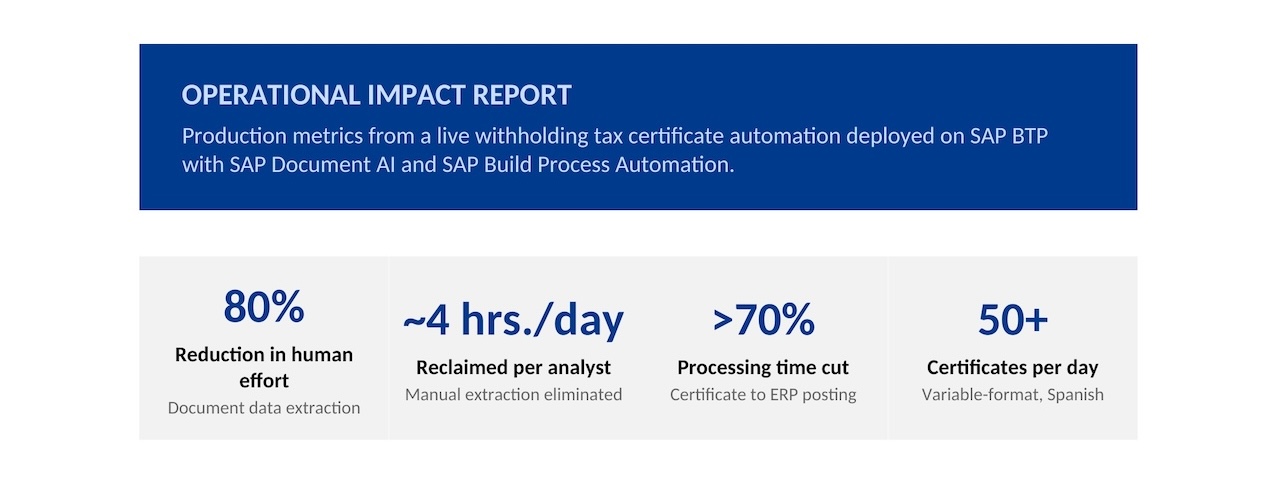
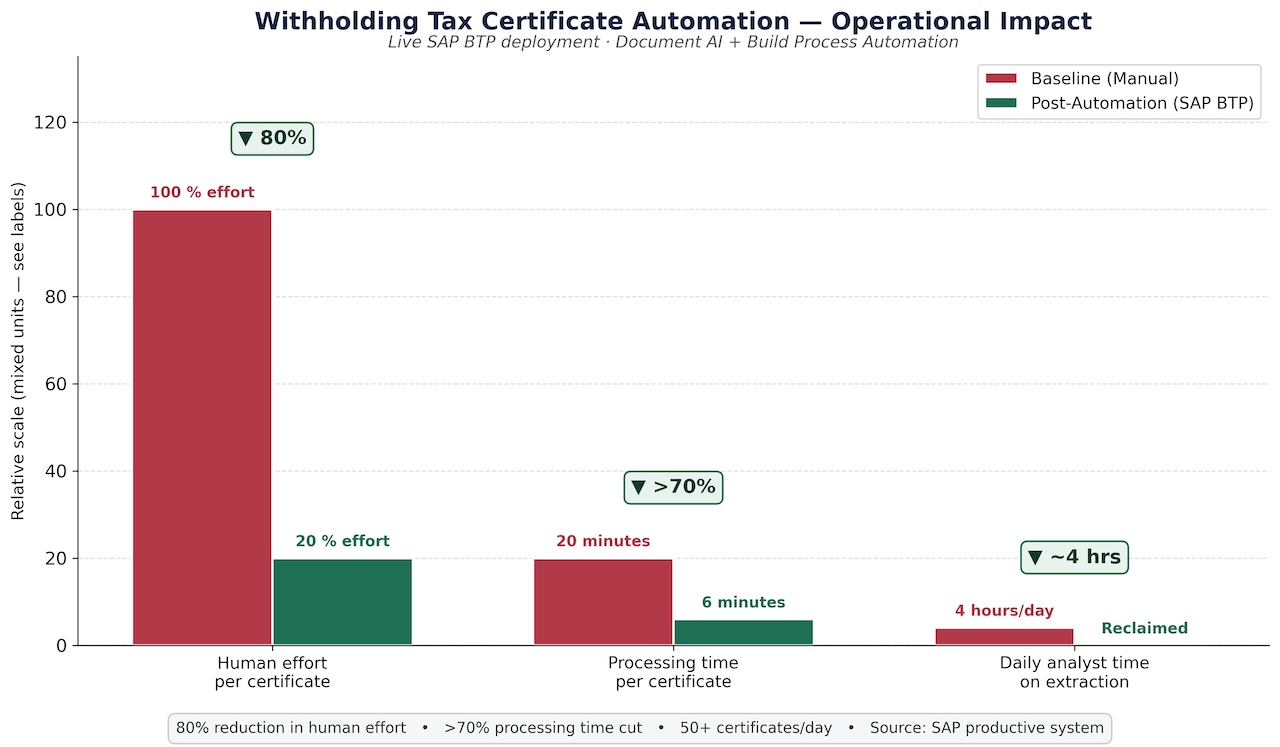
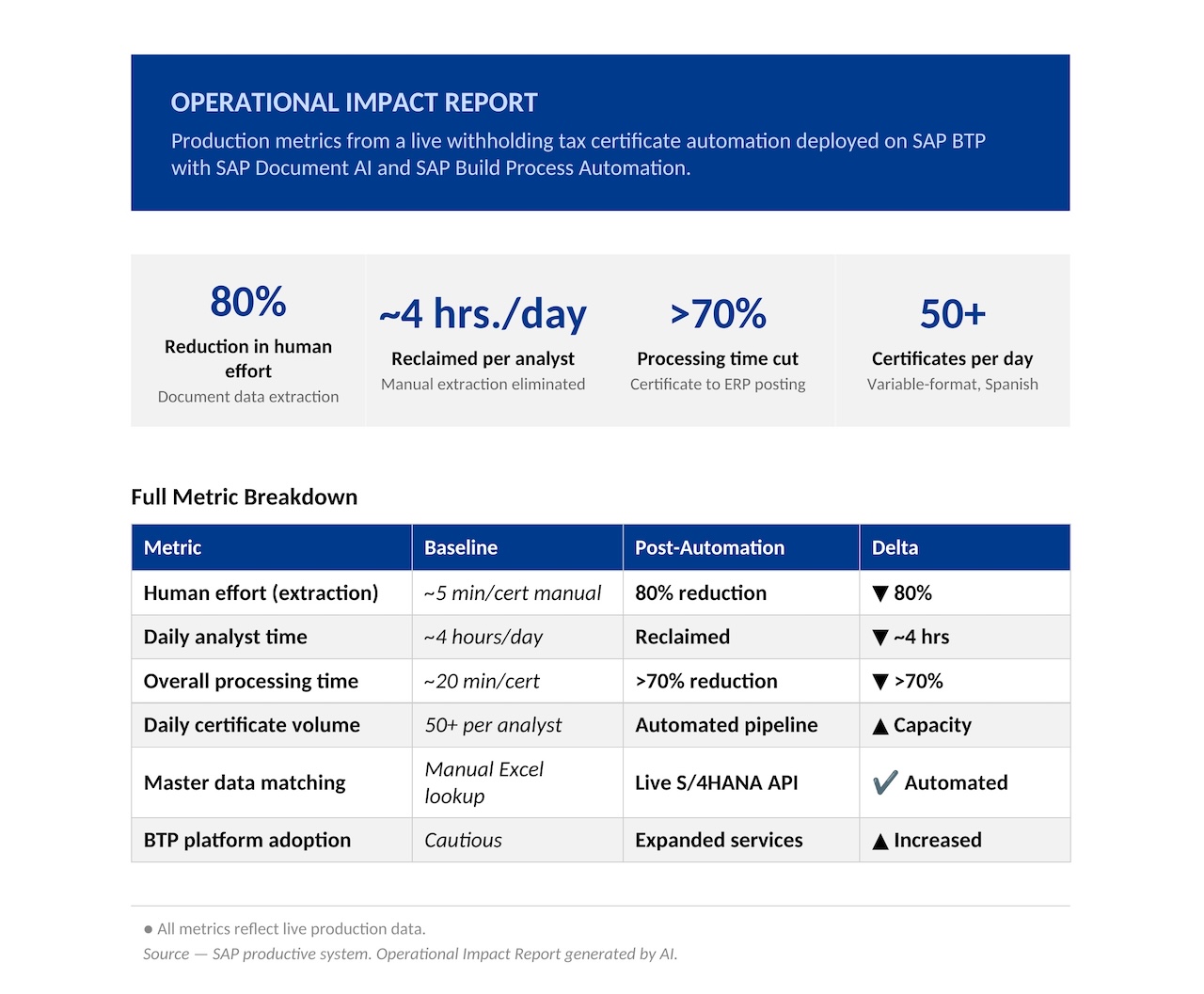
For its Latin American entities, and Argentina in particular, certificate handling was still a brute-force, people-powered workflow sitting awkwardly alongside an on‑premises ERP estate. Every certificate landed in a shared inbox, where analysts had to open the attachment, interpret Spanish-language data, rekey fields one by one, and reconcile the vendor’s CUIT (tax ID) with an internal business partner using a monster spreadsheet. Only after this grind could they post a clean record into the ERP system, which was a 20‑minute slog per certificate, with individual analysts churning through 50 or more every day and little time left for higher-value work.
The Bottleneck: Four Hours of Pure Data Extraction
Pulling the data alone took about five minutes per certificate. Multiply that by 50 documents a day, and a single analyst was burning four solid hours reading and retyping. That was just the extraction phase. Once the manual ERP posting was factored in, this single workflow could swallow an entire workday.
The matching process also was fragile and difficult. Analysts relied on a massive master spreadsheet to map local tax IDs (CUITs) to internal business partner numbers. It required constant manual upkeep. Every new customer or ID change meant adding rows and verifying lookups. A single mismatch could delay a posting, trigger a compliance flag or divert senior staff from strategic work to fix a clerical error.
To make matters worse, the inputs were unpredictable. Certificates flooded in as PDFs, messy scanned images and varying layouts by local jurisdiction. They were all in Spanish and no two vendors ever used the same template.
Analysis
What This Means for ERP Insiders
Hybrid ERP architectures can modernize compliance without core migration. By tethering cloud automation and AI services to an on‑premises ERP via governed connectors, enterprises can industrialize high‑volume tax workflows while deferring disruptive finance migrations and protecting existing core configurations.
Architecting the Solution Stack with Core Cloud Services
To resolve the operational bottleneck, the enterprise brought in a premium technical engagement team from its ERP vendor to architect a fix. After meeting with key finance users in credit and accounts receivable to map the exact bottlenecks, the mandate became obvious: The organization required a high-volume automation platform with sufficient embedded intelligence to read unstructured, variable-format data.
The new architecture was anchored on four core cloud services:
- The process automation engine: This acted as the central brain. It orchestrated the entire workflow while managing the underlying decision logic and action sequences.
- Document intelligence with generative AI: This served as the heavy lifter. A custom schema was built to identify specific data points: retention type, jurisdiction, customer name, monetary amounts, CUIT, certificate numbers and dates. Because a GenAI layer powered the service, it successfully bypassed document structure and language barriers to extract the necessary data.
- Cloud runtime environment: This provided the raw, scalable computing power needed to execute workflows and handle API calls at enterprise scale.
- Transport management service: This maintained a strict system governance, safely promoting automation artifacts from development through staging into the live production landscape.
The cloud stack was then tethered back to the on-premises ERP system. By using a dedicated connectivity layer and a cloud connector via REST/OData, a hybrid bridge was established. This integration allowed the automation platform to interact securely with live master data without forcing the enterprise to migrate its core financial system off-premises.
Automated Email Ingestion and Data Extraction
The initial automation functioned as the system’s front door. Relevant emails containing withholding certificates were routed to a predefined inbox, which was continuously monitored by the process automation engine.
Incoming emails triggered a sequential workflow:
- Detection: The engine identified the incoming message.
- Validation: System routines verified attachment integrity, checking the file type, content structure and certificate count.
- Extraction: The document intelligence service applied generative AI and a custom schema to extract retention details, jurisdiction codes, customer identifiers, amounts, CUIT values, certificate numbers and dates.
- Master data lookup: The engine queried the on-premises enterprise resource planning system, retrieving the internal customer number linked to the extracted CUIT.
- Results delivery: The system returned formatted results to the requester via email and staged the data for the final posting automation.
This process eliminated spreadsheet lookups, manual transcription, and toggling between applications.
Why Generative AI Matters for Variable-Format Documents
Traditional OCR (optical character recognition) and template-based tools fail when layouts vary. They require fixed grids and predictable anchor text, which Argentine withholding certificates lack. Generative AI interpreted each document using a custom extraction schema, identifying fields based on contextual understanding rather than pixel coordinates. Inconsistent layouts and Spanish text did not hinder data extraction.
Analysts reviewed extracted data before posting, catching edge cases and training the model. This continuous learning loop refined extraction precision with every validated batch. The system routed technical failures, data mismatches, and compliance exceptions to designated reviewers, building trust through transparent exception handling.
Modular Automation Pipeline Architecture
The deployment delivered four distinct automations to manage the certificate lifecycle, from email receipt to validated enterprise resource planning system posting. The first handled ingestion and extraction. Subsequent automations managed data enrichment, user validation workflows and final posting into the financial system.
All four operated within a single cloud platform subaccount, sharing connectivity, transport management and monitoring infrastructure. This modular design allowed individual components to be independently updated, tested and redeployed. Fixing the extraction schema did not require redeploying the posting logic and changing ERP connectivity did not require retraining the AI model.
Analysis
What This Means for ERP Insiders
GenAI becomes foundational for document-heavy finance operations. Using document intelligence with a custom schema to interpret unstructured, multilingual certificates shows that future ERP roadmaps must embed AI-native services for variable-format documents, not rely on brittle templates or OCR.
Measured Business Outcomes
Automating the withholding tax certificate workflow eliminated manual transcription bottlenecks. The deployment reduced compliance risk and reclaimed financial analyst capacity across Latin American operations. Manual transcription errors dropped sharply. The automation eliminated drudgery, but not judgment.
Platform Adoption Driven by Production Metrics
Initial adoption of the cloud business technology platform was cautious. However, the withholding certificate project demonstrated its value in a strict compliance environment. This success prompted other business teams to explore automation on the same platform. The enterprise expanded its use of platform services based on concrete production metrics rather than top-down mandates.
Four Key Lessons From Production Deployments
Several operational principles emerged from the live deployment:
- Generative models resolve format variability: Template-based extraction fails when document formats change. Generative artificial intelligence adapts and improves through user feedback, making it essential for processing unpredictable external documents.
- System integration eliminates shadow spreadsheets: Connecting directly to enterprise resource planning master data via application programming interfaces removes the risks of stale data, version conflicts, and missed updates inherent in manually maintained files.
- Human validation ensures compliance: Retaining a human-in-the-loop validation step maintains compliance integrity while still reducing manual effort by 80%.
- Modular pipelines improve resilience: Deploying loosely coupled automations that share infrastructure allows for independent testing and updates, offering greater stability than a single end-to-end script.
The back office now processes unpredictable, foreign-language certificates rapidly and accurately, eliminating hours of manual transcription.
Analysis
What This Means for ERP Insiders
Modular automation pipelines de-risk platform-led transformation. Separating ingestion, enrichment, validation, and posting into loosely coupled automations, backed by human-in-the-loop controls and measurable production outcomes, demonstrates how cloud platforms can scale adoption through resilience, governance, and concrete value delivery.