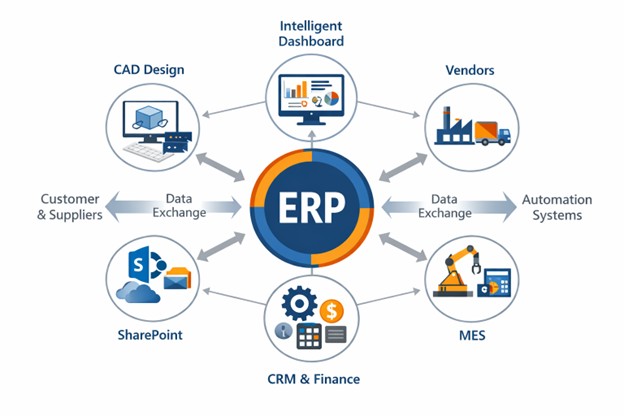

For many years, ERP systems focused on consolidating finance, procurement, inventory and HR into a single system of record. Modern industrial environments require more than transactional control; they require operational intelligence.
In manufacturing and control panel environments, ERP connects quotation, engineering data, procurement and production tracking into a unified operational view. This reduces manual coordination, minimizes errors caused by disconnected spreadsheets and improves cycle times across departments.
Executives gain access to consistent performance metrics across cost estimates, inventory and project status, allowing more confident decision-making.
ERP for OEMs and Machine Builders
For OEMs and machine builders, ERP supports engineer-to-order and configure-to-order business models. Many companies operate in environments where product engineering, manufacturing, procurement and service operations must remain tightly coordinated.
ERP acts as the backbone for:
- Bill of materials (BOM) management
- Engineering change control
- Project-based production
- After-sales lifecycle service.
For industrial equipment such as heat exchangers and engineered systems, organizations must track product information from design through installation and maintenance.
Modern ERP platforms also connect enterprise planning layers (L4–L5) with shop-floor systems (L1–L3) and manufacturing execution systems (MES). This alignment improves traceability, production accuracy and delivery reliability.
Six ERP Benefits for System Integrators
System integrators operate in highly customized, project-driven environments where every order may differ. ERP systems focus on operational coordination rather than repetitive production.
ERP supports system integrators through:
- Lead tracking and opportunity management
- Rapid BOM generation
- Real-time vendor pricing visibility
- Integration with engineering design tools
- Procurement and resource planning
- Project execution tracking across departments.
System integrators also interact with multiple stakeholders including component manufacturers, distributors and OEM customers. ERP platforms help maintain alignment between engineering design, procurement availability and delivery commitments.
By linking commercial, engineering and execution workflows, ERP reduces project risk and improves margin predictability.
Four Integration Patterns in Modern Manufacturing ERP
Industrial ERP success increasingly depends on connectivity across systems rather than isolated deployment.
- Real-time API integration. ERP integrates with dashboards, customer portals, vendor platforms and analytics tools to provide real-time operational insight.
- Cross-department tool integration. ERP connects with CAD tools, shared drives, documentation platforms and procurement software to synchronize engineering and operational data.
- Legacy data integration. Organizations often migrate from spreadsheets or outdated systems. ERP platforms must standardize historical data into a structured, usable format.
- Bi-directional workflows. Modern ERP supports two-way communication:
ERP ↔ Engineering Tools ↔ Vendors ↔ Customers ↔ Automation Systems
Integration Platforms Enabling ERP Connectivity
Integration platform-as-a-service (iPaaS) solutions help organizations connect ERP systems without heavy custom coding. These middleware tools enable scalable and maintainable integration architectures. These platforms accelerate implementation timelines and allow ERP ecosystems to evolve without repeated redevelopment.
The Strategic Value of Modern ERP
Modern ERP enables confident decision-making beyond transactional efficiency by providing these strategic benefits:
- Real-time insights: Immediate visibility into inventory, orders and financial performance
- Improved forecasting: Better planning and reduced working capital pressure
- Cross-functional collaboration: Unified data across departments
- Scalable growth: Modular expansion without operational disruption.
ERP Implementation Best Practices
Successful ERP deployment requires structured governance and planning. Common challenges include data quality, user adoption and integration complexity. ERP best practices for system integrators include:
- Defined requirements and data strategy
- Executive sponsorship and governance
- Phased rollout approach
- Alignment with integration and implementation partners.
Usability and configurability remain critical for adoption in manufacturing environments.
Measuring ERP Success
Organizations measure ERP value through operational outcomes such as:
- Improved order cycle time
- Reduced inventory cost
- Increased forecast accuracy
- Better resource utilization
- Higher customer satisfaction.
Linking these KPIs to business goals enables measurable return on investment (ROI) that can be recorded and tracked.
ERP has transitioned from a transactional platform into a digital coordination layer connecting engineering, operations and business leadership. For manufacturers, OEMs and system integrators, integrated ERP platforms improve visibility, reduce risk and enable scalable growth.
For enterprise technology leaders evaluating ERP investments, the focus should move beyond feature comparison toward how effectively a system connects data, workflows and decisions across the organization.
Editor’s Note: What This Means for ERP Insiders
Intelligent ERP becomes manufacturing’s operational command backbone. By unifying quotation, engineering, procurement, production tracking and service into a single operational view, ERP shifts from system-of-record to system-of-execution. This evolution demands product strategies that emphasize real-time visibility, standardized KPIs and decision support for executives who now rely on ERP for operational intelligence.
Engineer-to-order complexity is now a core design center. OEM and system integrator scenarios show ERP must natively support BOM management, engineering change control, project-based production and after-sales service to stay relevant. Vendors and GSIs should prioritize configurable project orchestration, lifecycle traceability and multi-stakeholder collaboration to protect margins and reduce risk in highly customized environments.
Integration architecture defines ERP’s strategic value in industry. The article’s integration patterns and emphasis on iPaaS underscore that success depends on scalable, low-code connectivity across CAD, MES, vendor portals and customer channels. Enterprise architects should treat ERP as a coordination layer, investing in API-first design, bi-directional workflows and integration governance as primary modernization levers.
Anant Mithsagar is the CEO of Rutamsoft, a partner member of the Control System Integrators Association (CSIA). He has more than 20 years of experience in system integration, control panel manufacturing and software development.