
Cloud transformation programs often begin with discussions about applications, integrations, migration schedules, and future-state architecture. Identity and access management (IAM) is usually viewed as one workstream among many, often delegated to technical teams responsible for security, provisioning, or infrastructure. The assumption is that once applications are integrated and authentication mechanisms are configured, access management will largely take care of itself.
My experience leading enterprise transformation initiatives involving cloud ERP platforms and connected third-party applications led me to a different conclusion. As organizations expanded their application ecosystems, IAM frequently became one of the most persistent operational challenges of the transformation effort. Although the authentication technology was working, functional governance practices had not evolved at the same pace as the application landscape.
Governance weaknesses usually became visible through everyday business activities. A routine change in an employee’s responsibilities could trigger unexpected delays in obtaining the right system access, while managers and support teams spent increasing amounts of time navigating fragmented approval processes and resolving provisioning exceptions whose origins were difficult to trace. These recurring operational issues revealed governance structures that had not kept pace with an increasingly interconnected enterprise environment.
Organizations often respond to these challenges by investing in additional automation, refining provisioning workflows, or introducing new IAM capabilities. While those investments may improve efficiency, governance issues often continue to create friction throughout the enterprise. Maintaining effective governance becomes increasingly difficult as organizations grow and application environments become more interconnected.
Growth Creates Complexity
Operational governance decisions typically accumulate over time as new applications are introduced, business processes evolve, acquisitions reshape responsibilities, and regulatory requirements add new approval and review obligations. Individually, those changes often make sense. Collectively, they can create governance structures that reflect years of incremental decisions, making it increasingly difficult to maintain clear ownership and effective oversight.
The consequences often become visible during routine access requests. When an employee joins a new project, transfers to another department, or assumes additional responsibilities, updates may be required across multiple applications, each governed by different approval paths, role definitions, and provisioning schedules. What appears to be a straightforward business change can quickly expose governance practices that had developed independently over many years.
Integrated governance supports much more than identity management. Inconsistent access decisions slow everyday operations, complicate compliance activities, and require significantly more effort during audit preparation. The growing complexity of modern ERP environments makes governance decisions increasingly important for maintaining consistent access, supporting compliance, and enabling day-to-day business operations.
Governance Requires Business Ownership
The most difficult identity governance challenges I encountered during enterprise cloud transformation initiatives were not caused by technology alone. In my experience, the greatest obstacles appeared when governance decisions lacked clear business ownership. Technology teams can automate provisioning, enforce security policies, and integrate enterprise applications. Business leaders define appropriate access, approve role changes, and ensure accountability as organizations scale.
Business ownership becomes especially important when enterprise systems span multiple departments and applications. Ensuring consistent access across an integrated environment depends on shared governance, clearly defined responsibilities, and ongoing collaboration among teams that naturally focus on their own business processes.
Audit reviews frequently provide the clearest illustration. During an audit, organizations often discover that access approvals follow different standards across applications, role definitions have gradually diverged, or ownership of key decisions is no longer clearly understood. Addressing these issues requires aligning governance responsibilities, approval processes, and accountability so that access decisions keep pace with expanding systems and changing business needs.
One project clearly illustrated this challenge. An employee’s responsibilities changed following an internal transfer. The HR update was completed correctly, and every connected application performed according to its configuration. Access modifications nevertheless followed different approval paths and provisioning schedules across the environment, leaving some permissions in place longer than intended while delaying access to other systems required for the employee’s new role. The experience demonstrated how inconsistent governance processes can undermine otherwise well-functioning technology, particularly when identity changes must be coordinated across multiple integrated applications.
A separate cloud ERP transformation illustrated a different governance challenge. In this case, enterprise governance objectives had been clearly established, yet individual business units continued following their own approval processes instead of adopting a standardized workflow. The fragmented approval paths delayed access requests and made it more difficult to demonstrate consistent governance during compliance reviews. Working together, business and technology stakeholders established common approval workflows that improved efficiency while strengthening audit readiness.
Get Our Free Weekly Newsletter
Building Governance for Long-Term Success
Effective identity governance begins with a change in perspective. Sustainable improvements come from treating IAM as an operational governance discipline supported by technology and embedded within everyday business operations.
Clear role ownership provides a practical starting point because access structures often arise independently from business responsibilities. Bringing those models together requires collaboration among security teams, application owners, and business stakeholders to establish common definitions for access, approval authority, and accountability. This approach also aligns with widely accepted identity governance principles.
Guidance from the National Institute of Standards and Technology (NIST), including Special Publication 800-53 Rev. 5, identifies account management and least privilege as core access-control practices, while the Cybersecurity and Infrastructure Security Agency’s (CISA) Zero Trust Maturity Model places identity among the five pillars of zero-trust maturity. Together, these principles reduce administrative complexity and provide a foundation for governance models that can support future organizational growth.
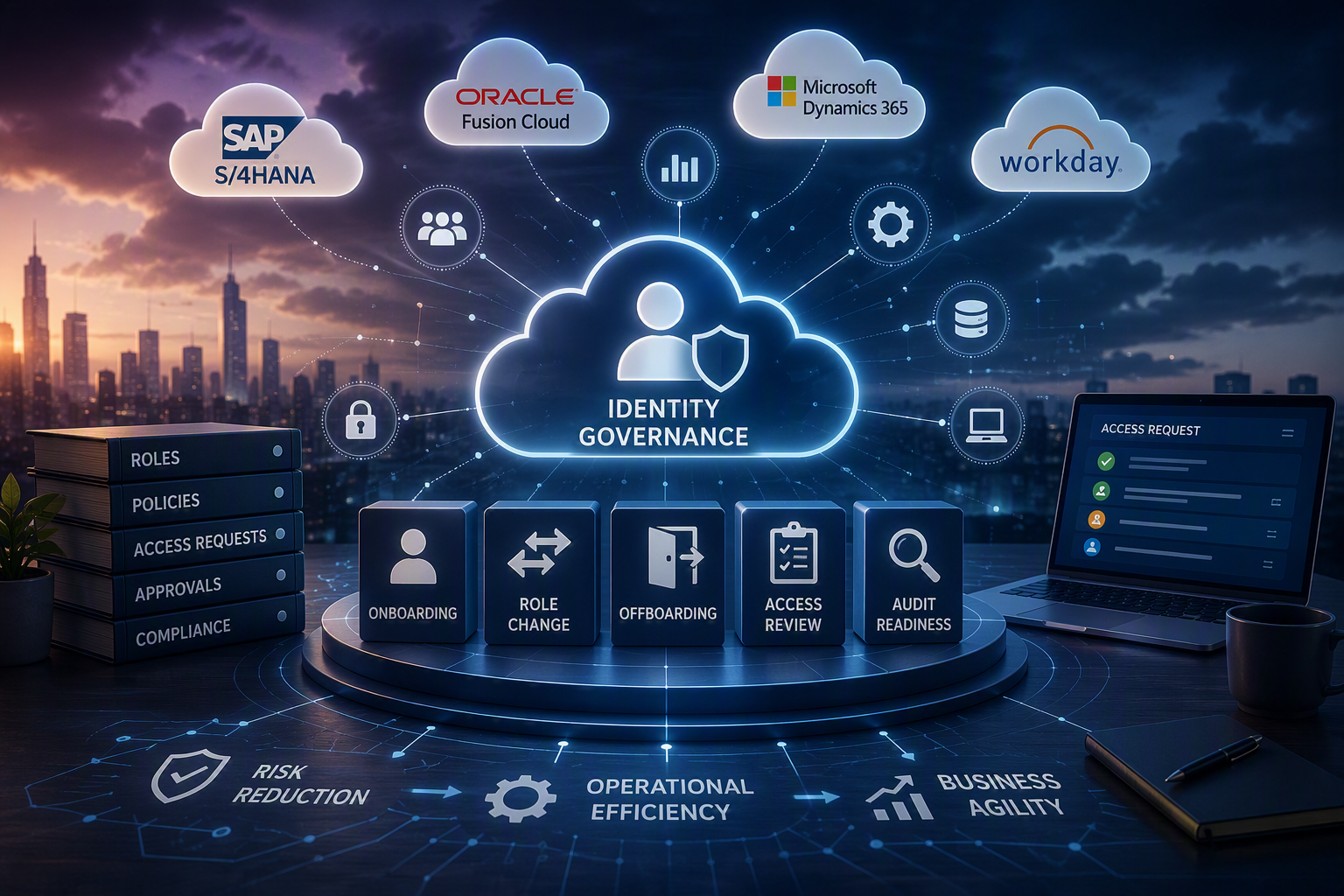
The same governance principles apply throughout the employee lifecycle, from onboarding and internal transfers to offboarding. These activities influence productivity, compliance, audit readiness, and operational continuity because each depends on timely, consistent access decisions. Viewing identity changes through a governance lens creates greater coordination across integrated environments while reducing many of the recurring exceptions that consume time and resources.
Modern cloud ERP platforms such as SAP S/4HANA Cloud, Oracle Fusion Applications, Microsoft Dynamics 365 Finance, and Workday Enterprise Management Cloud provide strong capabilities for supporting these efforts when integrated with broader identity governance and provisioning frameworks. Long-term success depends on governance structures that define ownership, accountability, and decision-making across the organization. Strong governance practices allow technology investments to continue delivering business value as application environments expand and business requirements change.
Sponsor Industry‑Grade Research
Governance Sustains Transformation
Enterprise application environments will continue to grow more interconnected as companies expand their use of cloud platforms, analytics, automation, and external integrations. Every new connection increases the importance of identity governance by extending the operational impact of inconsistent governance across business operations, compliance activities, and organizational resilience.
IBM’s 2025 Cost of a Data Breach Report highlights the financial stakes of weak security and governance, reporting a $4.4 million global average breach cost and recommending access control as part of core data-security fundamentals. Organizations that establish clear ownership, consistent access models, and scalable governance practices early in their transformation efforts are better positioned to reduce administrative overhead, simplify audit activities, improve the user experience, and support future growth.
My experience has shown that those outcomes depend on aligning identity governance with everyday business operations, allowing access decisions to adapt as organizational priorities and requirements change.
Editor’s Note: What This Means for ERP Insiders
Cloud ERP integrations turn identity into an operating model problem. As ERP environments connect with third-party applications, analytics tools, automation platforms, and external workflows, access decisions affect far more than login permissions. ERP leaders should treat identity governance as part of transformation design, not as a technical workstream that begins after applications are already connected.
Business ownership has to define who gets access and why. Security and IT teams can automate provisioning, enforce policies, and monitor exceptions, but business leaders need to own role definitions, approval authority, and accountability for access decisions. Without that ownership, organizations risk building technically functional cloud environments where permissions, reviews, and audit evidence still vary by department or application.
Role changes expose weak governance faster than go-live issues. Employee transfers, project assignments, reorganizations, and offboarding events often reveal whether access models are truly aligned across cloud ERP and connected systems. ERP teams should standardize joiner-mover-leaver processes, approval paths, and review cycles early so governance can scale with the business instead of creating recurring exceptions after transformation is underway.