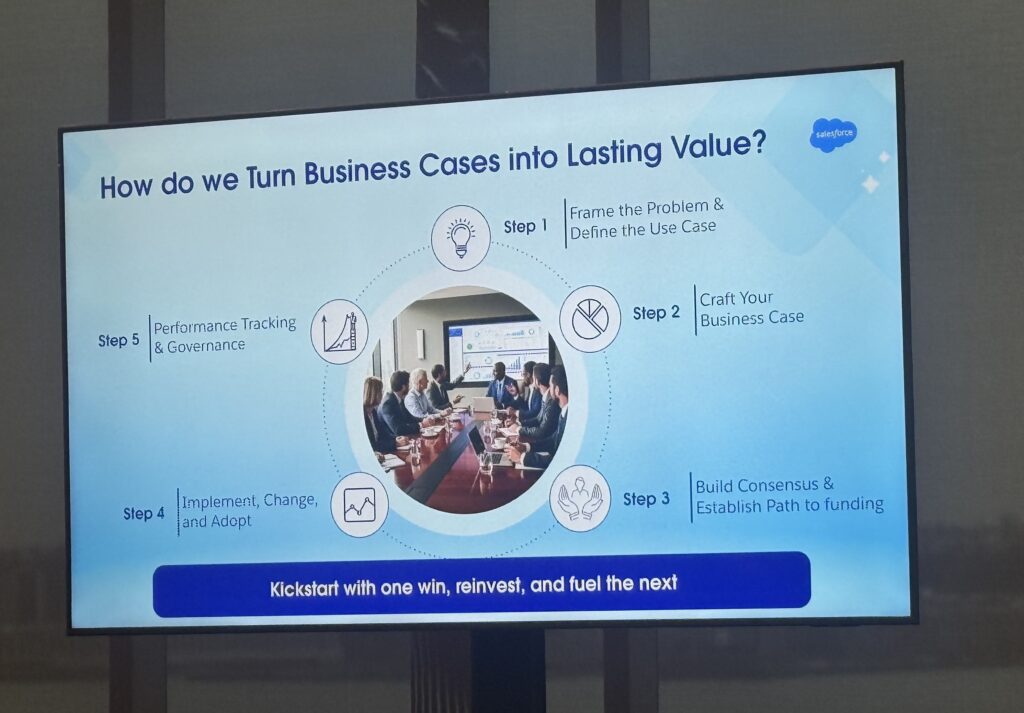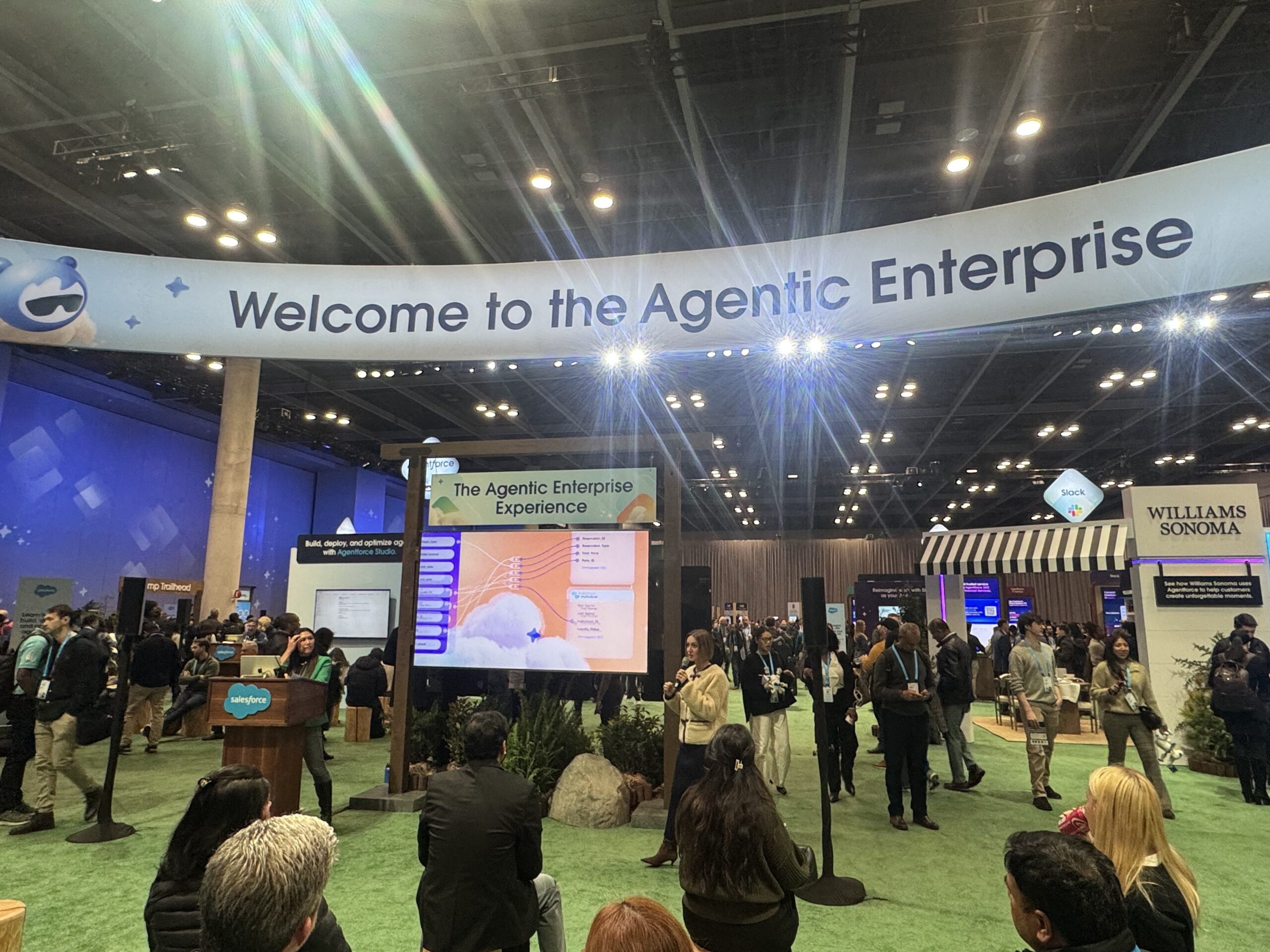
Executives are beginning to move AI agents into production by focusing less on hype and more on execution. ERP Today was invited to an exclusive executive roundtable during Salesforce’s Agentforce Tour on December 10, where the conversation shifted away from marketing and toward the realities of making agents work in the real world. Salesforce leaders, global systems integrators, and enterprise customers unpacked the data foundations, design patterns, and operating model changes that separate pilots from AI agents running at production scale.
Data First, Not Model First
The discussion first stressed that data, not model choice, is still the primary constraint on agent impact. Jennifer Cramer, SVP of customer success for AI products at Salesforce, says customers often want agents to “have all the understanding of these thousands of manuals” or product images, only to discover that AI “doesn’t speak unstructured data” without an activation layer that spans fragmented systems.
That activation layer is where Salesforce positions Data Cloud. Cramer describes it as the “activation layer of our platform” that lets customers “activate any data that they have about their customers” without moving everything into one stack. The message for leaders running mixed CRM-ERP estates is this: Agents that span sales, service, and back office will not perform without coherent, governed data that can be activated in context rather than left in silos.
Hybrid Reasoning as Default Design
A year into live deployments, the panel—comprising Karl Rupilius, principal at Deloitte and US lead alliance partner for the Salesforce Alliance; Stephanie Sadowski, senior managing director leading the Global Salesforce Business group for Accenture; and Ryan Gee, SVP of engineering at Vivint—agree that enterprises are moving away from pure “LLM-first” thinking toward hybrid reasoning that combines deterministic workflows with generative flexibility.
“We had more faith in the LLM as an industry” a year ago, says Sanjna Parulekar, SVP of product marketing at Salesforce, who moderated the discussion. But experience has shown that agents need clear guardrails and standardized processes when they touch money, inventory, or regulated data, she added. There is “no size fits all approach,” but the principle can be simple: Let the model improvise around the edges of experience but keep core flows under explicit control through flows and automation.
Deloitte’s Rupilius links that to lead management, describing how a large multinational used Agentforce to move from rigid rules to models that “recognize patterns in the answer intelligently,” increasing qualification rates and changing how inside sales teams work day-to-day.
Build vs Buy Test
Vivint’s Gee describes a company that “biases towards building,” having already developed its own hardware and software before testing Agentforce against an internal agent stack. Vivint’s internal AI team slowed down under the weight of plumbing and security, while the Agentforce team “stood up faster, had the security and governance,” and let the business focus on outcomes.
The winning path embedded an agent into Vivint’s existing mobile app, where customers already interact with around 15 devices and generate “17 daily interactions.” That context allows the agent to recognize who the customer is, which devices they own, and when to hand off to a human with the full picture instead of starting from scratch in a separate channel. The takeaway is not that build is bad, but that in a space changing as quickly as agents, build-versus-buy tests should include operational burden and security, not just fancy features.
Change Fatigue
Beyond tooling, all panelists repeatedly returned to people and change management. Agentic AI “can be scary” for teams who worry that workflows will be disrupted, they acknowledged, adding that some stakeholders lean in while others resist. Accenture’s Sadowski warns that too many transformations still run on a “build it and they will come” mindset instead of investing in change champions and embedding agents in the flow of work.
Forward-deployed engineering teams that sit at the intersection of tech and business came up as one way to bridge the gap. Cramer describes the rise of roles that work “side by side” with customers to co‑create use cases, rather than throwing generic tools over the wall. For her, the pattern that succeeds is embedding agents into the channels people already use, designing for default usage rather than optional add‑ons that can be ignored.
What This Means for ERP Insiders
Beyond integration, ERP programs need data activation strategies. The roundtable’s focus on reconciling unstructured manuals, images, and multi-system data highlights that agents working across Salesforce and ERP will only create value if enterprises build governed data layers that can be activated in context. ERP leaders should treat data fabric and semantics as part of the AI blueprint, not a technical afterthought.
AI in core business processes will follow a hybrid reasoning pattern. The distinction between creative recommendations and tightly controlled order and return flows offers a blueprint for embedding AI into finance, supply chain, and service without eroding compliance. ERP vendors and system integrators that mirror this pattern—improvisation at the edge, determinism at the core—will be better placed to support AI in regulated workflows.
Agent adoption depends on operating model shifts, not just features. The experience of forward adopters shows that embedded agents in existing channels, forward‑deployed engineering, and change champions make the difference between pilots and sustained use. For ERP ecosystems, that means focusing on how agents fit into day‑to‑day work across roles that already live in CRM and ERP, rather than launching standalone tools that may not add value.