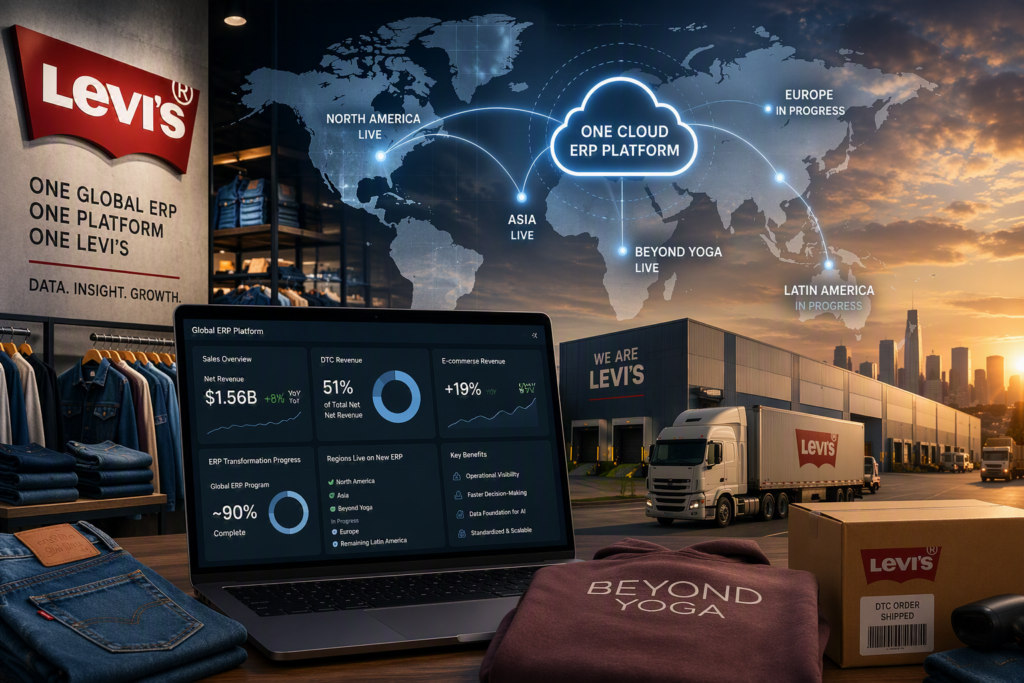
Three months after ERP Today reported that Levi Strauss & Co.’s global ERP overhaul was roughly 60% complete, a new Microsoft customer story adds detail on the cloud foundation supporting that transformation.
Microsoft on June 9 reported Levi’s migration to Azure to consolidate nine ERP systems onto one platform across its global business, with the broader technology platform following. The move reportedly has delivered a two-times improvement in latency, a 60% improvement in maximum IOPS, shorter migration timelines, and expected annual savings.
The update gives more operational context to Levi’s push toward a direct-to-consumer-first model, AI-driven orchestration, and standardized global processes. The March ERP Today article focused on the business case: Levi’s was modernizing ERP, supply chain, and commerce technology in parallel to support a $10 billion revenue ambition and a more data-centric operating model. The story now shows how much of that strategy depends on cloud infrastructure and platform consolidation.
From ERP Program to Cloud Foundation
Levi’s is five years into a seven-year digital transformation program aimed at creating a single global ERP platform, standardized processes, automation, and new AI capabilities.
The company had accumulated significant technical debt as it scaled globally. Microsoft said Levi’s had long-standing systems, data centers, about 160 applications, and differing processes across 110 countries. That fragmentation constrained the agility needed for a retailer shifting from a traditional wholesale model toward direct-to-consumer growth.
Saravana Ramaratnam, VP of Global ERP and Enterprise Platforms at Levi’s, said the goal is “a single global platform for ERP that drives standardization of processes, a high degree of automation, and new capability enablement such as AI and agentic AI.”
Cloud migration became part of that ERP agenda. Levi’s used Azure Migrate as the backbone of its data center exit strategy, reducing a planned nine-month migration timeline to about six months. Shawn Harris, Senior Director for Enterprise Platform Services at Levi’s, said Azure Migrate saved two to three hours per server migration and reduced overhead during final migration work.
Analysis
What this means: Retail transformation can span ERP, cloud, data, and work execution. Levi’s is rewiring the operating model from product design to store shelf while shifting toward direct-to-consumer growth. The strategic question is no longer whether ERP supports the back office, but whether it can anchor the data, automation, and cloud architecture needed to coordinate faster decisions across supply chain, commerce, finance, and IT.
Performance and Resilience Improve
Levi’s also reported measurable performance gains after moving key workloads to Azure.
Harris said the company saw a two-times improvement in latency and a 60% improvement in maximum IOPS after moving to the Next-gen General Purpose service tier of Azure SQL Managed Instance. The company also used Azure Arc to extend Azure Update Manager capabilities on-premises and simplify extended security updates.
Microsoft said Levi’s consolidated nine global ERP systems onto a single standardized platform in the Microsoft Cloud, giving the company more cohesive data across the organization. Michael Womack, Senior Director of Global Infrastructure and Engineering at Levi’s, said Azure regions allow the company to place compute closer to users and improve response times.
The migration also strengthened backup and disaster recovery for the global ERP environment. Ramaratnam said Levi’s now has a stronger backup and disaster recovery protocol in the cloud than it had in its own data centers. Womack also pointed to built-in resiliency and a zero-trust environment as benefits of the move.
Analysis
What this means: Cloud performance is part of ERP value realization. Levi’s reported latency, IOPS, migration, and disaster recovery improvements after moving ERP and related technology workloads to Azure. Modernization value does not come only from replacing the application layer; infrastructure performance, resiliency, and data placement shape whether global ERP can support real-time operations.
Sponsor Industry‑Grade Research
Agents Build on the Data Layer
The AI layer is now moving faster because the data and cloud foundation are more standardized.
Microsoft said Levi’s is using Fabric IQ, a semantic intelligence layer in Microsoft Fabric, to enrich unified data available through OneLake. Harris said the company uses Fabric IQ for end-to-end reporting on cost data across the business and has simplified that work so one employee, supported by a “digital buddy,” manages cost reporting for the company.
Levi’s has more than 1,000 agents deployed and is running training sessions and hackathons to help employees explore Copilot. GitHub Copilot is also being used by the roughly 40-person enterprise platform services team to support migration work and write infrastructure as code.
“GitHub Copilot has turned every single person on the team into a developer,” Harris said. He added that Levi’s plans to deploy more Azure agents to expand the scope of work the team can handle without dramatically increasing headcount.
Levi’s ERP modernization is not only a systems consolidation effort. It is becoming the operating base for AI-assisted reporting, engineering productivity, automation, and eventually broader agentic orchestration across the retail value chain.
Analysis
What this means: ERP standardization creates the conditions for agentic AI. Levi’s use of Fabric IQ, OneLake, Copilot, GitHub Copilot, and more than 1,000 agents builds on the same premise as its ERP program—data and processes have to become consistent before AI can scale. For transformation teams, agent deployment should be viewed as a downstream result of platform consolidation, not a workaround for fragmented systems.