Levi Strauss & Co. used its fiscal Q2 earnings call to report new progress on its global ERP transformation, moving Asia and Beyond Yoga onto its new platform as e-commerce and direct-to-consumer sales continued to outpace overall growth.
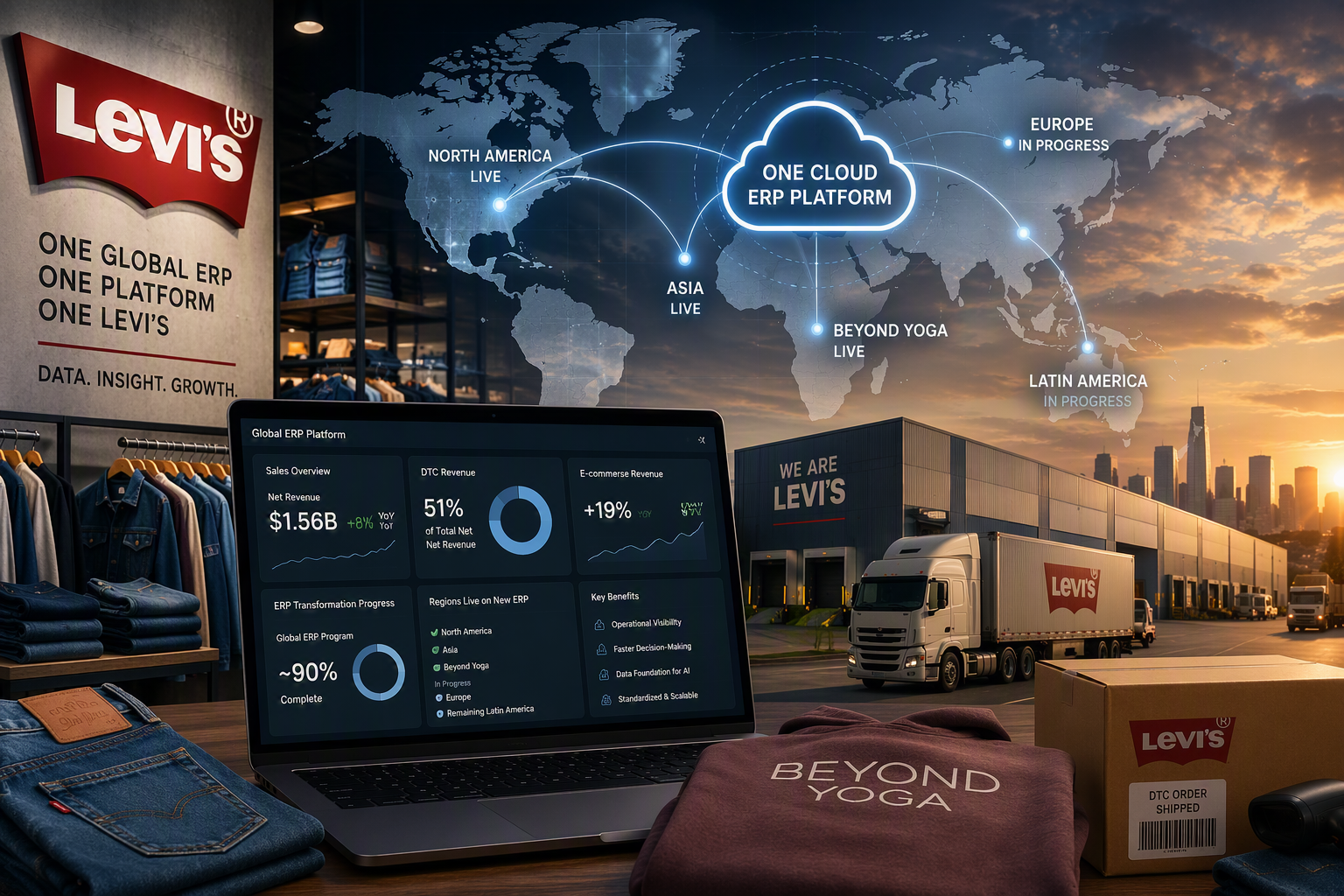
Levi’s reported Q2 net revenue of $1.56 billion, up 8% year over year on a reported basis and 6% on an organic basis. Direct-to-consumer revenue grew 11% on a reported basis and represented 51% of total net revenue, while e-commerce revenue increased 19% on a reported basis.
The e-commerce performance came as Levi’s continues shifting toward a DTC-first operating model. Stronger traffic, conversion, units per transaction, average prices, and a reduced reliance on promotions helped drive online sales, Digital Commerce 360 July 10 reports.
The ERP update gives that growth story a technology backbone. During the Q2 earnings call, Chief Financial and Growth Officer Harmit Singh said Levi’s had “reached a major milestone” by migrating Asia and Beyond Yoga onto its new global ERP platform after the successful North America transition. Europe and the remaining Latin American countries are on track for completion by mid-2027.
From Nine ERPs to One Cloud Platform
The Q2 update builds on ERP Today’s earlier Levi’s coverage. ERP Today reported in March that Levi’s global ERP modernization was roughly 60% complete, with the retailer positioning the program as the data foundation for AI-driven orchestration. ERP Today also reported in June that Levi’s Azure migration had consolidated nine ERP systems onto one Microsoft Cloud platform, improving latency, increasing maximum IOPS, and strengthening resilience.
Singh described the current program as a move from a “very disjointed, customized ERP system” to a standardized ERP system on the cloud. He said the work is business-led and technology-enabled, with the goal of unlocking data so users can access operational information faster and more consistently.
The practical example was visibility into stores and distribution centers. Singh said Levi’s can now see goods movement, fill rates, service, and sales activity in ways it could not previously do across regions.
Get Our Free Weekly Newsletter
ERP Part of the Retail Growth Model
Levi’s ERP program is running alongside changes to its commerce and fulfillment infrastructure. The company has selected SCAYLE to power its global e-commerce platform, with migration expected to begin this year and continue through 2027.
Levi’s also completed the remapping of Europe to an omnichannel distribution network at the end of Q2, consolidating e-commerce fulfillment into distribution centers in Germany and the UK. In the US, the company remains on track to complete the transition of its Hebron distribution center to Maersk by the beginning of Q4.
Together, those moves show how Levi’s is modernizing multiple layers of the retail stack at once: ERP, cloud infrastructure, digital commerce, distribution, and fulfillment. Once the ERP program is complete, Singh said Levi’s will operate on a single ERP, enabling faster decision-making, supporting the DTC-first model, and creating the foundation to scale AI and automation globally.
Sponsor Industry‑Grade Research
What This Means for ERP Insiders
Retail growth depends on synchronized technology layers. E-commerce gains, DTC expansion, omnichannel fulfillment, and AI-readiness all require core systems that can move data consistently across regions, brands, stores, and distribution networks. For retailers and consumer brands, ERP modernization should be planned alongside commerce and supply chain upgrades, not after them.
Regional cutovers turn transformation strategy into operational proof. A global ERP program only becomes valuable when business units, brands, and markets successfully move onto the common platform without breaking performance. For CIOs and transformation leaders, the next priority is sequencing cutovers in a way that protects revenue operations while steadily reducing legacy complexity.
AI scale starts with operational visibility. Levi’s is linking its ERP program to data access, faster decision-making, and future automation rather than treating AI as a separate initiative. For retailers building agentic or analytics-driven operating models, the practical lesson is to first standardize the data flows that show what is happening across stores, inventory, fulfillment, and customer demand.